When does air quality mold testing actually help a Tulsa home?
Air quality mold testing has specific use cases in Tulsa homes. It is most useful when:
- A musty odor exists with no visible mold and visual inspection has not located the source.
- A homeowner has health concerns and a doctor has asked for documentation of indoor mold types.
- A remediation project is finishing and post-remediation verification is needed.
- A real estate transaction calls for documented air quality data.
It is less useful when there is already visible mold and a clear moisture source. In those cases, sampling tells you nothing the visible growth does not already say. Spending the sample budget on tearing out the affected materials and fixing the moisture is the better path.
How is an air sample actually taken in a Tulsa home?
The standard method is a spore trap cassette pulled by a calibrated air-sampling pump. The cassette contains a sticky slide that captures airborne particles, including mold spores, fibers, and pollen. The pump pulls a measured volume of air through the cassette over a fixed time, usually five to ten minutes. The cassette is sealed and sent to a lab.
For a typical Tulsa indoor air quality test:
- An outdoor control sample is always taken first, ideally from a clean spot away from doors, mulch, and ventilation.
- One or more indoor samples are taken in the room or zone of concern.
- For a multi-room investigation, multiple indoor samples are taken to compare rooms.
- Doors and windows are kept closed for at least an hour before sampling to stabilize the indoor air.
- The sampling pump and cassette type are documented for the chain of custody on the lab form.
The outdoor control matters because indoor mold counts only make sense compared to local outdoor air. Tulsa outdoor counts vary by season; a moderately high count indoors might be normal in summer and a red flag in winter.
A useful frame for Tulsa homeowners weighing whether to test: an air sample answers the question "is something elevated indoors compared to outdoors right now?" It does not answer "is the home safe long-term?" or "is mold the cause of my symptoms?" Pairing the test with a thorough visual inspection turns it from an isolated data point into a defensible finding. A test result without inspection context is hard to act on; an inspection without sampling sometimes lacks documentation for a transaction or claim. The combination is what most professional Tulsa inspectors deliver as a single visit.
How do you read a Tulsa mold air quality lab report?
A typical lab report for an air sample includes:
- The sample location and date.
- The total spore count per cubic meter of air sampled.
- A breakdown by genus (Cladosporium, Aspergillus/Penicillium group, Stachybotrys, Alternaria, others).
- Particulates and other airborne debris counts.
The reading is interpretive. Roughly speaking:
- Indoor spore counts that are similar to or lower than the outdoor control are usually normal.
- Indoor counts that are markedly higher than outdoor (typically more than 2 to 3 times) for the same genera suggest an indoor source.
- Indoor counts that show genera not present outdoors (especially Stachybotrys or Chaetomium) usually indicate an indoor moisture source.
- Penicillium/Aspergillus-heavy indoor counts are a common signal of long-running moisture damage.
A good inspector ties the report to the visual and moisture findings: "Sample from the master bathroom shows Penicillium/Aspergillus at 4,200 spores/m3 indoor vs. 380 outdoor, consistent with the visible growth at the base of the shower wall and the elevated moisture reading in the adjacent baseboard."
What are the common mold types found in Tulsa homes?
The common mold genera identified in Tulsa air samples and their typical context:
- Cladosporium: Very common outdoors, often the dominant genus in any sample. Found on plant material and damp surfaces. Indoor counts only matter when significantly higher than outdoor.
- Penicillium / Aspergillus group: The most common indicator of indoor moisture problems. Often grows on wet drywall, insulation, and stored organic materials. The lab cannot distinguish the two by spore alone, so they are reported as a group.
- Stachybotrys ("black mold"): Less common than reputation suggests. Grows on chronically wet cellulose materials (wet drywall, wet wood). Detection in air is meaningful even at low counts.
- Chaetomium: Like Stachybotrys, an indicator of long-running moisture. Often found in wet wood.
- Alternaria: Common outdoors and indoors, often associated with allergic reactions.
- Curvularia, Ulocladium, Basidiospores: Various contexts, usually outdoor-dominant.
Tulsa's humid summers and storm season mean outdoor counts of Cladosporium and Alternaria run high from May through September. That outdoor baseline is the comparison point for indoor results.
Outdoor control sampling deserves more attention than it usually gets. The control is taken upwind of the home, away from mulch beds, garbage areas, and visible vegetation growth. Two outdoor controls are sometimes taken, especially during transitional weather, to capture variation. A control taken next to a flowerbed will read very high regardless of indoor conditions, which makes the indoor comparison meaningless. A control taken correctly anchors the entire interpretation. When reviewing a Tulsa air-quality report, the homeowner should look at where the control was taken and at what time before drawing any conclusion about the indoor numbers.
What is post-remediation verification, and why does it use air testing?
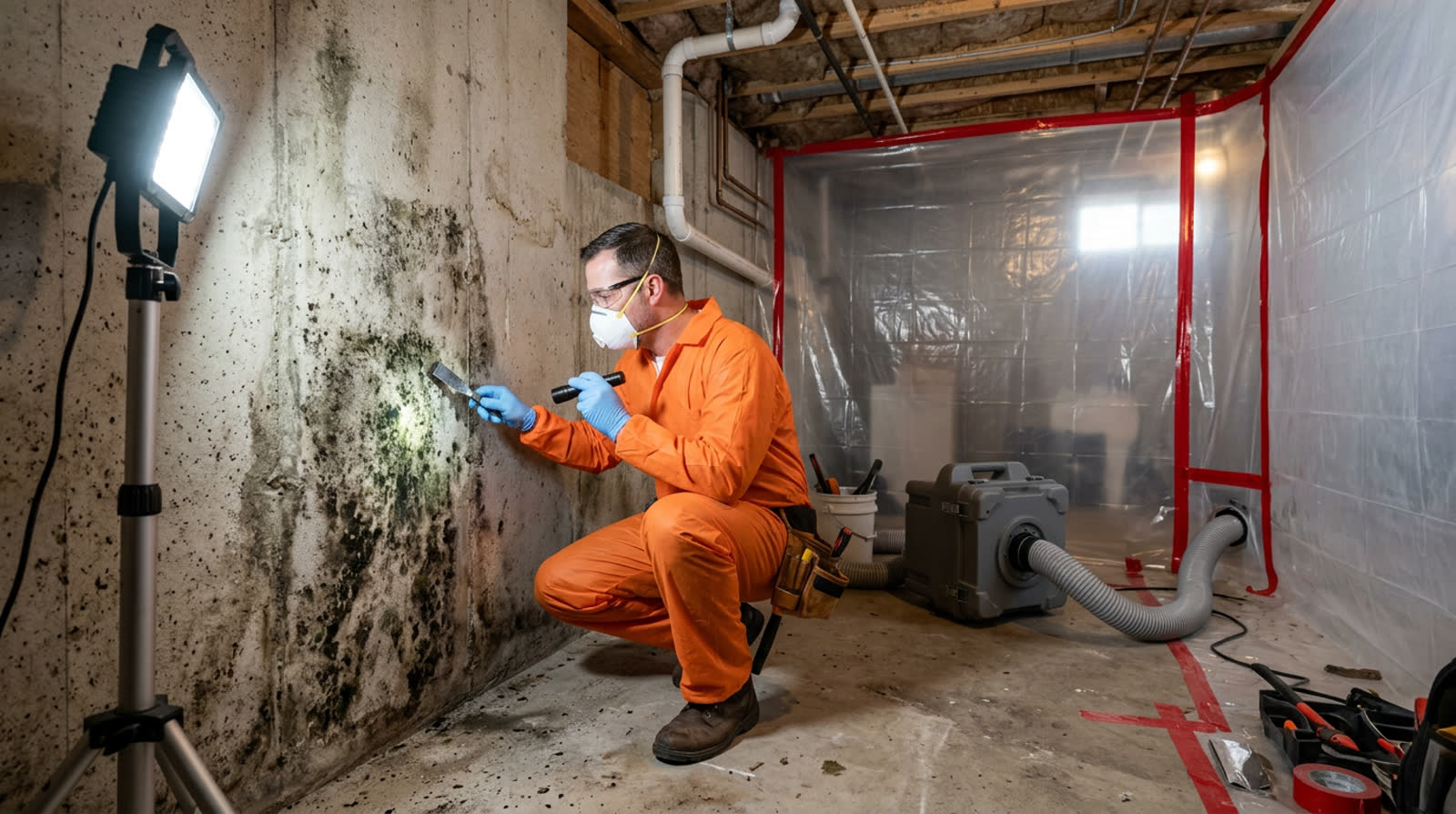
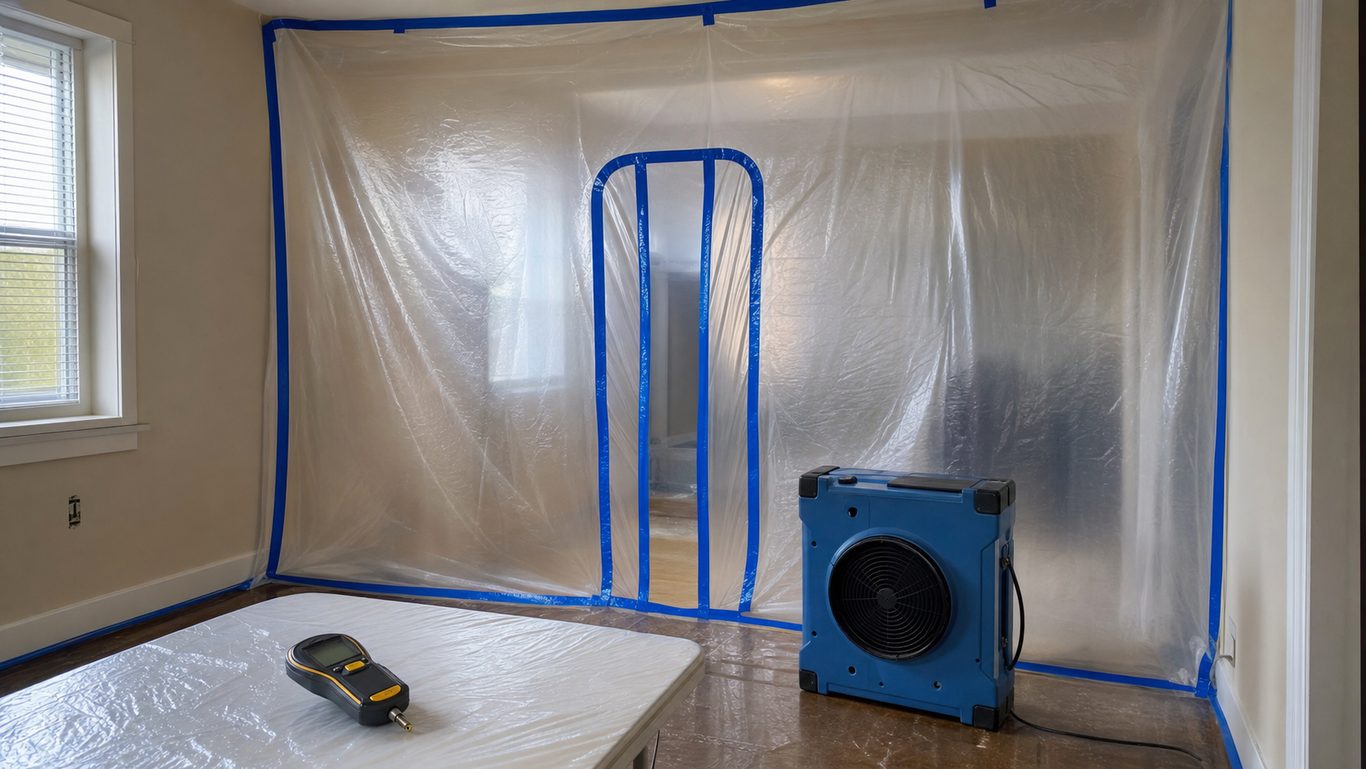
Post-remediation verification (PRV) is the final step of a defensible mold remediation project. After the contaminated materials are removed, the surfaces cleaned, the area dried, and the containment about to come down, an independent test confirms the area is clean. A typical PRV in a Tulsa home includes:
- Visual inspection inside the containment, confirming no visible growth and no residue.
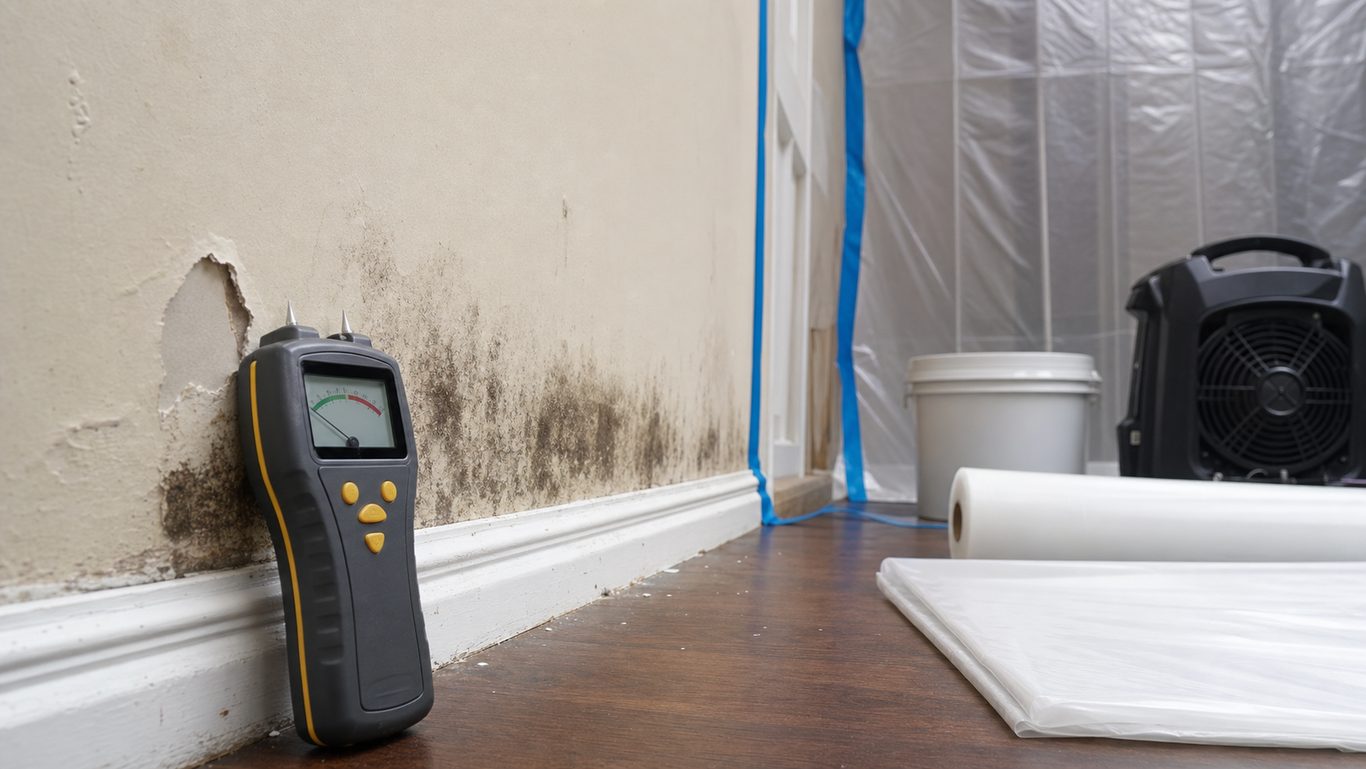
- Moisture readings on remaining surfaces, confirming dry standard.
- Air sampling inside the containment with an outdoor control, confirming counts at or below the outdoor baseline.
Passing PRV is the trigger to remove containment and rebuild. Failing PRV usually means a portion of the work needs to be redone. Most Tulsa real estate and insurance situations expect PRV documentation as part of the closing file.
What air testing cannot tell a Tulsa homeowner
Air sampling has real limits. It is a snapshot of the indoor air at one moment. It does not:
- Locate the moisture source. That is the job of visual inspection and moisture mapping.
- Tell a homeowner whether their specific symptoms are caused by the mold.
- Confirm presence of mold hidden inside a wall or under a floor — the spores have to be airborne to be captured.
- Distinguish viable (still alive) from non-viable spores by spore-trap method. Both count the same on the slide.
For those reasons, air testing should be a complement to visual inspection and moisture mapping, not a replacement. A test on its own is often less useful than a thorough on-site inspection.
One specific Tulsa context: post-storm air quality testing. After major storm events, especially those involving wind-driven rain, attic and crawlspace moisture can spike and create transient indoor air quality issues. A spore-trap test in a Tulsa home two weeks after a storm event sometimes captures a brief elevation that resolves as the home dries out naturally. If a test is taken in that window, the right follow-up is usually a moisture inspection of the attic and crawlspace plus a repeat test two to four weeks later. Acting on a single elevated post-storm reading without confirming the trend often leads to unnecessary remediation work.
How does Trustworthy Restoration handle air quality testing in Tulsa?
We pair every air quality test with a full visual inspection and moisture mapping so the result has context. Sampling is done with calibrated pumps, paired indoor and outdoor controls, and a documented chain of custody to an accredited lab. The written report ties lab numbers to the on-site findings and recommends next steps in plain language. If remediation is needed, our mold remediation crews handle the work under containment with HEPA filtration and post-remediation verification. Call (405) 669-4484 for service across Tulsa, Broken Arrow, Bixby, and the OKC metro.
Tulsa homeowners considering testing should also factor in the lab they are using. Not all environmental labs are accredited to the same standards, and the analytical methods vary slightly between providers. AIHA-LAP accreditation is the common professional benchmark for environmental microbiology labs. When scheduling a Tulsa air test, asking the inspector which lab will analyze the samples and confirming the lab's accreditation is a small step that meaningfully affects how defensible the result is. The cost difference between an accredited and an unaccredited lab is usually small or zero, but the credibility difference is large if the result is ever used in a transaction, claim, or legal context.
Finally, one practical limitation worth naming: an air test taken at 10 a.m. on a still day will read differently than the same test taken at 3 p.m. with the HVAC cycling. Spore counts in the room air fluctuate with airflow, occupancy, and outdoor conditions. The IICRC and other professional bodies recommend standardizing conditions during sampling — windows closed, HVAC at normal operation, no recent activity that would disturb dust. A Tulsa inspector who follows that protocol is producing a more comparable number than one who samples opportunistically. Ask about the protocol before sampling, not after results land.
Is air quality testing covered by Oklahoma homeowners insurance?
Most Oklahoma homeowners policies do not pay for routine, homeowner-requested air quality testing. They often do cover testing that is part of a covered water-damage claim — when a covered loss progresses to a mold finding, the inspection, testing, and remediation can usually be added to the claim, frequently subject to a mold sub-limit. For non-claim scenarios (real estate transactions, health investigations), the test is typically out of pocket.
Homeowners considering a test should call the carrier first if a recent covered water event is the trigger. If the test is purely precautionary, plan for it as an out-of-pocket inspection cost.
How do indoor and outdoor mold counts compare across the Tulsa year?
Tulsa outdoor spore counts vary widely by season and weather. Spring and summer rains, especially during severe weather season from April through July, drive Cladosporium and Alternaria counts up. Late summer drought can drop the same counts. Winter freezes lower most outdoor counts, but residual indoor sources can still produce elevated indoor readings.
That seasonal variation is why the outdoor control sample is non-negotiable on every test. A summer Tulsa air sample showing 3,000 Cladosporium spores per cubic meter is normal if the outdoor control is 5,000. The same indoor reading in January, with an outdoor control of 200, is a strong signal of an indoor source. Without the control, the indoor reading is meaningless. Any Tulsa sampling that omits the outdoor control should be treated with skepticism.
What about wall-cavity sampling on a Tulsa job?
Standard air sampling captures spores already in the indoor air. For a suspected hidden mold problem inside a wall, an inspector can take a wall-cavity sample using a small probe through a finishing-nail-sized hole into the cavity. The probe pulls air directly out of the wall and onto the spore-trap cassette, capturing any spores actively in the cavity that have not made it into the room.
Wall-cavity sampling is useful when:
- A musty smell is localized to one wall or one room with no visible growth.
- A known water event happened behind that wall and the dry-out is questioned.
- A real estate transaction is asking specifically about hidden mold.
The technique leaves only a small hole that can be filled with caulk after the test. Most Tulsa inspections do not need wall-cavity sampling, but for the right case it answers a question no room-air sample can.
Need help now? See our full Mold Remediation service page or browse all restoration services. Don't see your city above? The full Oklahoma service area covers 27 cities.
Local context for this article: see our Tulsa, OK restoration page and the Mold Remediation in Tulsa service page.
This guide also pairs with water damage restoration that prevents mold from forming and water mitigation inside the 72-hour window.
Will an air quality test prove my Tulsa home has "toxic black mold"?
"Toxic black mold" is a popular term, not a scientific category. Several mold types are black in color (including Stachybotrys, but also some Cladosporium and Aspergillus species), and many produce mycotoxins under specific conditions. An air sample can identify the genus present and an estimated spore count per cubic meter. It cannot directly measure mycotoxins in the air. If a doctor has asked about mycotoxin exposure, the test to discuss with them is usually different from a standard spore-trap air sample, and the conversation should be doctor-led.
Authoritative resources referenced
Need restoration help in Oklahoma?
24/7 dispatch, IICRC standards, direct insurance billing.