The 72-hour window — why it matters
The 72-hour figure is not a marketing number. It tracks the industry consensus codified in the IICRC S500 standard for water damage restoration and reflects the biology of mold spore germination on common building materials. Mold spores are airborne and ubiquitous — every Oklahoma home already has them in the dust. They only need water, organic material, and time to colonize, and most of the porous building materials in a residential structure (drywall paper, wood framing, carpet pad, fiberglass-batting facing) provide ideal substrates.
Water activity (Aw) — the threshold that controls germination
Mold growth is governed by water activity (Aw) — the ratio of vapor pressure of water in a material to that of pure water at the same temperature. Most common indoor molds (Aspergillus, Penicillium, Cladosporium) need Aw above roughly 0.80 to germinate; the more aggressive water-damage species (Stachybotrys, Chaetomium) need Aw above 0.90. After a water loss, drywall and wood typically sit at Aw 0.95+ for the first 24 to 48 hours. Drying their Aw back below 0.80 inside the 72-hour window is what stops the germination clock.
Why 72 hours is the practical, not theoretical, threshold
Some species germinate in under 24 hours under ideal conditions; some take five days. The 72-hour line is where the industry treats secondary biological damage as the expected outcome rather than a possibility. Past it, an IICRC-credentialed restoration company will typically scope mold remediation alongside water mitigation rather than treating drying alone as adequate. Inside it, drying alone usually suffices.
What is happening inside the wall hour by hour
Drywall and framing don't dry at the same rate as the visible surface of the room. The cavity behind the drywall is a different microclimate — warm, dark, low airflow, and in Oklahoma's humid spring and summer often holding 70%+ relative humidity at baseline. Here is what happens inside that cavity after a typical residential water loss in OKC, hour by hour.
Hours 0–12: absorption and migration
Water hits surfaces and begins absorbing into porous materials. Drywall paper wicks moisture upward at roughly 1 inch per hour; gypsum core absorbs slower. Carpet pad acts as a sponge, retaining 4 to 5 times its own weight in water and locking moisture against the subfloor. The visible surface of the drywall may look largely dry by hour 12 — that is misleading.
Hours 12–24: surface drying, deep saturation
Surfaces and edges begin drying. Cavity moisture is at peak. Wood framing has typically risen from a baseline 8 to 12% moisture content (MC) to 25 to 35% MC. Drywall is often above 1% on a moisture meter (the dry standard is whatever the unaffected drywall in the same room reads, usually 0.2 to 0.5%).
Hours 24–48: spore germination
Mold spores already present on the substrate (everywhere) begin germinating where Aw is high enough. Microscopic hyphae start extending into the substrate. Nothing is visible yet. A crew running moisture readings in this window will see drywall MC dropping but cavity humidity still elevated; the cavity is the slowest-drying compartment in most assemblies.
Hours 48–72: visible colonies form
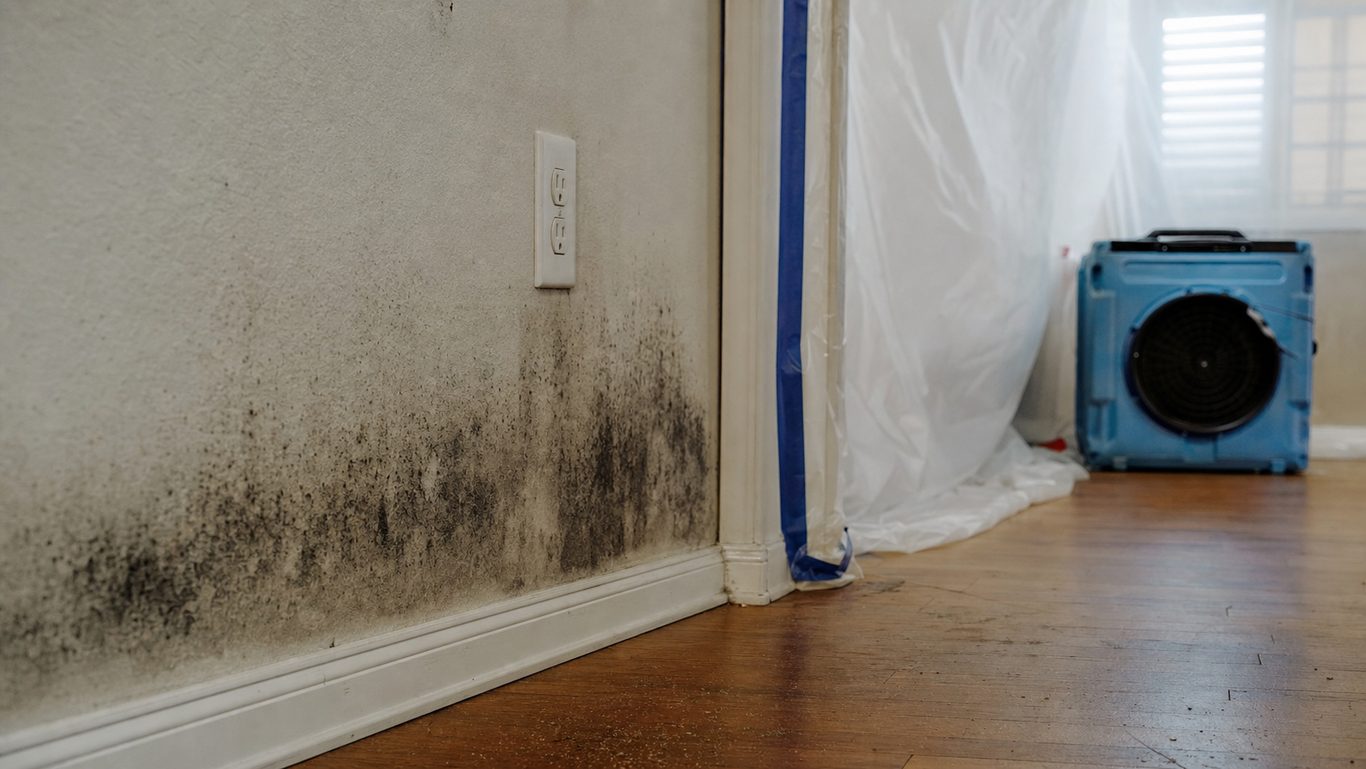
Colonies become visible to the eye on the most-saturated surfaces — typically drywall paper near the floor, the back of baseboard, and the underside of subflooring. Color depends on species: Aspergillus and Penicillium tend toward green-blue; Cladosporium, brown-black; Stachybotrys, the dark-greenish-black associated with persistent water intrusion. Spore release begins in this window, distributing reproductive material to previously unaffected areas.
Past 72 hours: established growth and secondary spread
Active growth, ongoing spore release, and HVAC-distributed contamination of rooms that were never wet. At this point the scope is no longer drying; it is mold remediation per IICRC S520 protocols — containment, HEPA filtration, controlled removal of affected porous materials, and verification testing.
Why DIY drying almost always misses the window
The single most common cause of post-loss mold in Oklahoma homes is well-meaning DIY drying that doesn't move enough air or pull enough moisture. The math is unforgiving: residential fans and dehumidifiers don't approach the throughput needed to dry a real water loss inside 72 hours.
Air movement: shop fans versus commercial air movers
A typical box fan moves 1,000 to 2,000 cubic feet per minute (CFM). A commercial air mover moves 2,500 to 3,200 CFM and is engineered to direct that flow across a wet surface, lifting the boundary layer of saturated air that otherwise sits against the material and slows evaporation. One commercial air mover does the work of 2 to 3 box fans aimed correctly, and 4 to 6 box fans aimed wrong.
Industry placement guidance from IICRC S500 is one air mover per 10 to 16 linear feet of wet wall, angled at the wall at 10 to 30 degrees. A 200-square-foot bedroom with three wet walls typically needs 4 to 5 air movers. Most homeowners run two box fans; the throughput gap is roughly 6x.
Dehumidification: residential versus LGR commercial units
A residential dehumidifier removes 30 to 50 pints of water per day under ideal conditions. A commercial LGR (low-grain refrigerant) dehumidifier removes 80 to 150 pints per day across a much wider temperature and humidity range. A residential unit running 24/7 in a 600-square-foot wet area cannot keep up with evaporation from properly-aired wet materials — the unit is throttled by intake humidity that exceeds its design envelope.
Moisture removed during drying has to go somewhere. Without adequate dehumidification, the moisture coming off the wet materials simply rises into the room air, then re-condenses on cooler surfaces — including surfaces that were not originally wet, like the back of the toilet tank, the inside of closets, and the underside of HVAC supply boots. DIY drying without commercial dehumidification often spreads the loss rather than ending it.
Cavity drying: what fans on the surface can't do
The cavity behind the drywall is sealed except for outlet penetrations and the bottom plate. Surface fans don't reach it. Cavity drying typically requires either drilling weep holes at the bottom plate and inserting drying tubes, or pulling the affected drywall section to expose the cavity directly. Without one of those steps, the cavity stays wet and the mold colonizes there even while the visible surface looks dry.
We've seen dozens of OKC losses where the homeowner ran two box fans for four days, the wall surface read "dry" on a pinless meter, and ten days later black streaks appeared along the bottom of the drywall — cavity colonization that surface drying never touched.
The "looks dry but isn't" trap
Surface dryness and cavity dryness are not the same. Most DIY readings stop at the surface and miss the part that actually controls mold growth.
Pinless meters versus penetrating meters
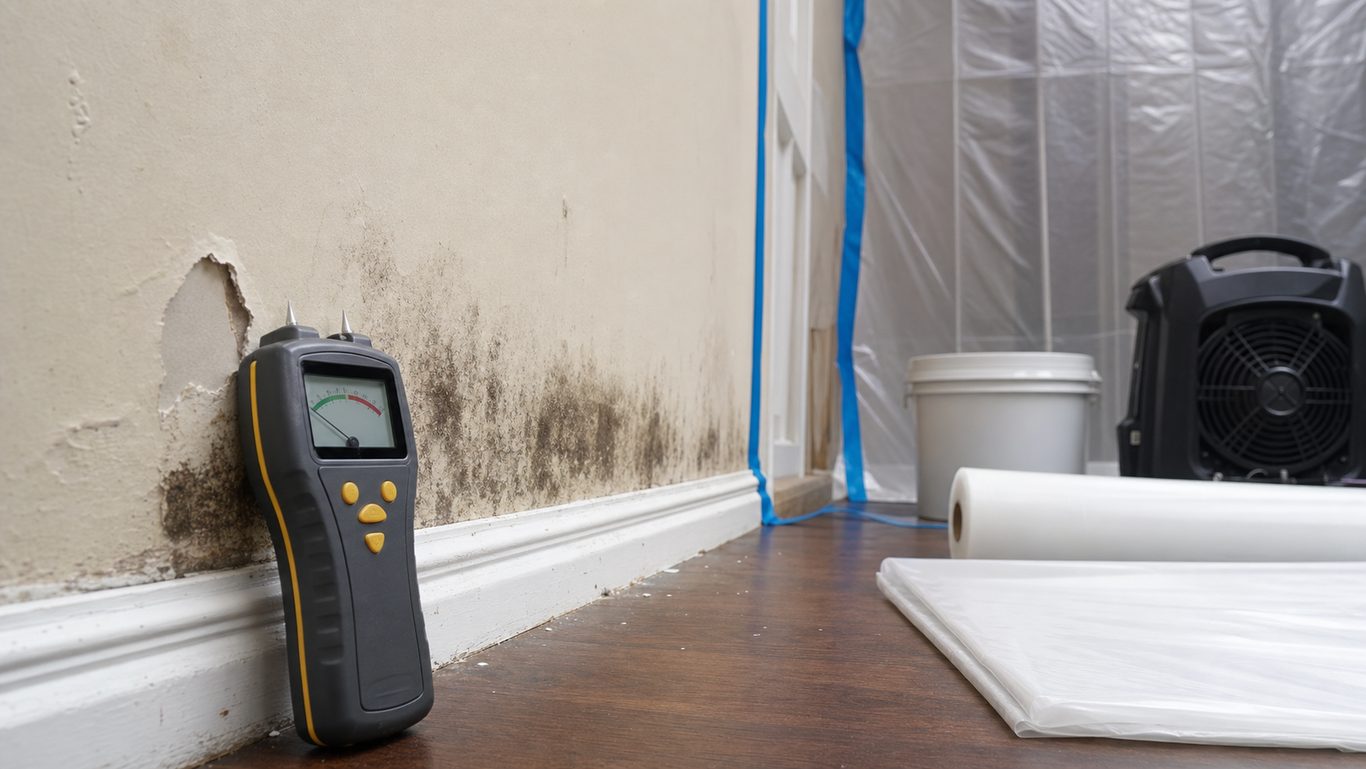
A pinless moisture meter reads through the drywall surface using capacitance and gives a reading from roughly the first 0.75 inches. A penetrating (pin) meter pushes electrodes through the drywall and reads at depth. A surface that reads "dry" on a pinless meter can sit above 1% MC at depth — well above the dry standard. Both meters belong on a real drying job; we use them in combination.
Material EMC — the moisture content that matters
Equilibrium Moisture Content (EMC) is the moisture content a material reaches when in equilibrium with the surrounding air at a given temperature and humidity. Wood framing in Oklahoma sits at EMC of roughly 9 to 12% under normal indoor conditions; wet framing has to dry back to that range, not just to "feels dry." A finished drying job documents both the as-found readings and the post-drying readings against EMC for the materials on site.
When containment becomes mandatory under IICRC S520
If you missed the 72-hour window and visible mold has established, you are in remediation territory. The IICRC S520 standard distinguishes mold conditions by how established the growth is and prescribes different containment requirements for each.
Conditions 1, 2, and 3 in plain language
Condition 1 is normal fungal ecology — the mold spores naturally present in any indoor environment. Condition 2 is settled spores or fragments from a Condition 3 area, but no active growth in that location. Condition 3 is actual visible or suspected actual fungal growth. Most post-water-loss mold scoping in OKC homes finds Condition 3 in the originally wet areas and Condition 2 in adjacent areas where spores have settled.
Containment requirements by condition
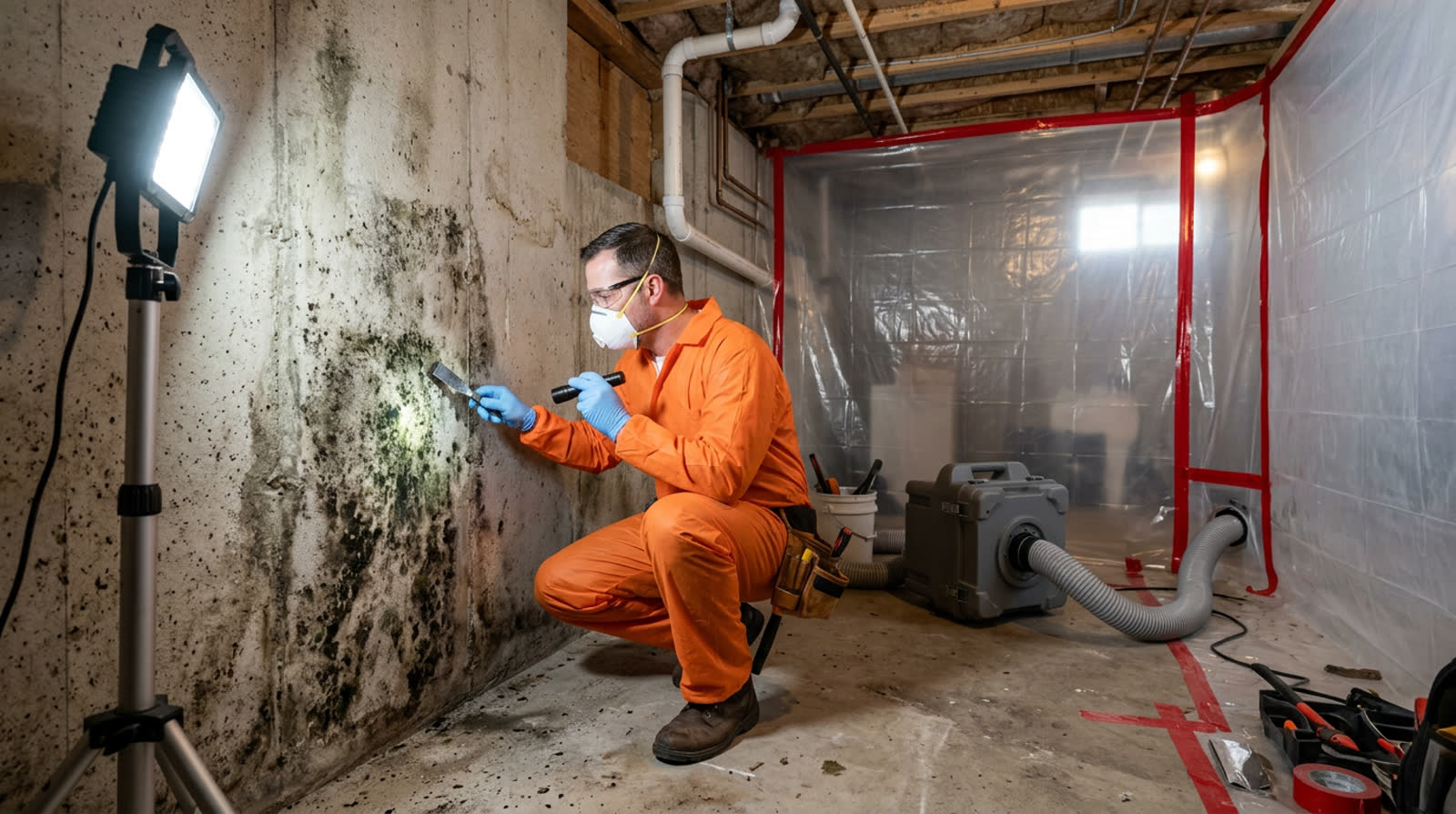
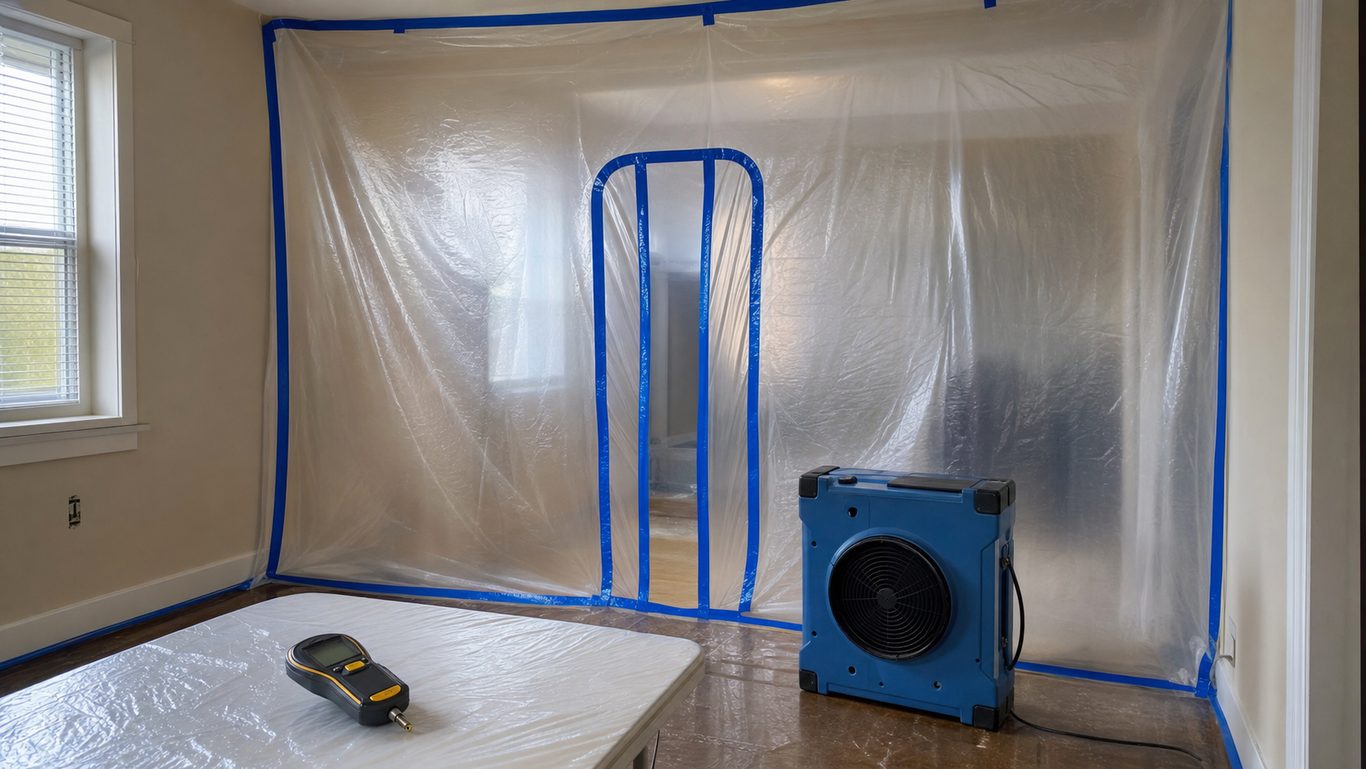
Condition 3 areas require physical containment with polyethylene sheeting and HEPA negative-air machines pulling air from the contained area to outside. Condition 2 areas often only require source removal and HEPA cleaning. Condition 1 requires no containment. Sloppy remediations skip containment in Condition 3 areas and simply scrub visible mold; that approach distributes spores throughout the home and routinely fails post-remediation verification testing.
Post-remediation verification — when to demand it
Post-remediation verification (PRV) is third-party visual inspection plus air or surface sampling, performed by a hygienist who is independent of the remediation contractor. Insurance carriers sometimes require PRV before they pay the final invoice; homeowners with health concerns (asthma, immunocompromise, infants) often pay for PRV out of pocket regardless. A clean PRV is the only objective evidence that the remediation worked. We coordinate independent PRV on every Oklahoma mold job where it's requested.
What proper drying actually looks like in an OKC home
A real IICRC-aligned drying job in an Oklahoma City home has specific equipment, specific placement, and specific documentation. Knowing what good looks like makes it easier to evaluate any quote you receive.
Equipment on a typical 600-square-foot OKC water loss
Truck-mounted extraction first — pulls 5 to 8 gallons per minute from carpet, pad, and standing water. Carpet pad removed; pad does not dry adequately and traps moisture against the subfloor. Air movers placed at one per 10 to 14 linear feet of wet wall, angled at 15 to 30 degrees against the wall. One LGR commercial dehumidifier per 600 to 900 square feet of affected area. Plastic containment between affected and unaffected rooms to keep humidity from migrating.
Daily moisture documentation
A drying log is created at hour zero with as-found moisture readings on every wet wall, ceiling, and floor. Readings are repeated every 24 hours. Equipment is repositioned as readings change. Drying continues until all materials reach the dry standard for unaffected materials in the same building. The log is delivered to the insurance adjuster and is the documentation backbone of the mitigation invoice.
Typical Oklahoma timeline
Most clean OKC residential water losses dry to standard inside 3 to 5 days when caught fast. Larger losses (whole-floor saturation, 1,500+ square feet, or losses caught at hour 36+) typically need 5 to 7 days. Past that, the question shifts from drying to remediation. For the broader claim-side context, see our Oklahoma water damage insurance claim guide.
If you missed the window: what changes
If you are reading this 4 days into a water loss and you're smelling musty odor or seeing dark streaks at the floor line, drying alone is no longer the right scope. Here's what changes.
Scope shifts to remediation
Remediation typically removes drywall to 12 to 24 inches above the high-water mark on every affected wall, removes saturated insulation, removes any wet wood that has visible colony growth, HEPA-vacuums framing, applies an EPA-registered antimicrobial, and installs a sealing primer (B-I-N or shellac) on residual framing where micro-residue may persist. Containment and HEPA negative air run throughout. A typical OKC residential remediation runs 5 to 10 working days for the remediation phase, then a separate rebuild.
Insurance changes too
Mold remediation hits your mold sub-limit, not your dwelling limit. In Oklahoma, that sub-limit is typically $5,000 to $10,000 unless a higher-limit endorsement is in place. A larger remediation can exceed the sub-limit even when the underlying water loss was covered — see our mold cost breakdown for worked examples and where the sub-limit hits.
Bleach is not remediation
Surface bleaching kills visible mold on non-porous surfaces but does not penetrate the substrate, does not address the spores embedded in the gypsum core, and does not handle the cavity. Bleach on porous mold-affected materials is a cosmetic fix that fails post-remediation testing every time. If you've already bleached visible mold, tell the remediation contractor — it changes the inspection workflow.
Companion guides on this site: first 24 hours after water damage in Oklahoma City, how much mold remediation costs in OKC, hidden water damage warning signs, and filing an Oklahoma water damage claim. Service-area pages: Oklahoma City, Tulsa, Edmond, and the full Oklahoma service area.
Need help now? See our full Mold Remediation service page or browse all restoration services. Don't see your city above? The full Oklahoma service area covers 27 cities.
Local context for this article: see our Oklahoma City, OK restoration page and the Mold Remediation in Oklahoma City service page.
This guide also pairs with water damage restoration that prevents mold from forming and water mitigation inside the 72-hour window.
Will my Oklahoma homeowner's insurance pay for mold remediation if I missed the 72-hour window?
Sometimes — and it depends on the cause. If the underlying water loss was sudden and accidental and you took reasonable mitigation steps, most Oklahoma carriers cover the resulting mold up to your mold sub-limit (commonly $5,000 to $10,000). If the carrier can argue you delayed mitigation unreasonably and that delay caused the mold, they can decline the mold portion of the claim under the duty-to-mitigate clause. Document everything you did and when.
Authoritative resources referenced
Need restoration help in Oklahoma?
24/7 dispatch, IICRC standards, direct insurance billing.