The seven warning signs (and how each one shows up)
Most water damage in Tulsa homes hides for weeks before becoming visible. By the time you notice the visible signs, secondary damage — mold, rot, weakened framing — is already underway. The seven indicators below are the ones our crews find most often during free inspections across Tulsa, Broken Arrow, Owasso, Bixby, Jenks, and Sand Springs. Each one is rated by urgency: Tier 1 means call within 24 hours, Tier 2 means inspect within a week, Tier 3 means monitor and re-check.
The pattern matters: any single sign can be benign in isolation, but two or more in the same area is almost always active intrusion. Tulsa's mid-century housing stock — particularly Brookside, Maple Ridge, Florence Park, and the older sections of Midtown — is especially prone to hidden moisture because of cast-iron drains, copper supply lines reaching end-of-life, and original-construction roof pans that were never built for current weather patterns.
1. Musty or earthy odor with no visible source — Tier 1
A musty smell with no visible source is the single best indicator of hidden moisture. Mold is metabolically active in any wet area; the byproducts of that metabolism are microbial volatile organic compounds (mVOCs) that smell musty, earthy, or like a damp basement. If a room smells musty even after cleaning, something is wet that shouldn't be.
Where to sniff
Closets that share a wall with bathrooms or laundry. Under-sink cabinets. The base of toilets. Crawlspaces (Tulsa has more crawlspaces than OKC because of the Arkansas River-influenced soil). Behind washing machines and water heaters. Smell the HVAC return when the system kicks on — if the smell intensifies, the duct system is moving moisture.
Why this is Tier 1
mVOCs only appear after spore germination, which means the colony is established. Every additional day of growth multiplies remediation cost. A musty smell three days old is a different scope than a musty smell three weeks old — see why the 72-hour mold window matters.
2. Stained or discolored drywall — Tier 1 (active) or Tier 2 (historic)
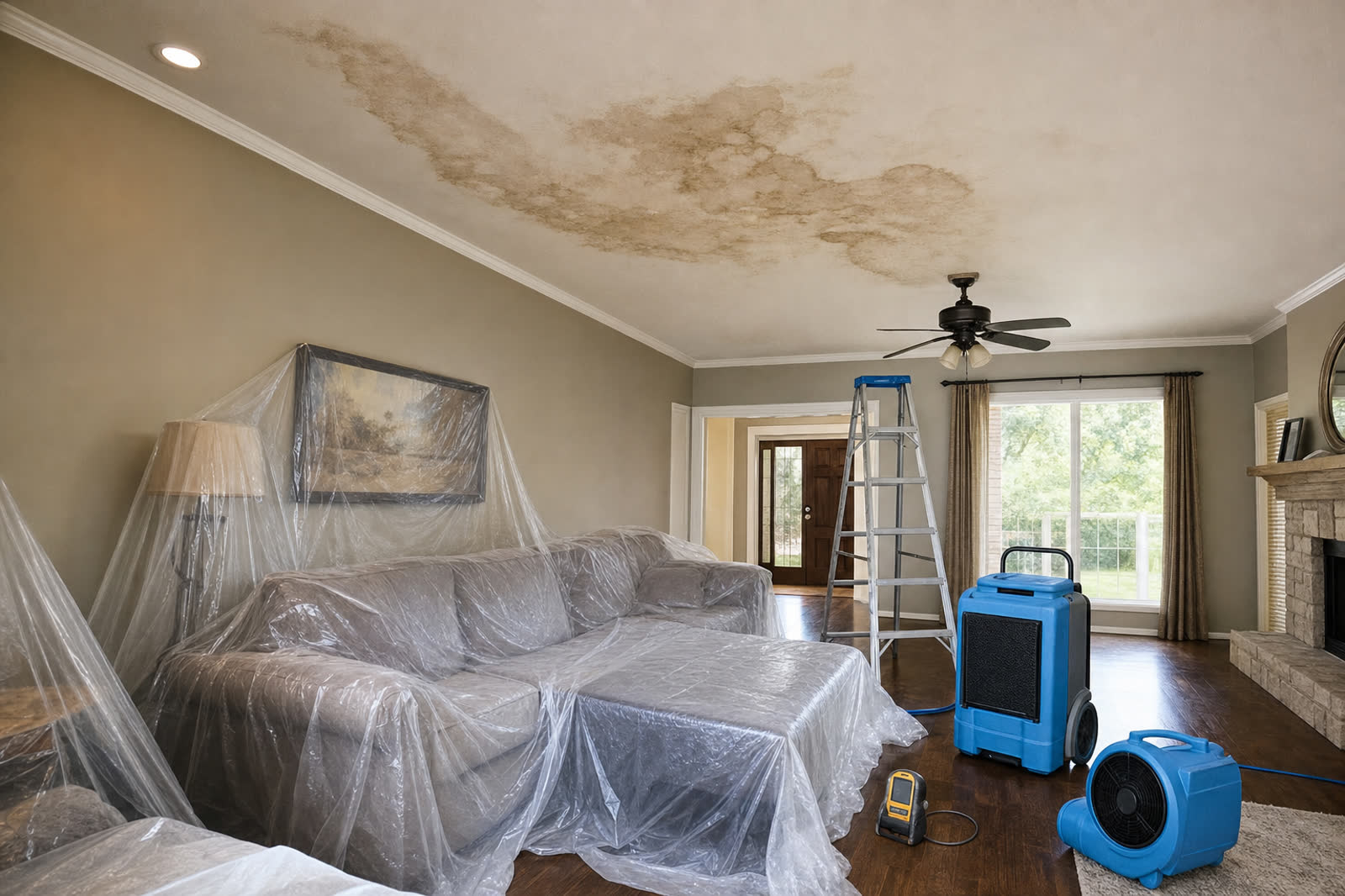
Yellow, brown, or rust-colored stains on walls or ceilings indicate water intrusion. Stains that grow, change shape, or darken between visits mean active intrusion. Stains that have been the same shape for >12 months and feel dry to the touch may be historic damage that was never cleaned or reframed.
The Tulsa ceiling-stain pattern
Three sources cause most ceiling stains in Tulsa homes: roof flashing failures (especially around skylights and chimneys after spring hail), HVAC condensate-line backups in attic air handlers (typical in builds from 1985–2010), and second-story bathroom failures (toilet wax rings, shower pan leaks). The location of the stain narrows the cause — a stain directly under an upstairs bathroom is rarely a roof issue.
Touch test (with caution)
Press the stained drywall lightly with a fingertip. If the surface is firm, the damage may be historic. If it gives, even slightly, water is present and the section will need to come out. Do not press hard — a saturated ceiling can release substantial water.
3. Bubbling, peeling, or cracking paint — Tier 2
Paint failure is often the first visible sign of moisture in drywall. Water vapor pushes the paint film away from the substrate. If paint that was fine last month is now bubbling, there's water behind it.
Hairline cracks vs. true bubbling
Hairline cracks at corners and along the joint between drywall and trim are usually settlement or normal drywall flex — Tier 3. Bubbling that you can press with a fingertip and feel collapse, or peeling that lifts from the substrate, is a Tier 2 moisture issue. The difference matters because the response is different.
4. Warped, cupped, or sagging flooring — Tier 1
Hardwood that has cupped (edges raised, center low), laminate that has lifted at the seams, vinyl that has bubbled, or carpet that feels soft underfoot all indicate moisture in or under the floor. In Tulsa's older Maple Ridge and Brookside homes — many on slabs or shallow crawlspaces — cupped hardwood usually points to a slab leak or crawlspace humidity issue.
Sub-floor moisture in slab homes
Slab leaks on hot-water lines are particularly common in pre-1985 Tulsa builds. Warm spots on the floor, an unexplained water-bill jump, and a hot-water heater running more than usual are the classic combination. We diagnose with thermal imaging and pressure-decay testing — see our Tulsa water damage restoration page for the full inspection process.
5. Spike in your water bill — Tier 1
An unexplained jump in your monthly water bill almost always means a leak somewhere — slab, supply line, irrigation, or a toilet flapper. The Tulsa Utility Board sends digital usage charts on the bill; a 30%+ month-over-month jump with no lifestyle change is the threshold to investigate.
The 15-minute meter test
Turn off every fixture in the house. Locate the water meter (typically at the curb in a meter pit, lid marked "Water"). Note the reading or the position of the leak indicator (a small triangle or star that spins when water moves). Wait 15 minutes with nothing running. If the reading changed or the indicator moved, you have a leak somewhere on the supply side. Toilet flappers are the #1 cause; turn off each toilet's supply valve one at a time to isolate.
6. Sounds of water with nothing running — Tier 1
A faint hissing, dripping, or running sound in a wall or under the floor with no fixtures running indicates a pressurized leak. Don't ignore it. The sound is loudest where the leak is closest to a wall surface; an electronic stethoscope (under $30 online) helps localize before opening drywall.
7. New cracks in drywall, ceiling, or grout — Tier 2
Settling and minor cracks are normal in any home. New cracks — especially horizontal cracks on walls, ceiling cracks that lengthen between visits, or grout failures in a tiled wall above a bathtub — can indicate water-weakened framing. Tile grout failure on the bottom row of a tub surround is a tell for a failed shower pan and should be inspected before the next remodel.
Tulsa-specific risk factors by neighborhood and era
Not every Tulsa home is at the same risk profile. Three patterns are worth flagging:
Mid-century slabs (1955–1975 builds)
Brookside, Maple Ridge, Lortondale, parts of Florence Park. Original copper hot-water lines under the slab are reaching end-of-life. Slab-leak repair through epoxy lining or above-slab re-route is common.
1990s–2000s suburban builds (Broken Arrow, Owasso, Bixby, Jenks)
Polybutylene supply lines (recalled, but still present in some homes) and PEX with brass fittings prone to dezincification. HVAC air-handlers in the attic with secondary drain pans that were never cleared since installation.
Older Midtown homes with basements (1920–1950 builds)
Cherry Street, Owen Park, North Maple Ridge. Cast-iron drain stacks, original-cement basement floors, and clay sewer lines under tree roots. Hidden moisture often shows up at the basement-stair stringer first.
Tools a Tulsa homeowner can actually use
You don't need a thermal camera to triage. Three sub-$50 tools cover most homeowner-level checks:
- Pin-style moisture meter ($25–$45): press the pins into drywall, wood trim, or behind a baseboard you can pop. Anything reading >15% on wood or >1% above the dry standard on drywall is wet.
- Infrared thermometer ($20–$30): point at suspect areas. Wet drywall reads 5–10°F cooler than dry drywall on the same wall — not diagnostic alone, but a useful screen.
- Water-bill comparison: open last 12 months on the Tulsa Utility Board portal, look for the month-over-month jump. Free.
Tools we use that homeowners don't need to buy: a FLIR thermal camera ($1,200+), a pin-less capacitance meter ($300+), a hygrometer with grain-per-pound readout ($400+), and a borescope for cavity probes ($150+). A free inspection from our water damage restoration team brings all of these.
When to stop investigating and call
Stop and call when any of the following are true: visible mold of any color (black, green, white fuzz, pink slime around a tub), drywall soft to the touch, a sagging or wet ceiling, a smell that's worse on day 3 than day 1, or a moisture-meter reading >30% on framing. Past those thresholds, more investigation just delays remediation. The fix isn't more diagnosis — it's a crew, equipment, and the two-phase mitigation/restoration sequence.
What a professional moisture inspection actually finds
A typical free inspection takes 45–60 minutes. We map suspect areas with a FLIR thermal camera, confirm with pin meters, probe wall cavities with a borescope where access is non-destructive, log hygrometer readings (interior temp, RH, grains per pound), and provide a written summary. If we recommend mitigation, the inspection cost is folded into the job; if we don't, there's no charge.
Inspections cover the full Oklahoma service area with same-week scheduling in Tulsa, Broken Arrow, Owasso, Jenks, Bixby, Sand Springs, Sapulpa, Glenpool, and Claremore.
What the written report includes
Our inspection report is the document a homeowner can hand to a carrier or a real-estate agent: a labeled floor plan with marked moisture readings, thermal images annotated with the date and the meter reading at each point, a summary classification (Tier 1 active, Tier 2 borderline, Tier 3 historic), recommended next steps, and an itemized scope-of-work estimate if mitigation is warranted. Reports are delivered as PDF the same day for OKC-metro inspections and within 24 hours for Tulsa-metro and outlying inspections.
Pre-purchase and pre-listing inspections
Tulsa-area buyers and sellers increasingly request a moisture inspection alongside the standard home inspection — particularly on Brookside, Maple Ridge, and pre-1985 ranch homes where hidden water damage is common. Our inspection slots in alongside a general home inspection and produces a written report that's specific enough to negotiate against. Sellers benefit too: a documented dry house is a stronger position than an undocumented one.
Tulsa weather patterns that drive hidden-water risk
Tulsa's climate has three patterns that hide water damage longer than in drier regions. Sustained high humidity in summer keeps materials slow to release trapped moisture; sharp freeze-thaw cycles in winter open and close hairline cracks in masonry and grout; spring hail and severe weather create roof and flashing damage that often only manifests as ceiling stains weeks later.
Spring hail aftermath (March–June)
Hail rarely creates an immediate, dramatic leak. The pattern that catches Tulsa homeowners off-guard is mat damage to asphalt shingles — the granule loss accelerates UV degradation, and the underlying asphalt mat then fails on a 30–60 day timer. Ceiling stains in May–August traceable to a March–April storm are extremely common. If you had a hail event recently, schedule a moisture and roof inspection inside the storm-claim window — most Oklahoma policies have a 1-year filing deadline for hail and wind, see our storm damage restoration playbook.
Summer humidity (June–August)
Outdoor relative humidity above 70% slows the natural release of moisture from drywall and framing. A small leak that would dry on its own in a January house grows mold in a July house. The signs are the same — musty smell, stained drywall, soft floors — but the timeline from "first sign" to "established Condition 2 mold" is roughly half what it is in winter.
Winter freeze events (December–February)
The 2021 February freeze remains the high-water mark for Tulsa-area pipe failures, but minor freeze events happen most winters. The hidden risk: a pipe that froze, partially split, and is now weeping slowly into a wall cavity. Spring is when these typically surface. If your house went below 20°F indoors during a power outage and you find a damp spot in March, you've found the cause.
What to do when the inspection finds active damage
Most inspections find one of three outcomes: dry, borderline (Tier 2 or 3 historic damage), or active wet (Tier 1). The first two are routine; the third is where homeowners need a clear playbook so the next 24 hours don't become the same 72-hour mold window mistake we cover for visible-loss customers.
If the inspection finds Tier 1 active intrusion
- Source isolation first — close the supply valve, divert the leak, contain the spread.
- Photograph everything before any cleanup, same as on a visible loss.
- Call your carrier the same day; reference the written inspection report when you file.
- Authorize mitigation immediately — the duty-to-mitigate clock starts at discovery, not at when the leak began.
If the inspection finds Tier 2 or 3 historic damage
Historic damage that's now dry doesn't trigger an emergency response, but it does deserve a documented repair plan. The carrier may or may not cover it depending on policy language; the inspection report and the repair documentation are what determines coverage. Don't assume historic damage is uninsurable — document the discovery date, file the claim, and let the carrier evaluate.
If the inspection finds nothing
Get the written "dry" report and keep it with your home records. If you sell the home in the next 12 months, that report is a documented baseline that supports your disclosure. If a future leak is found, the prior "dry" report establishes a clear timeline that supports a sudden-and-accidental classification.
Need help now? See our full Water Damage Restoration service page or browse all restoration services. Don't see your city above? The full Oklahoma service area covers 27 cities.
Local context for this article: see our Tulsa, OK restoration page and the Water Damage Restoration in Tulsa service page.
This guide also pairs with emergency water mitigation and mold remediation when drying is missed.
Is a free moisture inspection actually free in Tulsa?
Yes — no cost, no obligation. We send an IICRC-trained technician with a thermal camera, pin and pin-less moisture meters, and a hygrometer. The inspection takes 45–60 minutes and produces a written report. If the home is dry, we say so and there's no charge. If the home is wet, the inspection is folded into mitigation. We cover Tulsa, Broken Arrow, Owasso, Jenks, Bixby, Sand Springs, Sapulpa, Claremore, and Glenpool.
Authoritative resources referenced
Need restoration help in Oklahoma?
24/7 dispatch, IICRC standards, direct insurance billing.