Step 1 — Mitigate first, file second
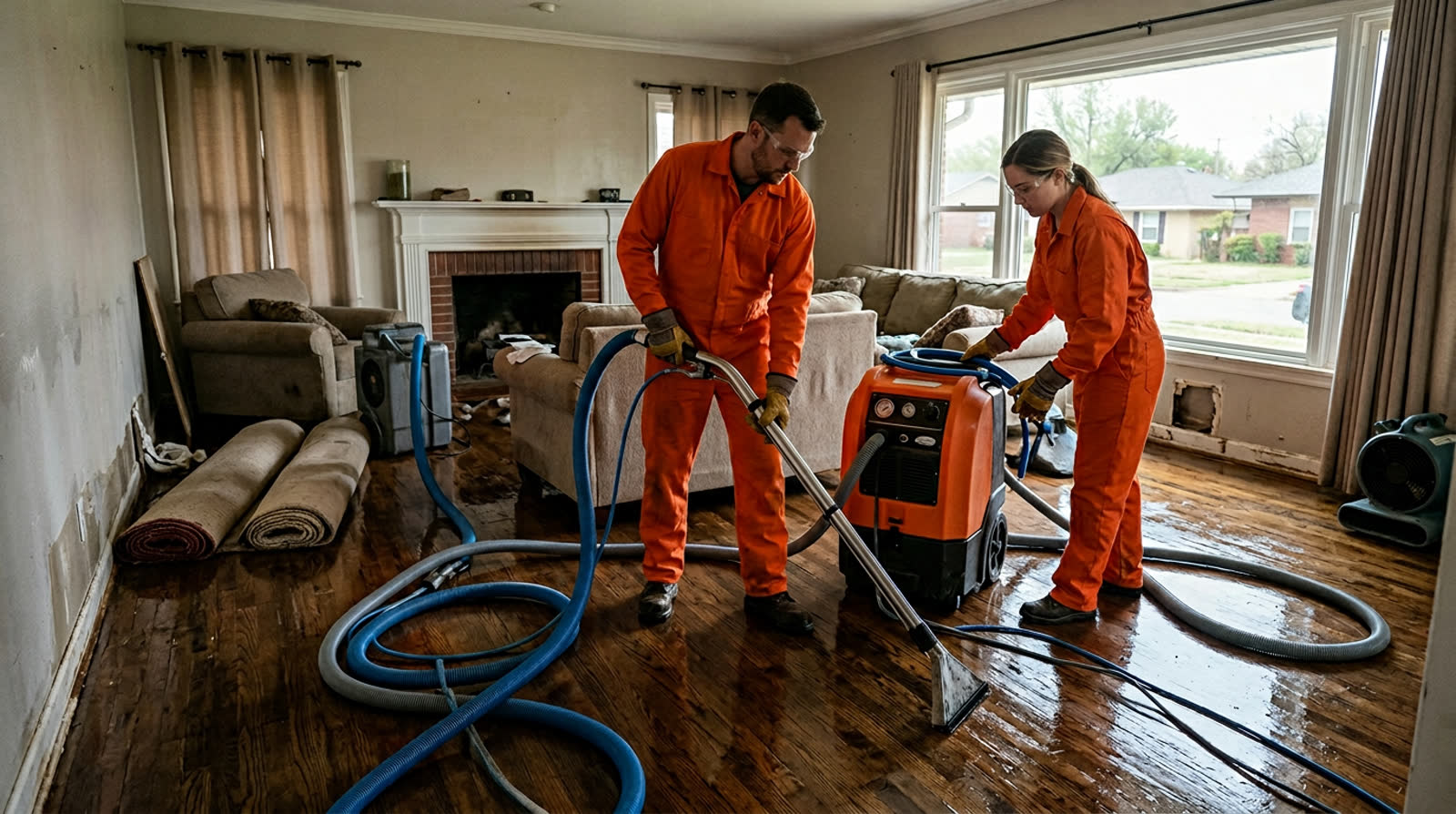
Every standard Oklahoma homeowner's policy contains a duty-to-mitigate clause: the homeowner is required to take reasonable steps to prevent further damage after a covered loss. In practice that means stopping the source, extracting standing water, and starting structural drying before you wait days for an adjuster to be assigned. Carriers reimburse mitigation costs incurred before the adjuster appears — provided you can document the cause, the scope, and the timestamps.
What "reasonable steps" actually means
Reasonable mitigation has a fairly settled definition in Oklahoma claim files: shut off the water at the fixture or the main; place containment around the wet area; call an IICRC-credentialed restoration company; begin extraction and drying within 24 hours; and document the work in writing and photos. If you delay any of those steps and mold or rot follows, the carrier can argue the secondary damage was caused by your delay, not the original loss — and decline that portion of the claim.
If you are out of town when the loss happens, call a neighbor or family member to take initial photos and shut off the water, then call a restoration company to start mitigation remotely. Many Oklahoma policies still expect you to act fast even if you're not physically present.
When to start before calling the insurer
If standing water is actively damaging the structure and the carrier's claim line has a hold time, start mitigation and call in parallel. Document the start time, the equipment placed, and the moisture readings. We've handled hundreds of Oklahoma claims where the homeowner started mitigation hours before the claim number was issued — and the mitigation invoice was paid in full because the documentation was clean.
Step 2 — Document the loss the way an adjuster needs
Documentation is the single largest determinant of how a water damage claim settles. Adjusters do not see your loss; they see the evidence you and your contractor present. Generic phone snapshots are not enough — a structured documentation pass takes 20 minutes and pays for itself many times over.
The wide-mid-close photo pattern
Walk every affected room with three shots per surface: a wide shot showing the room context, a mid shot showing the damaged section in scale, and a close-up showing the moisture line, staining, or material failure. Capture every wall, every ceiling section, every flooring transition, and every damaged content item. Photograph serial numbers on appliances and HVAC equipment that may need replacement.
If standing water is still present, place a tape measure or ruler against the wall before photographing so the depth is documented. After extraction, photograph the high-water mark on the drywall — the discoloration line is critical evidence for category and scope.
Video walkthrough with narration
After the photo pass, do a single video walkthrough narrating what you see: the source, the path of water, the rooms affected, the contents damaged, and the mitigation actions you've already taken. The narration becomes a contemporaneous statement — far harder to dispute later than a written account assembled days afterward.
Receipts, logs, and digital backups
Save every receipt: emergency hotel nights, meals out if displaced, equipment rental, replacement clothing, pet boarding. Log them daily — a spreadsheet beats a shoebox of receipts when ALE reimbursement comes around. Back everything up to cloud storage; phones get lost or damaged in chaotic mitigations, and a single device failure can cost you thousands in reimbursable expenses.
Step 3 — File the claim and get the right answers
When you call your carrier's claim line, you are opening a claim file that will be referenced for months. The first call sets the cause-of-loss narrative the rest of the claim is built on. Get the framing right.
What to have ready
Policy number, declarations page, date and time of loss, the cause if known, a one-paragraph plain-language description, and the name and license number of the restoration company you've engaged. If the loss involves a plumbing failure, have the plumber's name and report ready — most adjusters want to know who isolated the source.
Questions to ask before you hang up
Ask explicitly: (1) What is my claim number? (2) Who is my adjuster and how do I reach them directly? (3) Is mitigation pre-approved up to a stated dollar amount, and what is that amount? (4) Does my policy have a separate deductible for water versus storm? (5) Are there any sub-limits — mold, sewer backup, ordinance and law — that apply to this loss? Note the answers. Carriers vary in how they answer the same question by phone versus in writing; the call notes are part of your file.
Step 4 — Sudden-and-accidental versus gradual: where Oklahoma claims get denied
The single most common reason Oklahoma water damage claims get denied is the cause-of-loss language. Standard Oklahoma homeowner's policies cover sudden and accidental discharge of water — a burst supply line, a ruptured washer hose, a freeze-broken pipe. They typically exclude gradual damage: slow leaks behind walls, weeping fittings, condensation, long-term roof seepage.
How adjusters draw the line
Two diagnostic markers separate sudden from gradual: tannin staining patterns and material decomposition. Tannin rings on drywall with multiple distinct edges suggest repeated wetting and drying — gradual. Saturated drywall with a single sharp moisture line and no biological staining suggests sudden discharge. Wood rot, dimensional change, and active mold colonies argue gradual; clean wet wood with no decomposition argues sudden.
Photographs from the day of loss matter here. A current-day snapshot of an obviously old leak doesn't help. A photo showing the rupture point with water actively running, or a contractor's same-day report identifying the failure mode, anchors the sudden classification.
What to do if you suspect a gradual leak became sudden
Many real losses are mixed: a slow drip behind drywall finally caused a fitting to fail and dump fifty gallons in two hours. Carriers sometimes cover the sudden component (the dump) and exclude the gradual component (the rotten subfloor under the slow drip). The right approach is to document both — the visible sudden event and the hidden gradual condition — and let the adjuster make a written determination on each.
Step 5 — Walk the loss with your adjuster and your contractor
The adjuster meeting is the single most important hour of your claim. Your contractor speaks Xactimate; the adjuster speaks Xactimate; you do not. Have your contractor at the meeting — ideally the same person who wrote the mitigation scope and will write the rebuild scope.
What gets walked
Every wet room. Every wet ceiling. Every wet floor transition. Every damaged content category. Cabinets, vanities, trim, baseboards, doors, door jambs, flooring, subfloor, drywall, insulation, paint, ceiling texture. The contractor calls out what's salvageable and what isn't, and the adjuster takes notes for the scope of loss.
Bring the moisture maps. A documented map showing wet zones, dryness targets, and equipment placement makes the scope objective rather than negotiable. Adjusters who see clean documentation generally write cleaner scopes.
Code-upgrade and matching coverage
Oklahoma policies often include ordinance-and-law coverage for code upgrades triggered by the loss — for example, GFCI outlets in a refinished bathroom, smoke detectors hardwired to the new ceiling, or insulation upgrades to current code. Ask the adjuster to itemize ordinance-and-law line items separately. Matching-materials coverage handles the situation where damaged flooring needs to be replaced and the old SKU is discontinued; in many cases the carrier will cover replacing the entire run rather than leaving you with a visible mismatch.
Step 6 — Understand depreciation, ACV, and recoverable depreciation
Most Oklahoma homeowner policies pay water claims in two installments. The first installment is Actual Cash Value (ACV) — the depreciated value of the damaged materials. The second is recoverable depreciation, released after the work is completed and invoices submitted. Understanding this two-step structure is the difference between a claim that pays out fully and one that gets stuck.
Worked example: a $14,000 loss
A typical OKC loss writes at $14,000 in scope. The carrier applies depreciation — say 25% on flooring and paint based on age — leaving $10,500 ACV. After your $1,000 deductible, the first check is $9,500. You complete the work; total invoiced cost is $14,200 (a small supplement was approved). You submit final invoices. The carrier releases the $3,500 recoverable depreciation, plus the $200 supplement. Final out-of-pocket: just the $1,000 deductible.
If you stop after the first check and don't complete the work, you keep the $9,500 ACV — but you lose the $3,500 recoverable depreciation. Many homeowners trying to pocket the difference end up with half-finished houses and forfeited recovery.
ACV versus RCV policies
If your policy is RCV (Replacement Cost Value), the structure above applies and you can recover depreciation by completing the work. If your policy is ACV-only — common on older roofs, secondary structures, and some manufactured-home policies — the first check is the only check. Read your declarations page to know which you have before the loss.
Step 7 — Track Additional Living Expenses if you're displaced
If the home is uninhabitable, Additional Living Expenses (ALE) — sometimes called Loss of Use — covers the difference between your normal cost of living and your displaced cost of living. Hotel, meals out beyond what you'd normally spend, laundromat costs, pet boarding, mileage to and from the temporary housing, and similar reasonable expenses. ALE is reimbursed against documentation, not paid as a lump sum.
What counts and what doesn't
Hotel rate at the lower of the local average and the actual: covered. Restaurant meals beyond your normal grocery spend: the increment is covered. Laundry, pet boarding, parking at the temporary housing: covered. Buying a new TV because you missed the one at home: not covered. Stocking a vacation rental's pantry beyond your normal spend: not covered.
Keep a one-line daily log — date, amount, category, receipt photo — and submit weekly. Carriers approve ALE faster on weekly bundles than on a single 60-day pile. Most Oklahoma policies cap ALE at 20% of dwelling coverage and 12 to 24 months in time; check your declarations.
Step 8 — Common Oklahoma exclusions and sub-limits to know
Several exclusions and sub-limits show up consistently in Oklahoma water damage claims. Know them before the loss; they're often non-obvious until they bite.
Mold sub-limit
Most Oklahoma homeowner policies cap mold-specific coverage at $5,000 to $10,000 unless a higher-limit endorsement is in place. If a covered water loss leads to mold, the water damage portion is paid against the dwelling limit and the mold portion is paid against the mold sub-limit. A large mold remediation can blow through the sub-limit even when the underlying water loss was covered. Our mold remediation cost guide for OKC walks through real-world examples of where the sub-limit hits.
Sewer and drain backup
Standard Oklahoma policies do not cover water that backs up through a sewer or drain — the line that runs from your house to the city main, or the city main itself. A water-and-sewer-backup endorsement (typically $50 to $150 a year for $5,000 to $25,000 of coverage) closes the gap. Without it, basement and lowest-fixture sewage losses are out of pocket. See our sewage backup guide for the cleanup side of those losses.
Flood, surface water, and groundwater
Homeowner's policies in Oklahoma exclude flood — water from outside the structure that overflows from a body of water, surface runoff, or rising groundwater. Flood coverage requires a separate NFIP policy through the National Flood Insurance Program or a private flood policy. The OKC and Tulsa metros have meaningful flood-prone zones (Bricktown, parts of Mesta Park, lower Brookside, anything along the North Canadian or the Arkansas) where uninsured flood losses are routine.
Roof age depreciation walls
If your roof is over 15 years old, many Oklahoma carriers apply heavy depreciation to roof claims and some refuse to write replacement-cost coverage at all. Storm-driven water intrusion through an older roof is a frequent dispute point — see our storm damage guide for the storm-side mechanics.
Step 9 — When to escalate: the Oklahoma Department of Insurance
If a claim stalls — adjuster non-responsive for weeks, scope-of-loss numbers that don't match documented conditions, repeated unexplained denials — the escalation path is the Oklahoma Department of Insurance. Filing a complaint is not adversarial; it's a formal request for the regulator to look at the claim file.
What escalation looks like
The Oklahoma Department of Insurance (oid.ok.gov) accepts complaints by online form, mail, or phone. Provide the policy number, the claim number, the adjuster's name, and a chronological narrative with dates. Attach the key documents: the cause-of-loss report, the moisture maps, the contractor's scope, the carrier's scope, and any written correspondence. The Department typically responds to the carrier within 15 to 30 business days, and the carrier typically responds in writing to the Department.
Complaints are most useful when the dispute is documentation-driven (carrier's scope omits items clearly visible in your photos) rather than interpretation-driven (cause-of-loss disagreements often need a public adjuster or attorney rather than a regulator). Knowing which kind of dispute you have shapes whom to call.
When to bring in a public adjuster
Public adjusters work for the policyholder, not the carrier, and typically charge 8% to 15% of the recovered amount. They are most useful on large losses ($50,000+), complex causation disputes, and claims that have been formally denied. For routine OKC residential water losses inside the metro, a competent restoration contractor with strong documentation usually achieves the same outcome without the percentage. For larger losses or a denied claim, a public adjuster is often the right call.
What an Oklahoma claim timeline actually looks like
A clean OKC water damage claim with no disputes typically runs 6 to 10 weeks end to end. A disputed claim can run 6 months. Here is the typical no-dispute timeline so you know when to push and when to wait.
Days 1 through 5: mitigation
Source isolation, extraction, demo of unsalvageable materials, drying equipment placed, daily moisture readings. Adjuster assigned within 1 to 3 business days. Mitigation typically dries to industry standard inside 5 days for a clean OKC residential loss. See our companion piece, First 24 Hours After Water Damage in Oklahoma City, for the mitigation-side detail.
Days 5 through 14: scoping
Adjuster walks the loss with the contractor. Scope of loss written. ACV check issued — usually 7 to 10 business days after the walk. Contracts signed for the rebuild. Materials ordered.
Weeks 3 through 8: rebuild and final payment
Drywall, paint, flooring, trim, fixtures. Most OKC residential rebuilds run 3 to 5 weeks once materials arrive. Final invoices submitted. Recoverable depreciation released within 10 to 15 business days of invoice submission. Claim closes. For the framing of mitigation versus rebuild as separate insurance phases, see our explainer on mitigation versus restoration.
Companion guides on this site: first 24 hours after water damage in Oklahoma City, water mitigation versus restoration, hidden water damage warning signs, and the 72-hour mold window. For service-area coverage, see Oklahoma City, Edmond, Norman, and the full Oklahoma service area.
Need help now? See our full Water Damage Restoration service page or browse all restoration services. Don't see your city above? The full Oklahoma service area covers 27 cities.
Local context for this article: see our Oklahoma City, OK restoration page and the Water Damage Restoration in Oklahoma City service page.
This guide also pairs with emergency water mitigation and mold remediation when drying is missed.
Does Oklahoma homeowner's insurance cover water damage from a burst pipe?
Yes — sudden and accidental water discharge from a burst pipe is covered under standard Oklahoma homeowner's policies. The water damage to the structure and contents is paid against your dwelling and personal property limits. The plumbing repair itself (the broken pipe) is typically not covered — only the resulting damage. If the burst caused mold, the mold portion is paid against your separate mold sub-limit, which is usually capped at $5,000 to $10,000.
Authoritative resources referenced
Need restoration help in Oklahoma?
24/7 dispatch, IICRC standards, direct insurance billing.