Why sewage cleanup is genuinely not a DIY job
An indoor sewage backup is the highest contamination tier the IICRC S500 standard defines — Category 3, black water. It carries infectious bacteria and viruses, parasitic protozoa, and chemical contaminants. The risk is not theoretical. The CDC and the EPA both publish specific guidance treating raw sewage indoors as a public-health event requiring containment, PPE, and disinfection — not a mop-and-bleach job.
What is actually in residential sewage
Residential sewage in Norman carries the same pathogens as anywhere else: Escherichia coli (gastrointestinal illness), Salmonella, Shigella, hepatitis A virus, norovirus, rotavirus, Giardia lamblia and Cryptosporidium parvum (parasitic protozoa), and Leptospira (bacterial). It also carries decomposition byproducts — hydrogen sulfide, methane, ammonia — and any household chemicals discharged into the system. Inhalation, ingestion, and skin contact are all routes of exposure.
Why a shop-vac makes it worse
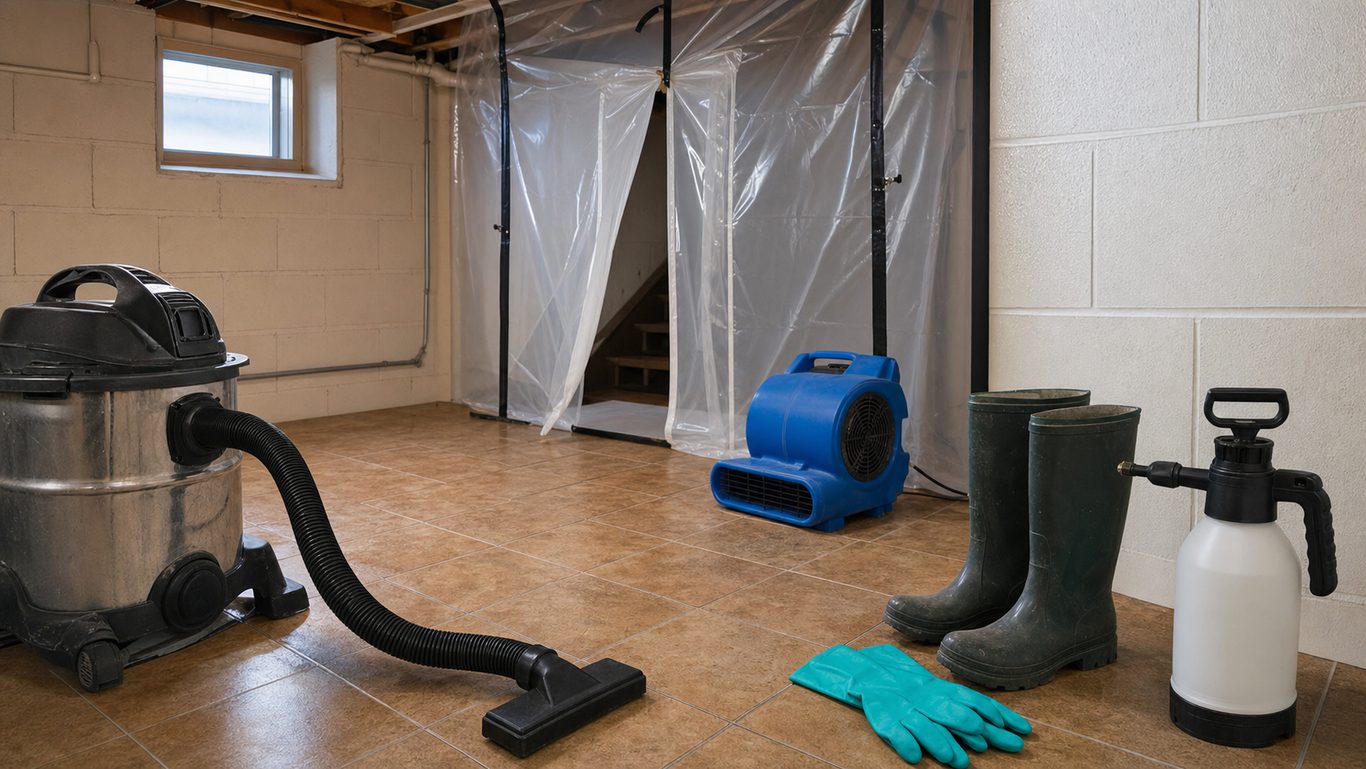
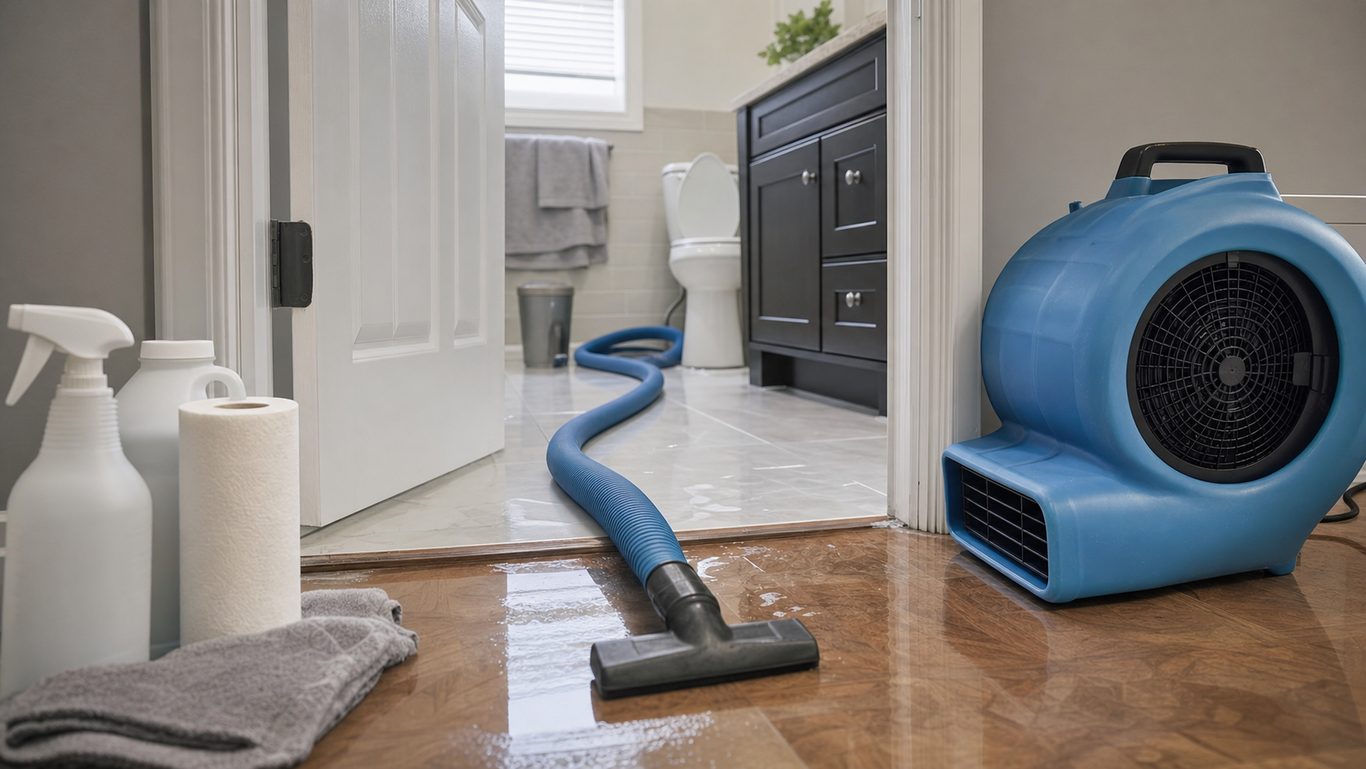
A standard wet-vac discharges air through an exhaust port that does not filter pathogens. Vacuuming raw sewage with a shop-vac aerosolizes the pathogens and distributes them across the room — the floor is now "clean" and the air is contaminated. Cat 3 extraction requires either truck-mounted equipment that exhausts outside the structure or a HEPA-filtered air-mover assembly. Neither is in a homeowner's garage.
Why bleach-and-mop fails
Sodium hypochlorite (household bleach) is a registered disinfectant on hard, non-porous surfaces under specific contact-time and concentration conditions. It does not penetrate porous materials (drywall, carpet, MDF, particleboard, untreated wood) and does not reach pathogens that have absorbed below the surface. Bleach-mopping a sewage-touched floor leaves contamination embedded in the substrate and dilutes a perception of safety that is not real.
Health risks: what exposure actually does
Sewage exposure causes a predictable range of illness. Children, elderly residents, pregnant women, pets, and anyone immunocompromised are disproportionately affected. Until the area has been professionally cleaned and disinfected, no one — and no pet — should enter without appropriate PPE.
Acute illness pathways
Gastrointestinal illness (nausea, vomiting, diarrhea, cramping) from ingestion of contaminated water or contaminated hands. Skin and wound infections from skin contact, especially through cuts or abrasions. Respiratory irritation and infection from aerosolized pathogens. Conjunctival exposure (eye contact) causing infection. Symptom onset is typically 12 to 72 hours after exposure for most pathogens; norovirus can hit in 12 hours, hepatitis A in 15 to 50 days.
Higher-risk groups
Children under 5 and adults over 65 face the highest rates of severe outcomes from gastrointestinal pathogens. Pregnant women face elevated risk from listeriosis and from pathogens that can cross the placenta. Pets — especially dogs that may drink standing water — can develop both bacterial and parasitic infections. Anyone immunocompromised (chemotherapy, transplant, HIV, autoimmune medication) faces a sharply elevated risk profile and should not be in the structure until clearance.
When to see a doctor
Any GI symptom that persists 48 hours, any fever above 101°F, any skin infection at a contact site, and any respiratory symptom that develops within a week of exposure warrant a call to your physician with explicit mention of the sewage exposure. Norman Regional Health System and OU Health both see sewage-exposure cases routinely; the documentation matters for both treatment and subsequent claim work.
What to do in the first hour
The first hour determines whether the loss stays manageable or escalates. Do not start cleaning. Do not flush. Do not run appliances that drain into the affected line. Here is the first-hour playbook.
Stop using anything that drains into the affected area
Don't flush toilets, run sinks, run the dishwasher, or run the washer. Each adds water to the failed line and pushes more sewage into the home. Identify the lowest fixture in the house — usually a basement floor drain, a basement-bath toilet, or a low-elevation tub — because sewage in a clogged main line backs up there first.
Isolate the area and ventilate carefully
Close interior doors to the affected rooms. Open exterior windows in the affected area to ventilate; do not run interior fans that push contaminated air into clean rooms. Keep the HVAC off — the duct system will distribute aerosols across the entire house if the blower runs.
Keep kids, pets, and anyone vulnerable out
Mark the affected area off. Children and pets are drawn to standing water; the exposure risk in the first hour is among the highest of any indoor scenario. Anyone immunocompromised should leave the building entirely until it is cleaned and disinfected.
Document, then call
Photograph the affected area from outside it — wide and mid shots of the standing water, the suspected source, the affected materials. Then call a Cat 3-capable restoration company. We dispatch to Norman 24/7 from our OKC home base; for active sewage emergencies see our Norman sewage cleanup service page.
PPE and equipment: what a real Cat 3 response looks like
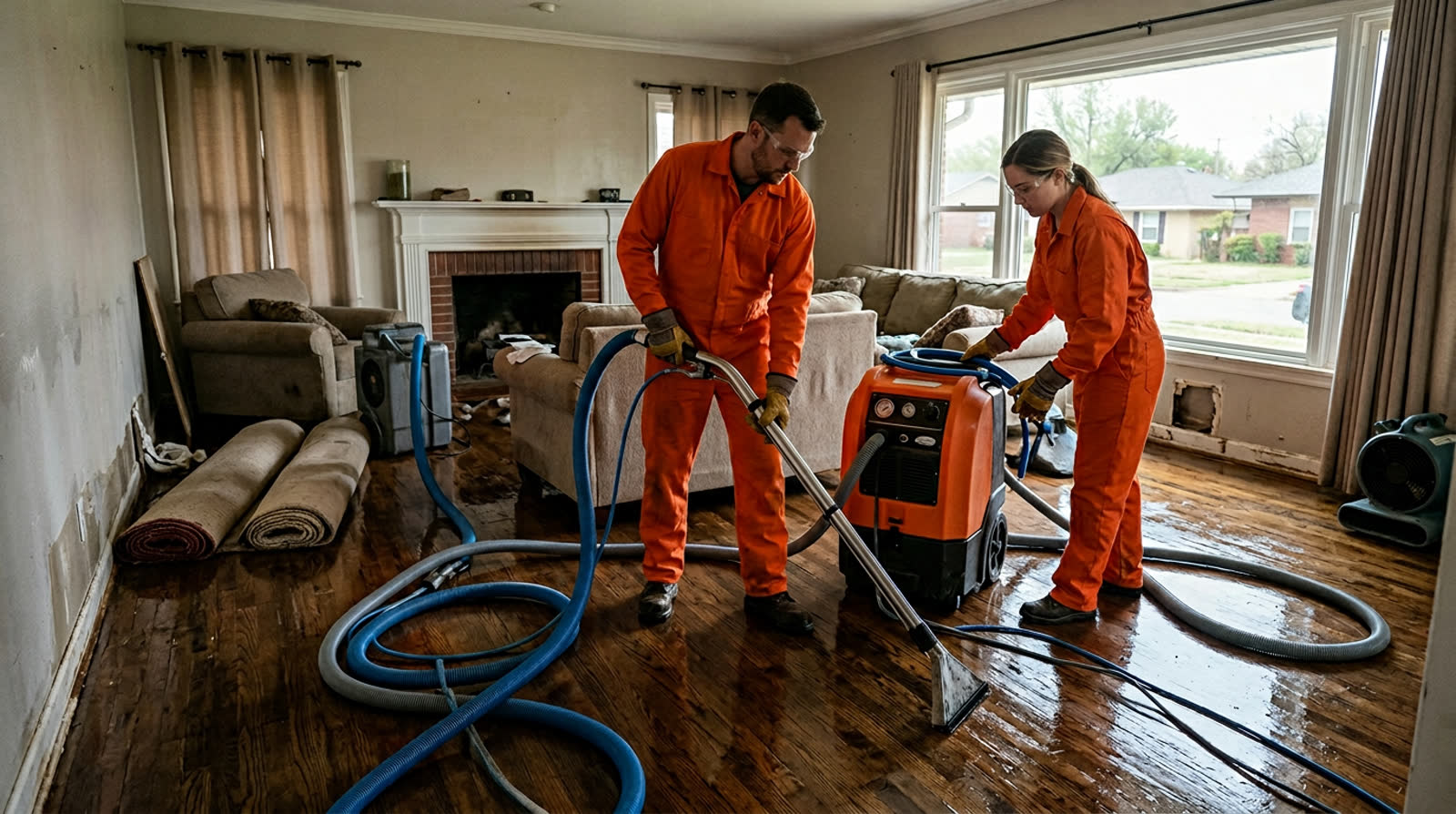
Professional Cat 3 response in Norman runs on specific PPE and specific equipment. Every Cat 3 job we run uses the same stack.
Personal protective equipment
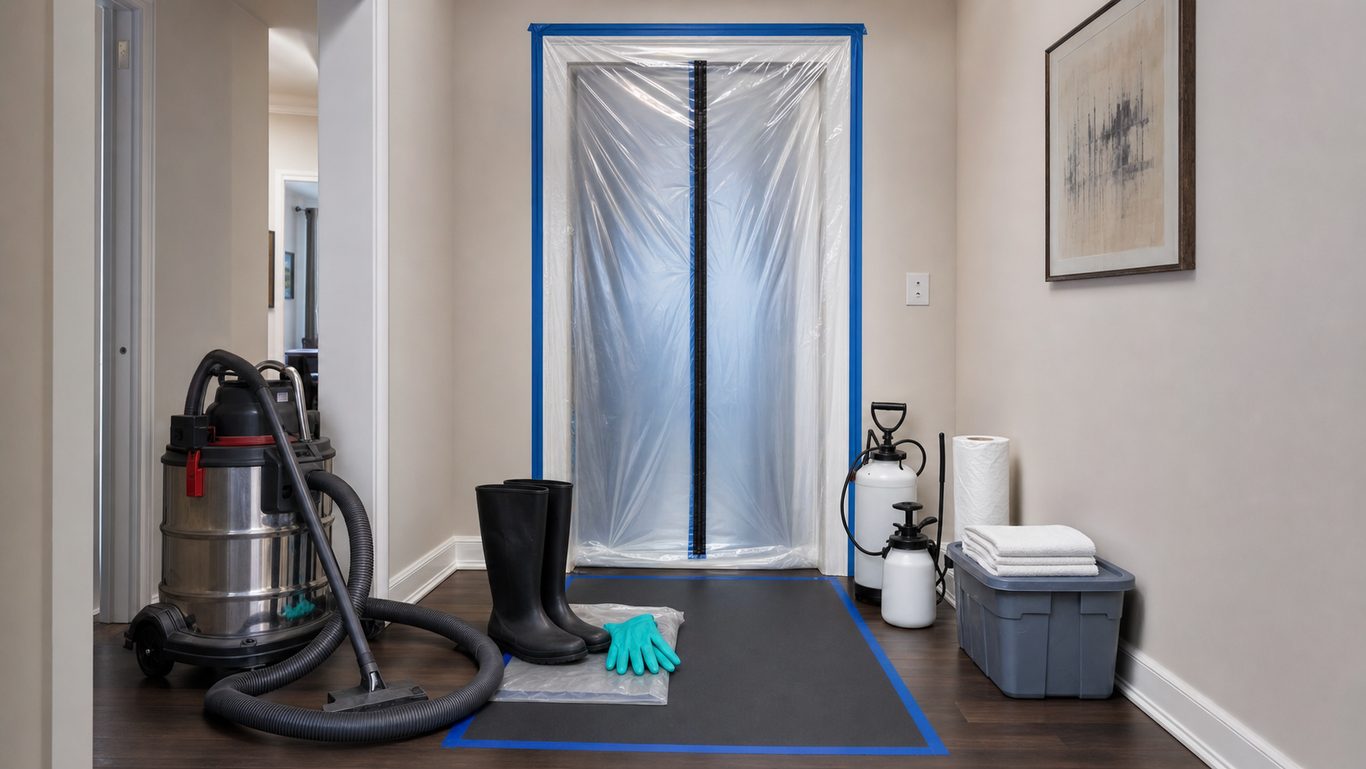
Disposable Tyvek or equivalent full-body suit with hood. Nitrile gloves under chemical-resistant outer gloves. Boot covers or dedicated rubber boots that don't leave the contained area. Full-face respirator with P100 + organic-vapor cartridges for occupants near aerosolized contamination, or a half-face respirator plus eye protection at minimum. PPE is donned and doffed at a decontamination chamber set up at the work-area boundary; PPE that has touched contamination does not exit the chamber except as sealed waste.
Containment and air management
Polyethylene sheeting walls isolate the affected rooms from the rest of the home. HEPA negative-air machines pull air from the contained area to outside, creating negative pressure that prevents aerosol migration into clean rooms. Air scrubbers run continuously inside containment. The HVAC system is off; supply and return registers in the affected rooms are sealed.
Extraction and disposal
Truck-mounted extraction with the discharge routed outside the structure to a sealed waste bladder or directly to an approved disposal point. We do not use the same extraction equipment on Cat 3 work that we use on Cat 1 (clean-water) jobs — Cat 3 equipment stays Cat 3. Solid contamination is bagged in red biohazard bags and disposed per Oklahoma Department of Environmental Quality (DEQ) guidance.
Disinfection
EPA-registered hospital-grade disinfectants applied at the contact time and concentration on the label. Surfaces are pre-cleaned (organic load removed) before disinfection — a disinfectant applied over solid contamination doesn't do its job. Disinfection covers every hard surface in the contained area: subfloor, framing exposed by demo, hard floors not removed, fixtures, and the lower 4 feet of any wall surface that remained.
Materials that always come out
Cat 3 contamination of porous materials is functionally permanent — disinfection cannot reach embedded pathogens in the substrate. The IICRC S500 protocol prescribes removal of porous materials touched by sewage. Here is what does not survive a sewage event in a Norman home.
Always removed
Carpet and pad. Drywall to a minimum of 24 inches above the high-water mark on every wall touched. Insulation behind affected drywall. Untreated wood subflooring where the sewage stood. MDF, particleboard, and laminate cabinets that absorbed water. Upholstered furniture that touched sewage. Mattresses that touched sewage. Foam-core anything. Books and paper goods that contacted sewage.
Sometimes salvageable
Solid hardwood may be saveable if the sewage was extracted within hours and the wood has not absorbed water deeply. Engineered hardwood (with composite core) typically delaminates and is not. Solid-wood cabinetry can sometimes be cleaned and refinished if the contamination did not penetrate the core. Tile floors are usually saved; the grout is steam-cleaned and sealed. Any salvage decision is contingent on disinfection access and post-cleanup verification.
Always removed but sometimes replaced in kind
Toilet wax rings if affected (always replaced as new). Floor registers and supply boots in the contaminated area (replaced new). HVAC filter (replaced; sometimes a coil cleaning is also required). Sometimes the trap and drain assembly under the contaminated fixture, depending on the cause.
Norman-specific causes we see
Norman has specific housing-stock and infrastructure patterns that drive certain sewage-backup scenarios more than others. Knowing the local pattern helps both response speed and prevention.
Older clay-pipe sewer laterals (east of Berry, central Norman)
Many Norman homes built before about 1980 have clay-tile or cast-iron sewer laterals from the house to the city main. Tree roots — especially from the mature elms and oaks that line older Norman streets — exploit the joints in clay pipe and gradually choke the line. We see periodic backups in these neighborhoods that follow heavy rains, when the partially-blocked line can't handle peak flow. A camera inspection followed by hydro-jetting or pipe-bursting replacement is the long-term fix.
Lift-station and city-main events
City-main blockages and lift-station failures during heavy storms occasionally back sewage into the lowest-fixture homes in a service area. These are City of Norman maintenance events; the homeowner's job is documentation and Cat 3 cleanup, not source repair. The City sometimes pays a portion of the cleanup when the cause is documented as a city-side failure — claim the homeowner files with their own carrier first, then a separate City of Norman claim for damages caused by the City's failure to maintain the main.
Failed sump pumps in finished basements
Norman has more basements than the OKC metro median, especially in older neighborhoods. Sump-pump failures during spring storms back groundwater (and sometimes sewage if the sump shares discharge with the sanitary line) into finished basements. Battery-backup sumps and float-switch maintenance prevent most of these.
Frozen sewer vents on extreme cold snaps
Less common but real: extended sub-freezing weather can ice-block the vent stack on the roof. With no air admission, drains glug and partial siphons cause unpredictable backups. The fix is roof-side de-icing and replacement vent caps. We see one or two of these per Norman winter.
Insurance: the sewer-and-drain backup endorsement
This is the most common, and most painful, gap we see in Oklahoma homeowner's insurance. Standard policies do not cover sewer or drain backups. The endorsement is cheap; the loss without it is brutal.
What the standard policy covers (and doesn't)
Standard Oklahoma homeowner's policies cover sudden and accidental water discharge from plumbing inside the home — a burst pipe, a failed supply line, an overflowing tub. They typically exclude water that backs up through a sewer or drain — the line that runs from your house to the city main, and the city main itself. A toilet overflow from inside the house is usually covered (sudden plumbing failure); a sewer backup pushing water up through the floor drain typically is not.
What the endorsement does
A water-and-sewer-backup endorsement (sometimes called a sewer/drain backup rider) adds coverage for water that enters the home through a sewer or drain line. Typical Oklahoma pricing: $50 to $150 per year for $5,000 to $25,000 of coverage. Most carriers offer multiple coverage tiers; the cost difference between $5,000 and $25,000 of coverage is often $30 to $50 a year — small money for a 5x coverage increase. Anyone with a basement, a finished basement, or a crawl space at a low grade in Norman should have this endorsement.
When the City of Norman is potentially liable
If the cause is a documented City of Norman main-line failure or maintenance lapse, the homeowner can sometimes recover damages from the City separately from the insurance claim. Documentation is the entire game: photographs of the source point, the City's maintenance log if available, and the cleanup invoice. The Norman city engineer's office handles initial intake on these claims; the timeline is typically 60 to 180 days.
Decontamination verification — what "clean" actually means
The end of a Cat 3 job is not when the visible contamination is gone; it is when verifiable cleanliness has been documented. The right verification protocol depends on the scope and the homeowner's risk profile.
Visual inspection plus moisture verification
Every Cat 3 cleanup ends with a visual inspection of the contained area against the original IICRC S500 protocol, plus moisture readings on every previously-wet material to confirm dryness back to the unaffected baseline. Dry, clean, and visually free of contamination is the floor.
ATP swab testing
ATP (adenosine triphosphate) swab testing measures organic residue on a surface. A 30-second swab plus a portable luminometer gives a relative reading of remaining organic load. Most carriers and most homeowners are satisfied with documented post-cleanup ATP readings below the threshold the disinfectant manufacturer cites for hospital-grade clean. Cost: $150 to $400 for a residential swab pass.
Surface microbial sampling
For higher-risk situations — immunocompromised resident, infant in the home, severe contamination scope — surface culture sampling from a third-party hygienist gives a gold-standard verification. Lab turnaround is 3 to 5 business days; cost runs $400 to $900 for a residential sample set. Most Oklahoma sewage cleanups don't require culture sampling; the ones that do are usually pre-discussed with the carrier and the homeowner before remediation begins.
Companion guides on this site: why mold grows after water damage and the 72-hour window, filing an Oklahoma water damage insurance claim, how much mold remediation costs in OKC, and the first 24 hours after water damage. Service-area pages: Norman, sewage cleanup in Norman, sewage cleanup overview, and our full Oklahoma service area.
Need help now? See our full Sewage Cleanup service page or browse all restoration services. Don't see your city above? The full Oklahoma service area covers 27 cities.
Local context for this article: see our Norman, OK restoration page and the Sewage Cleanup in Norman service page.
This guide also pairs with water damage restoration after the contamination is cleared and mold remediation that often follows sewage events.
Will my Oklahoma homeowner's insurance pay for a sewage backup cleanup in Norman?
Only if you have a sewer-and-drain backup endorsement. Standard Oklahoma homeowner's policies exclude water that backs up through a sewer or drain line. The endorsement typically costs $50 to $150 per year and adds $5,000 to $25,000 of coverage. Without it, sewage cleanup is out of pocket. Anyone with a basement, finished basement, or low-grade crawl space in Norman should add this rider before the next storm season.
Authoritative resources referenced
Need restoration help in Oklahoma?
24/7 dispatch, IICRC standards, direct insurance billing.