Why the first 24 hours decide everything
In Oklahoma City water damage cases, what happens in the first 24 hours determines whether the loss stays a manageable mitigation job or escalates into a full mold remediation plus structural repair. Mold spores are everywhere in the air. Give them standing water, organic material like drywall and wood, and 24–48 hours of warm temperatures, and you have an active colony. The IICRC's S500 standard treats 72 hours as the upper bound — past that, secondary damage is the rule, not the exception.
Inside the first 24 hours, the goal is simple: stop the water source, document everything, and start drying. The order below is the same playbook our crews run every day across the OKC metro — Bethany, Edmond, Mustang, Yukon, Moore, Norman, Midwest City, Del City, and the central Oklahoma City ZIPs (73008, 73012, 73099, 73107, 73112, 73118, 73127, 73132, 73159, 73170).
Two cost realities are worth flagging up front. First, the average homeowner's deductible in Oklahoma is $1,000–$2,500 — and a contained loss caught inside 24 hours typically lands close to that number out-of-pocket. Second, a loss that breaches 72 hours and grows mold routinely doubles or triples in scope, hitting the $5,000–$10,000 mold sub-limit on most Oklahoma policies. The 24-hour playbook isn't just about the house. It's about the policy.
Hour 1: Stop the source and shut off power
If the leak is from a fixture, valve, or appliance you can isolate, isolate it. If you can't find the source, shut off the main water valve to the house — usually outside near the meter or inside a utility area. In OKC, most pre-1995 homes have the main shutoff at the meter pit near the curb (you'll need a 12-inch meter key, available at any Lowe's or Home Depot for under $15). Newer Deer Creek, Quail Creek, and Mustang builds typically have an interior shutoff in the garage or a mechanical closet.
Electrical safety in the first 60 minutes
Water near electrical outlets, light fixtures, or the breaker panel? Cut power to those circuits at the breaker before anyone walks through the affected area. Standing water plus live circuits is how people get hurt. If the breaker panel itself is wet, do not open it — call OG&E (1-800-272-9741) for a service disconnect at the meter and stay outside the structure until a licensed electrician confirms the panel is safe.
What to do if you can't find the shutoff
Call OKC Water Utilities Trust at (405) 297-2833 for a curb-stop shutoff at the city meter. After-hours emergencies route to dispatch. The crew typically arrives in 60–90 minutes. While you wait, contain spread: towels and rags at door thresholds, plastic sheeting over furniture you can't move, buckets under active drips.
Hour 2: Document everything before you move anything
Photograph and video every wet surface, ceiling, wall, floor, and damaged contents. Adjusters need this. Contractors need this. Future you needs this. The pattern that works:
- Wide shots — every affected room from each corner, before any cleanup.
- Mid shots — each affected wall, the floor pattern of standing water, ceiling stains.
- Close-ups — serial number plates on appliances, the failed fitting or supply line, brand labels on flooring, water-line stains on baseboards (use a coin or a ruler for scale).
- Video walkthrough — narrate as you walk: room, source, time, what you've already done. Phones lose this metadata when shared by text — keep the originals.
What carriers actually look at
Adjusters open every claim by reviewing pre-mitigation photos. The two questions: (1) is the cause sudden and accidental, and (2) is the scope of damage what the contractor is invoicing? Photos that answer both questions move claims faster. See our step-by-step Oklahoma water damage insurance claim guide for the full documentation pattern.
Saving everything digitally
Email the photos to yourself before you do anything else. Phones get lost during chaotic mitigation. A folder in Google Photos or iCloud titled with the date and address is the simple version that works.
Hour 3-6: Call your insurance and a restoration company in parallel
Both calls happen now — not sequentially. Your homeowner's insurance opens the claim and assigns an adjuster. The restoration company starts mitigation. Most policies require you to take reasonable steps to prevent further damage; hiring a restoration company is exactly that.
What to ask your insurance carrier
- Claim number and adjuster contact info.
- Is mitigation pre-approved up to a stated amount before the adjuster inspects?
- Does the policy include Additional Living Expenses (ALE), and if displacement is required, what's the cap?
- Is there a mold sub-limit (typically $5,000 or $10,000 on Oklahoma policies)?
- Is there a sewer-and-drain backup endorsement on this policy?
What to ask the restoration company
- Are they IICRC-certified for S500 water restoration?
- Will they bill insurance directly?
- Do they handle reconstruction in-house, or only mitigation?
- What's the typical drying timeline for this scope?
Mitigation and rebuild are typically two phases of one claim — see our explainer on water mitigation vs. water restoration for the line-item difference.
Hour 6-24: Extract, demo, and start commercial drying
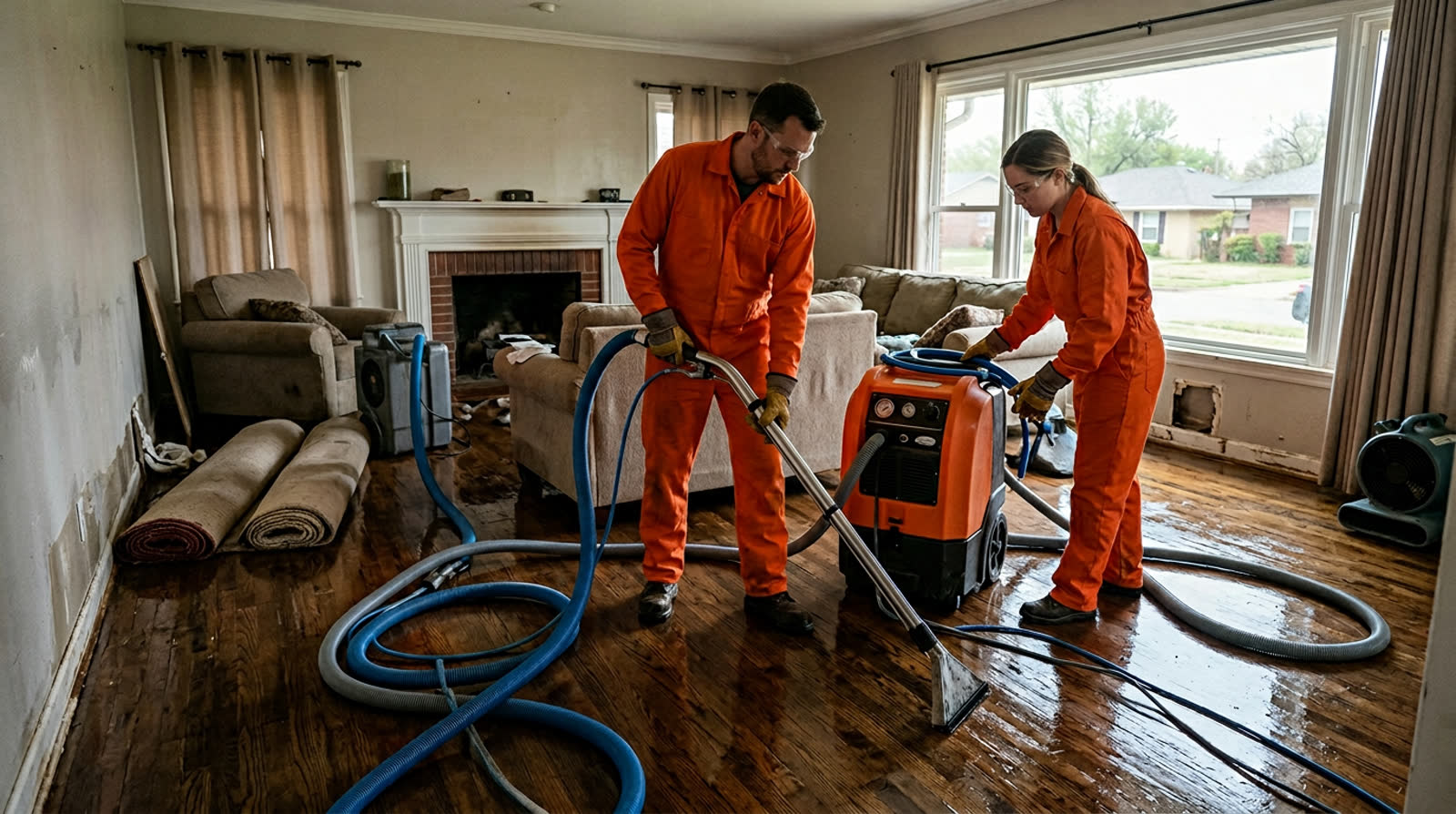
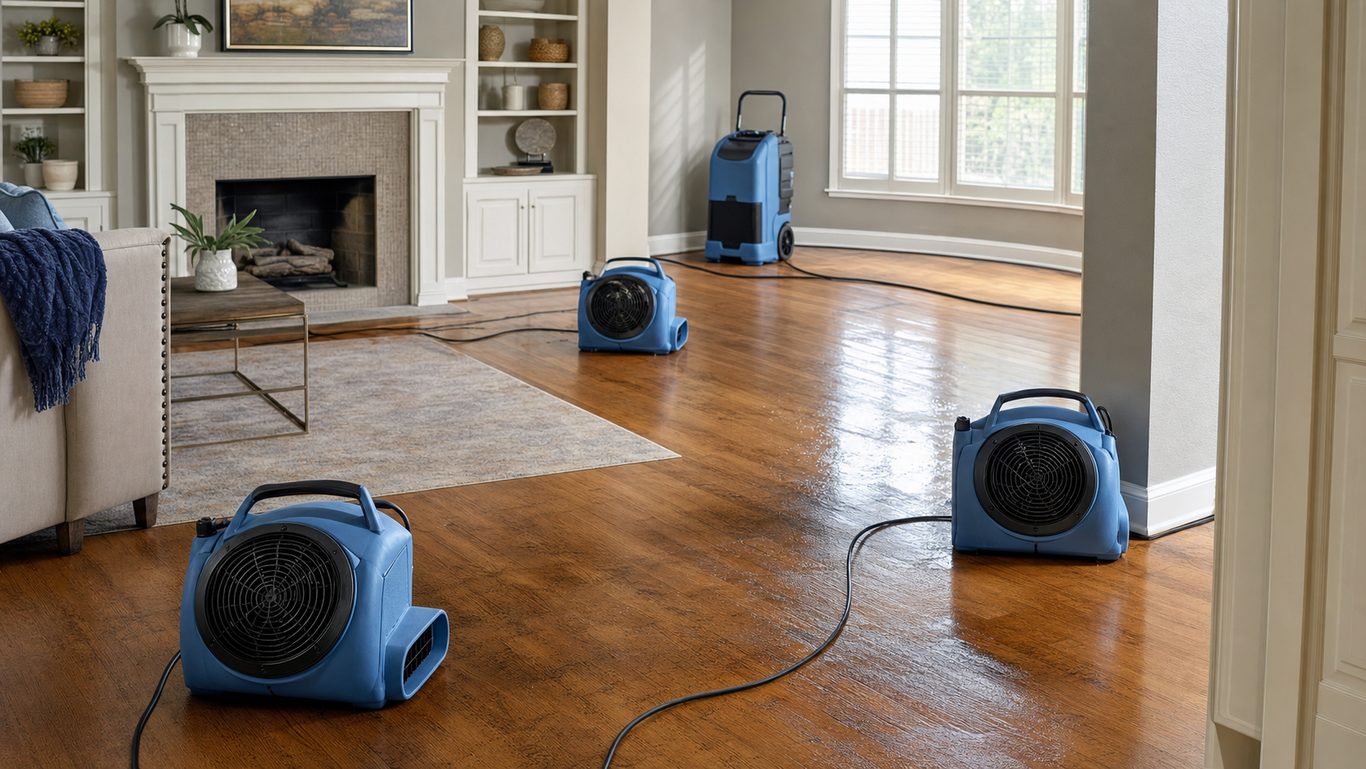
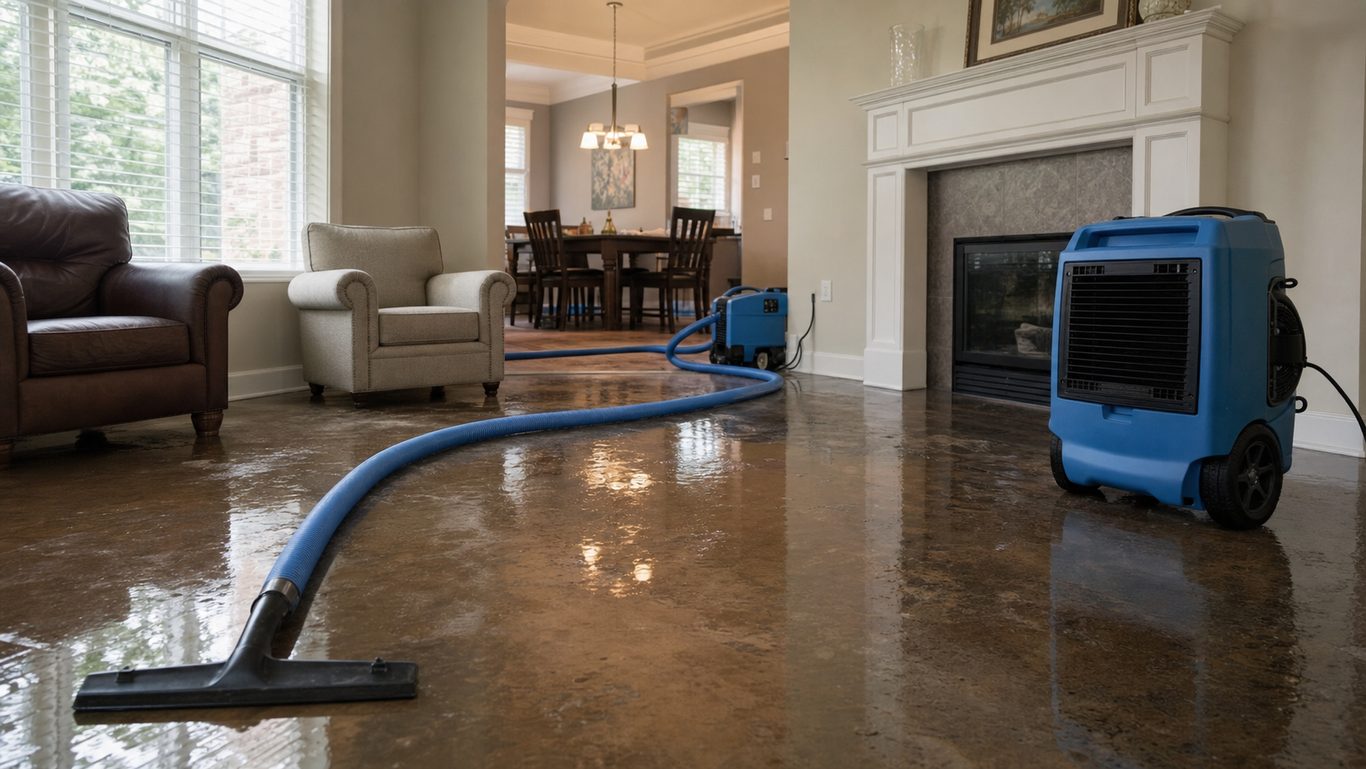
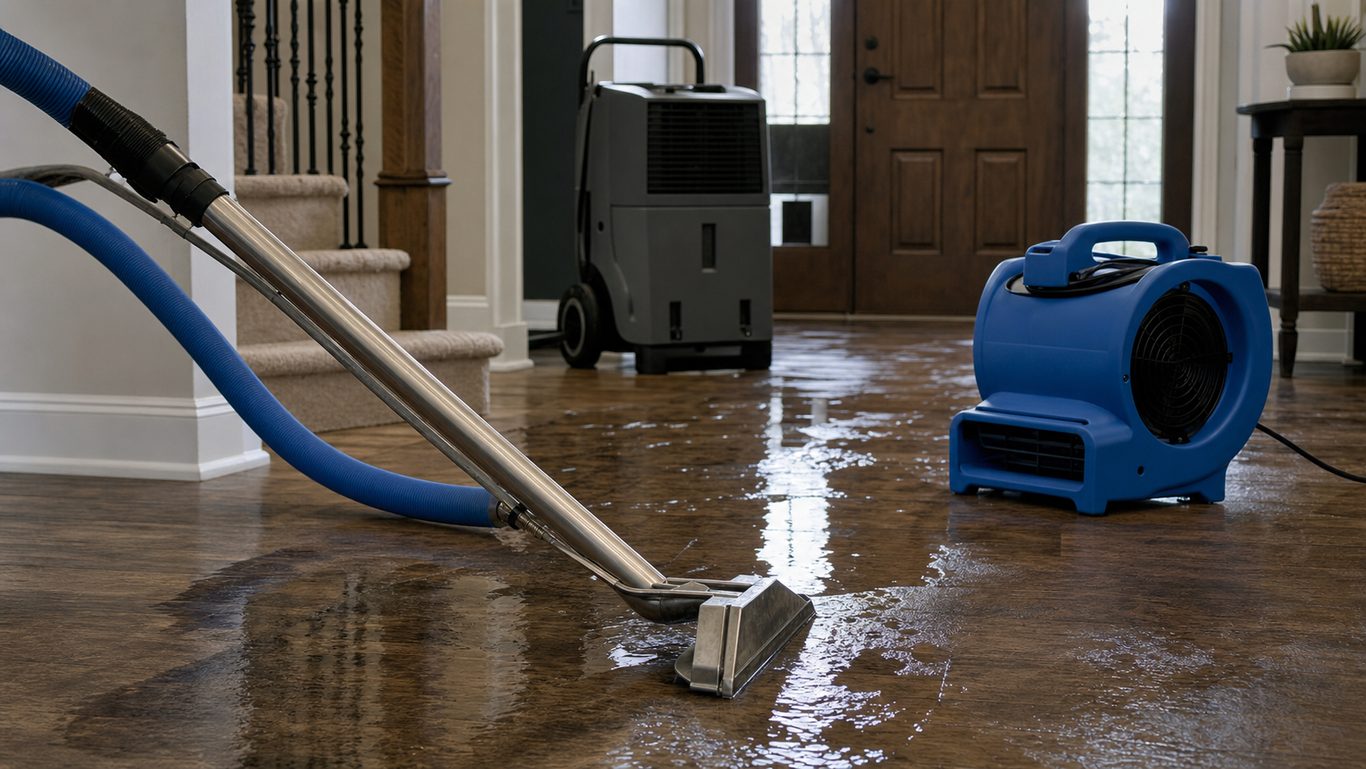
Standing water gets pumped out with truck-mounted extractors moving 200+ gallons per minute — orders of magnitude faster than any shop vac. Wet carpet pad almost always needs to come out; it doesn't dry well and traps moisture against the subfloor. Air movers and commercial dehumidifiers go in within hours.
What "commercial drying" actually means
The math: a residential box fan moves about 1,500 cubic feet per minute (CFM). A commercial air mover moves 2,500–3,500 CFM and is angled for laminar flow across wet surfaces. A residential dehu pulls 30–50 pints per day; a commercial low-grain refrigerant (LGR) dehu pulls 80–150 pints, and a desiccant on a large loss can pull 200+. Air movers are placed every 10–14 feet, dehus are sized to the room volume in cubic feet, and moisture readings get logged daily.
What "dry" looks like in numbers
Wood framing: 16% moisture content or below (a baseline reading from a dry area in the same house sets the target). Drywall: within 1% of the unaffected dry standard, measured with a pin meter. Concrete slab: relative humidity in the slab below 75% on an in-situ probe. We log these every 24 hours and adjust the equipment until targets are met.
What gets demolished, and what gets dried in place
Carpet pad always comes out. Carpet itself usually stays if the water was Category 1 (clean, sudden). Drywall comes out below the water line — typically 12–24 inches, full sheet replacement above. Insulation in wet wall cavities comes out (saturated insulation has zero R-value and mold grows in it). Hardwood flooring is usually dried in place with floor mats; engineered laminate almost always comes out. Cabinets that absorbed water at the toe-kick get pulled.
Common Oklahoma City causes by season
The cause matters because the response varies. The five most common water losses we see in OKC, ranked:
- Supply-line failures (year-round, #1): washing machine hoses, dishwasher supply, refrigerator ice-maker line, toilet supply. Replace washing machine hoses every 5 years or use stainless-braided lines.
- Winter freeze breaks (December–February): pipes in exterior walls, garage walls, and unheated crawlspaces. The 2021 Texas/Oklahoma freeze remains the high-water mark for OKC pipe failures; below 10°F we run on 24-hour dispatch.
- Slab leaks on hot-water lines (year-round): common in pre-1990 OKC homes built with copper hot lines under the slab. Watch for warm spots on the floor and unexplained water-bill jumps.
- Roof leaks during storms (March–June): the OKC severe-weather season. See our storm damage playbook for hail and wind specifics.
- HVAC condensate overflows (May–September): failed primary drain pan, clogged drain line, missing or damaged secondary pan. Annual HVAC service heads this off.
When to leave the house
Most water losses are not evacuation events. Three situations are:
- Category 3 (black water) — sewage backup, river/floodwater intrusion, water sat for >72 hours. See our sewage cleanup service page and the Norman sewage backup health risks guide.
- Structural concerns — sagging ceilings, soft floors, visibly bowed walls, or a roof that took weight from collapsed insulation. Get out, call a structural inspector before re-entry.
- Active electrical hazard — wet panel, wet outlets near standing water, signs of arcing or burning insulation smell. Cut the main, leave, call OG&E.
If you're displaced, your policy's ALE coverage typically pays for hotel, meals out, and pet boarding against documented receipts. Save every receipt and keep a daily log.
What to expect on day 2 through day 5
Day 2: dehus and air movers running 24/7, daily moisture readings, removal of unsalvageable contents to a pack-out facility. Day 3: most surfaces showing measurable progress; ceiling drywall decisions made (sag means demo). Day 4: framing and substrate readings approach dry standard. Day 5: equipment removed, final readings logged, transition meeting with adjuster scheduled. The rebuild phase — drywall, paint, flooring, trim — typically starts inside week 2 and runs 3–8 weeks depending on scope.
Three signs the loss is going badly
(1) Musty odor on day 3 — drying is incomplete or a cavity was missed. (2) Drywall still soft to the touch — extraction was inadequate. (3) Daily moisture readings flat or rising — dehu sizing is wrong. Any of these and the contractor needs to escalate equipment, not stay the course.
Where the rebuild bill typically lands
For a single-room OKC water loss caught inside 24 hours, total bill (mitigation + rebuild) usually runs $4,500–$9,500. Whole-floor losses run $12,000–$28,000. Whole-house or large-loss situations exceed $50,000. The split is roughly 25–35% mitigation, 65–75% rebuild on the dollar value, but mitigation is the urgent phase. Insurance covers both phases under one claim, with the homeowner's out-of-pocket typically just the deductible — see our Oklahoma claim filing guide for the full payment sequence and how ACV/RCV holdbacks work in practice.
How drying actually works — psychrometry in plain language
Commercial drying isn't just "more fans." It's a controlled physics problem: pull moisture out of saturated materials into the air, then pull moisture out of the air with dehumidification, and balance the two so the room moves toward dryness instead of just shuffling water around. The IICRC S500 standard codifies the math.
Grains per pound (GPP) — what techs actually watch
GPP is the absolute moisture content of the air. The drying target on most OKC residential losses is to keep the affected room's GPP at least 5 grains lower than the saturation point of the wet materials, and 10–20 grains lower than the outside air. A hygrometer reading of 90 GPP inside vs. 70 GPP outside means the dehu is undersized or there's a continuing moisture source. Daily readings catch this on day 2; weekly readings catch it after the materials have already grown mold.
HVAC vs. desiccant dehus
Most OKC residential losses use low-grain refrigerant (LGR) dehus, which work efficiently down to about 50 GPP at typical room temperatures. For Class 4 losses (saturated dense materials like concrete slabs, hardwood, or thick wood subfloor), desiccant dehumidifiers can drive GPP below 30 — the only practical way to dry concrete to S500 targets in under 14 days. Desiccants are louder and pull more power; LGRs are the daily workhorses.
Why "dry the air" isn't the same as "dry the materials"
Air is fast; materials are slow. A dehu can pull a room down to 40% relative humidity in a few hours, but the wet drywall, framing, and subfloor will keep releasing moisture for days. The technician's job is to keep the room dry enough that materials lose moisture into the air faster than they can re-equilibrate. Pull the dehu out too soon (when only the air feels dry) and the materials re-wet themselves overnight as moisture re-equilibrates.
Working with insurance during the first week
The first 24 hours sets the documentation baseline; the next six days is when most of the claim's flow happens. Knowing the carrier's expectations heads off the disputes that delay payment.
The mitigation pre-approval phone call
On day one, the call to the carrier should produce a verbal pre-approval for mitigation up to a stated dollar amount — typically $2,500–$10,000 depending on the carrier and the apparent scope. Ask for the pre-approval number in writing (email or claim portal). If the carrier won't pre-approve, that's a flag, but it doesn't change what you do — the duty to mitigate still requires you to start drying. Document the conversation if you proceed without a pre-approval.
Day 2–5 documentation the adjuster expects
- Daily moisture readings logged in writing — wood framing, drywall, sub-floor — at the same probe points each day.
- Equipment counts on-site each day (number of air movers, dehus, scrubbers).
- Photos of demo before disposal — saturated insulation, removed carpet pad, drywall demo.
- Receipts for any homeowner out-of-pocket emergency spending (hotel, meals if displaced, fans or supplies before the crew arrived).
The transition-to-rebuild meeting
Around day 5–7, schedule a walkthrough with the adjuster, your contractor, and you. The contractor presents the moisture log, the equipment timeline, the demo scope, and the proposed rebuild scope. Most disputes that surface here trace back to documentation gaps from days 2–4 — which is why the daily-log discipline matters even when nothing seems wrong.
The full claim playbook is in our Oklahoma water damage insurance claim guide; the mitigation/restoration billing split is covered in water mitigation vs. water restoration.
Need help now? See our full Water Damage Restoration service page or browse all restoration services. Don't see your city above? The full Oklahoma service area covers 27 cities.
Local context for this article: see our Oklahoma City, OK restoration page and the Water Damage Restoration in Oklahoma City service page.
This guide also pairs with emergency water mitigation and mold remediation when drying is missed.
Will my Oklahoma homeowner's policy pay for emergency mitigation in the first 24 hours?
Yes, in almost all cases. Standard Oklahoma homeowner's policies include a duty to mitigate, which means the carrier expects you to start extraction, drying, and demo immediately and reimburses reasonable mitigation costs even before an adjuster inspects the loss. We bill mitigation directly to all major carriers (Allstate, State Farm, USAA, Liberty Mutual, Farmers, Travelers, Progressive, Nationwide), document every step photographically and with moisture logs, and supply Xactimate-formatted invoices your adjuster expects.
Authoritative resources referenced
Need restoration help in Oklahoma?
24/7 dispatch, IICRC standards, direct insurance billing.