Why smoke odor lives so long in Moore homes
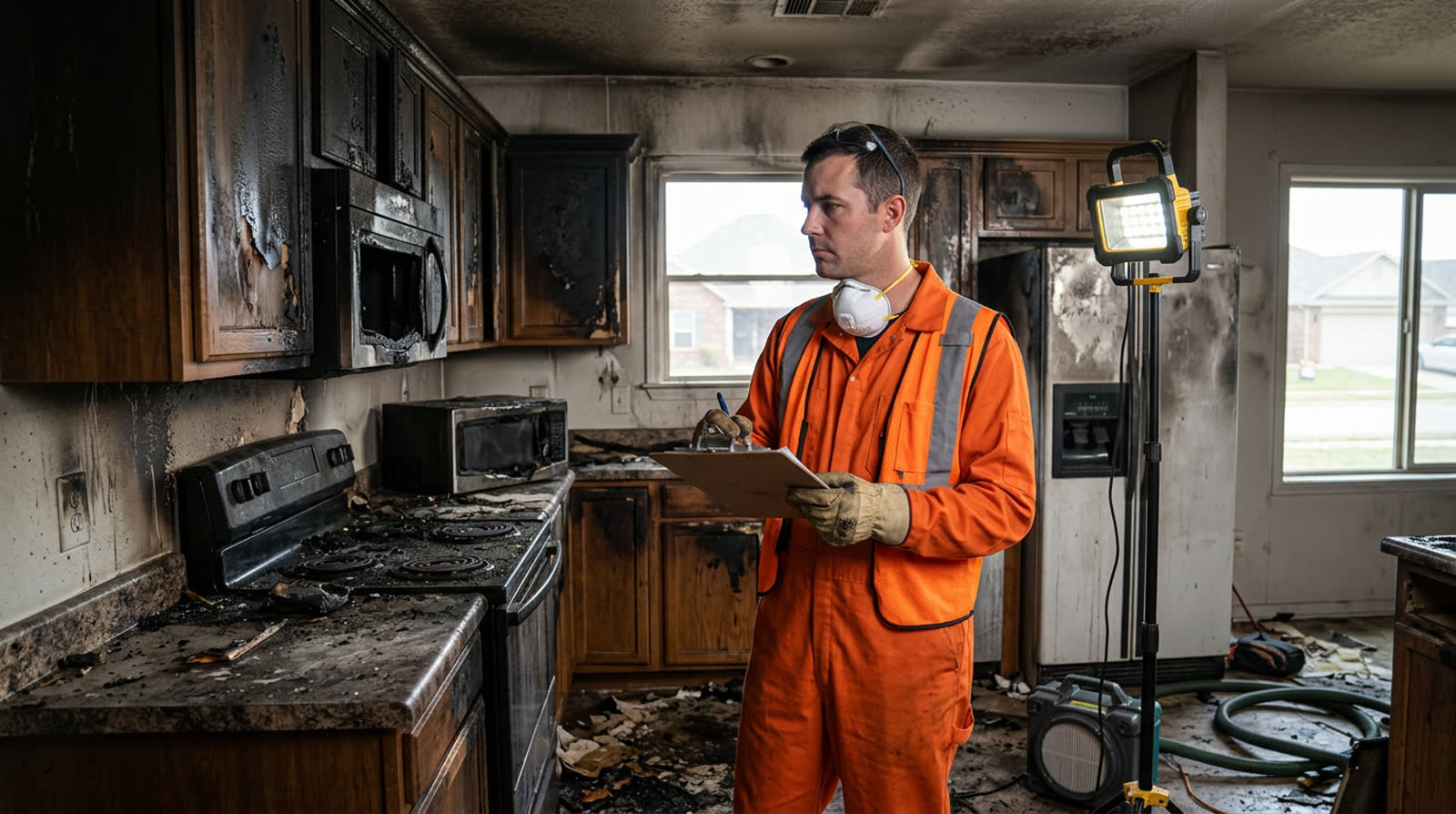
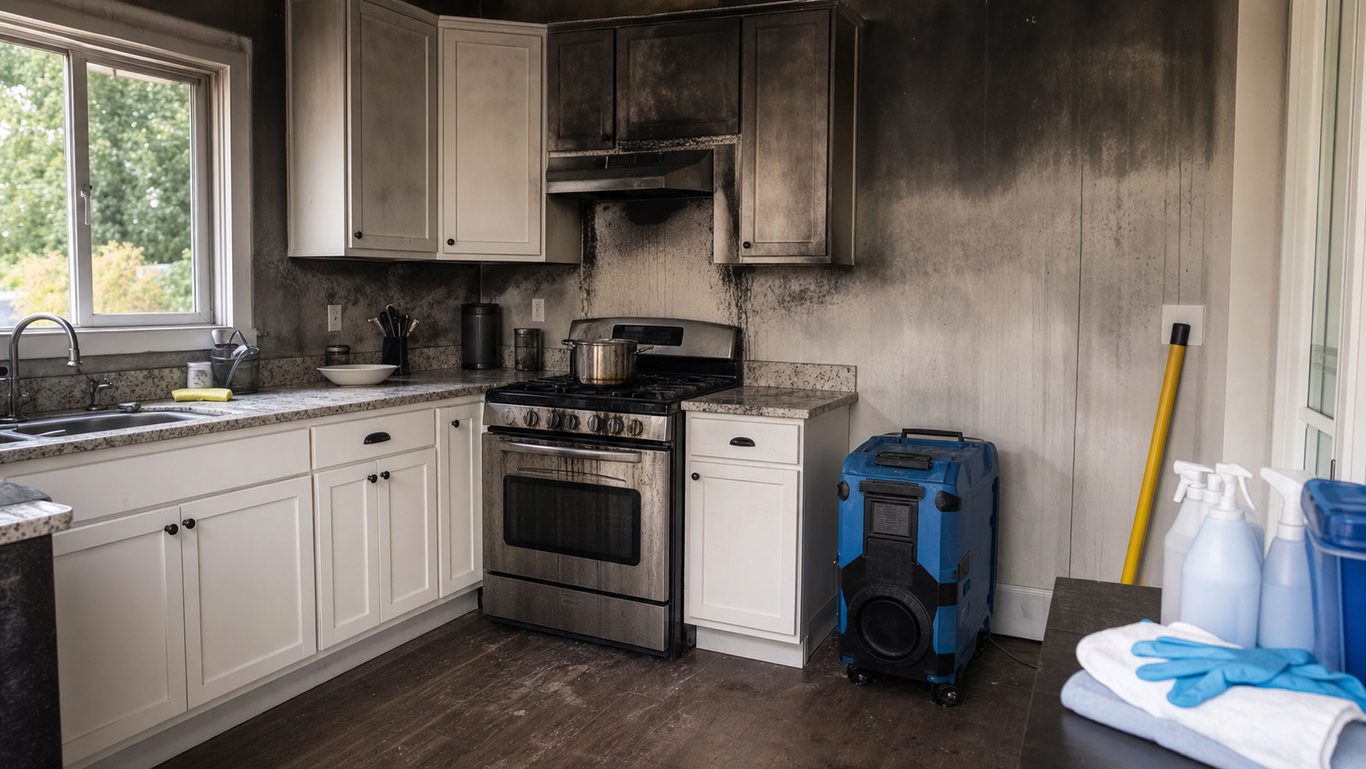
Smoke is more than visible soot. It's microscopic particles and gaseous compounds — phenols, aldehydes, sulfur compounds, and partially combusted hydrocarbons — that absorb deep into porous materials: drywall, insulation, framing, carpet, fabrics, HVAC ductwork. Painting over smoke residue without proper cleaning and sealing locks the odor in temporarily, then it bleeds back out within 4–12 weeks as the paint cures and breathes. This is the single most common reason a Moore homeowner calls a second contractor: the first one painted, and the smell came back.
The three smoke categories under IICRC S700
The restoration industry classifies smoke residue into three categories based on the fuel source. Each category requires a different cleaning strategy.
- Protein smoke — kitchen fires (grease, food, meat) and pet-related fires. Yellow-brown haze, sharp odor, deep absorption into porous materials. Requires aggressive degreasing and the most time-intensive deodorization.
- Complex/wet smoke — low-temperature smoldering fires of mixed materials (synthetics, plastics, soft furnishings). Sticky residue, strong chemical odor, often requires solvent-based cleaners.
- Natural/dry smoke — high-temperature fast-burning fires of paper, wood, and natural materials. Fine powdery residue, lighter odor, generally the easiest category to clean.
Most residential fires in Moore are mixed wet/dry — kitchen fires that spread to a living room are common, and post-2013 tornado rebuild homes use a high proportion of synthetic materials (engineered floors, vinyl trim, MDF cabinets) that smolder rather than burn cleanly.
Why HVAC is the #1 odor spreader in Moore homes
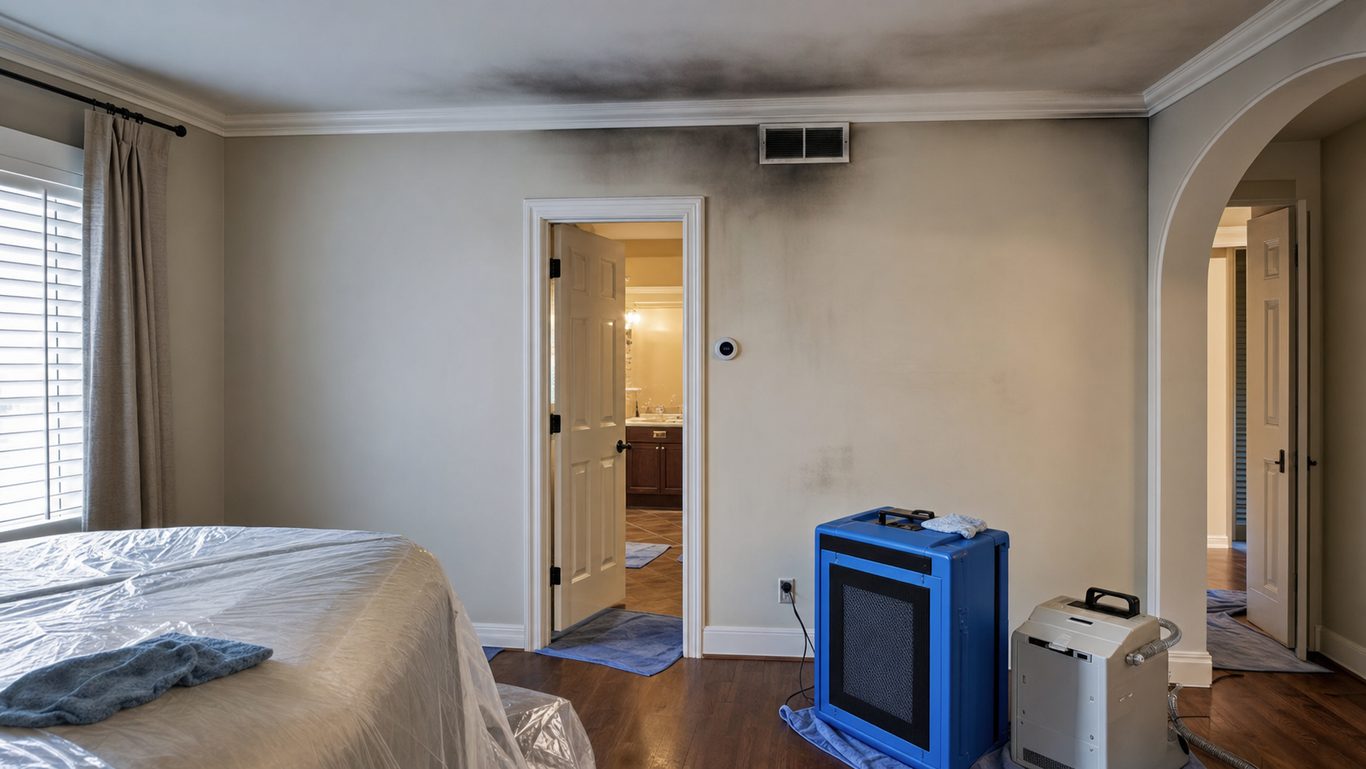
If the HVAC ran for even a few minutes during or after the fire, soot is now coating every duct surface from the air handler all the way to every supply register. Every time the system cycles — air conditioning in July, heat in January — it reaerosolizes the odor compounds and redistributes them throughout the home, including rooms the fire never reached. This is why a "cleaned and painted" home smells fine for two weeks, then the smell returns the first hot week of summer when the system runs continuously.
Moore housing stock and shared duct designs
A meaningful share of single-family homes in Moore were built or rebuilt in the wave following the 1999 and 2013 tornadoes. Those rebuilds use fairly consistent HVAC designs: an air handler in the attic, flexible insulated supply ducts running through the attic to ceiling registers, and a single return at hallway level. That layout means soot deposited in the attic ductwork sits directly above every bedroom — and gravity plus negative pressure during cooling cycles brings odor right back into the living space.
NADCA-standard duct cleaning
Source-removal duct cleaning under NADCA ACR-2021 standards is the right protocol for a post-fire HVAC system. Steps:
- Inspect with a borescope and document soot loading throughout the system
- Seal supply and return registers, then negative-pressure the ductwork
- Brush the duct interior with rotating-brush cables sized to each duct diameter
- HEPA-vacuum all loosened residue
- Replace the HVAC filter, and replace the blower wheel and motor if soot has loaded the squirrel cage
- Apply EPA-registered antimicrobial coating to interior duct surfaces if specified by the carrier
Total time for a typical 1,800–2,400 sqft Moore home: 4–8 hours.
Step 1: Source removal — what comes out before any cleaning
Anything that absorbed heavy smoke and can't be washed effectively comes out before cleaning starts. Trying to deodorize a room with the contaminated insulation still in the attic, or the carpet pad still on the floor, or the saturated drywall still on the framing, is a guaranteed odor-rebound job.
Always removed
- Burned and heavily charred materials (drywall, framing, sheathing in the fire's direct path)
- Carpet pad in heavily affected areas — pad never deodorizes effectively
- Batt or blown-cellulose insulation in any cavity exposed to smoke
- HVAC filters (every time, no exceptions)
- Fabric upholstery that can't be ozone-treated off-site
- Mattresses, pillows, and any closed-cell foam exposed to protein smoke
- Particle-board and MDF furniture or cabinetry
Sometimes removed, depending on smoke type
- Drywall in rooms with heavy smoke webbing — wet smoke and protein smoke often penetrate gypsum core; dry smoke usually cleans off the paper face successfully
- Carpet (not just pad) in rooms adjacent to the fire origin
- Curtains, blinds, and window treatments
- Books, papers, and uncoated office materials
Step 2: Cleaning every salvageable surface
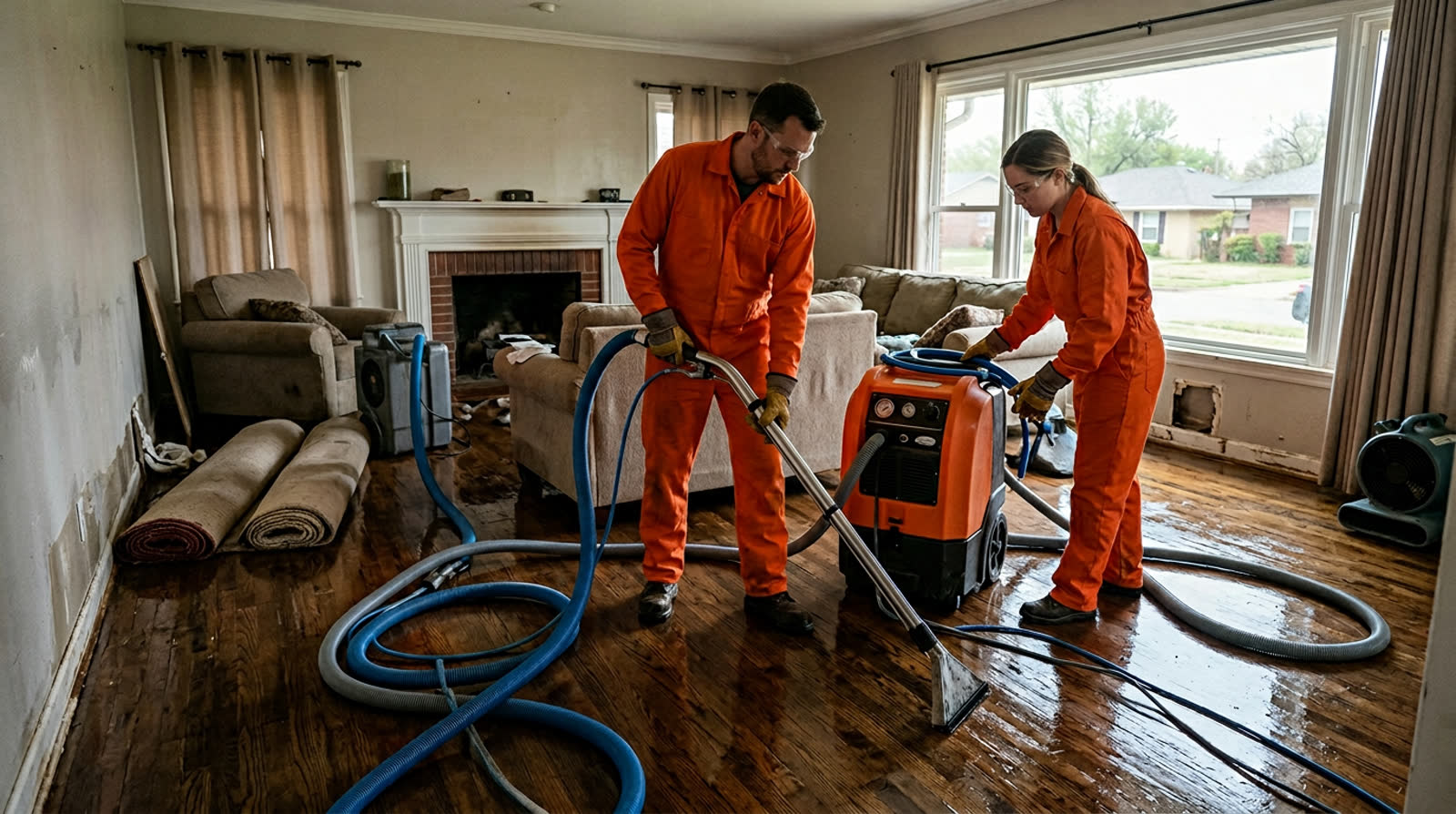
Hard surfaces get dry-sponge cleaning first to lift loose soot — wiping with water before dry-sponging smears the soot and sets stains. Then wet cleaning with specialized fire-damage degreasers and deodorizers. Fabrics that can be salvaged go to specialty cleaning at our facility, not on-site.
The dry-sponge first rule
Chemical sponges (vulcanized rubber blocks) lift dry soot from non-porous surfaces — walls, ceilings, hard furniture, light fixtures — without water. This is critical: water on dry soot turns it into a paste that smears into the substrate and sets. Dry-sponge first, then wet-clean. The IICRC S700 standard specifies this order for every fire job.
What gets wet-cleaned and with what
- Walls and ceilings (after dry-sponging): alkaline degreaser like Unsmoke Degrease-All or equivalent, applied with a sponge mop, rinsed with clear water
- Cabinets and trim: mild detergent first, then a wood-safe deodorizing cleaner
- HVAC components: as detailed above, NADCA-standard source removal
- Hard floors: degreaser then a thermal fog or hydroxyl pass
- Light fixtures and switches: remove from the wall, ultrasonic clean off-site
Soft contents pack-out
Salvageable soft contents (clothing, drapes, bedding, area rugs) leave the home in sealed bags and are processed at our cleaning facility under controlled conditions. Trying to clean soft contents on-site means they reabsorb odor from the still-contaminated structure within hours. Off-site processing also lets us run an ozone chamber on each load — far more effective than a single ambient ozone treatment in the home.
Step 3: Air-side treatment — hydroxyl, ozone, and thermal fogging
Once cleaning is complete, the air-side treatment phase breaks down volatile odor molecules at the chemical level. This is what gets the lingering "fire smell" out of materials that can't be physically replaced — framing, sheathing, sub-floor, hardwood, masonry.
Hydroxyl generators
Hydroxyl generators use UV light to convert ambient water vapor into hydroxyl radicals, which break down odor compounds the same way they're broken down in the natural atmosphere. Hydroxyl is safe in occupied spaces — slower (3–7 days for full cycle) but doesn't displace residents. We run hydroxyl during active cleaning when the homeowner may still be cycling in to retrieve items.
Ozone generators
Ozone (O₃) is a stronger oxidizer than hydroxyl and works much faster (24–72 hours), but it's a respiratory irritant and requires the home to be unoccupied with HVAC off and pets removed during the cycle. Ozone is the typical final deodorization step on a Moore residential fire job, run for 48–72 hours after cleaning is complete and the family is in temporary housing under their ALE coverage.
Thermal fogging
Thermal fogging vaporizes a deodorizing solvent at the same temperature smoke was created, which means the fog penetrates the same paths smoke took into porous materials. It's used as a follow-up when ozone alone isn't enough — primarily on protein-fire jobs and on attic spaces where insulation was retained.
What you cannot DIY in this phase
Big-box-store ozone units (under $200) move 3,000–6,000 mg of ozone per hour and are designed for car interiors and small rooms. Professional units run 20,000–60,000 mg/hr and have to be sized to the cubic-foot volume of the home. Homeowner ozone units used in a 2,000 sqft Moore home for a few hours produce an odor "mask" that fades within weeks and leaves the underlying contamination untouched.
Step 4: Sealing the substrate — why this step is non-optional
Once cleaning and deodorization are complete, framing, subfloor, and any other newly exposed wood gets a coat of odor-locking sealing primer (B-I-N or similar shellac-based primer). This locks any residual smoke compounds in the wood so they can't bleed out and re-contaminate new finishes. This is the single most important step in preventing odor rebound — and the step amateurs and underbudgeted contractors skip most often.
Why shellac specifically
Latex primers are breathable. Oil-based primers are partially breathable. Shellac is non-breathable — once cured, it's a vapor barrier that residual smoke compounds in the substrate cannot pass through. Two coats of B-I-N (or equivalent shellac-based pigmented primer) on every exposed framing surface before drywall is the difference between a home that smells fine in a year and a home that's still off-gassing through the next summer.
What gets sealed
- All exposed framing studs, top plates, and bottom plates in any wall that had drywall removed
- Roof sheathing in attic spaces where insulation was removed
- Subfloor (top side) before any new flooring is installed
- The back of any drywall that was retained but had heavy smoke contact on the other face
- Stairwell stringers, exposed rim joists, and any structural lumber in unfinished spaces
Step 5: Reconstruction with the right finish sequence
New drywall, paint, flooring, trim. With cleaning, sealing, and HVAC handled correctly, the new finishes won't pick up odor. The reconstruction sequence matters: do not install carpet pad and carpet until at least 7 days after the final ozone cycle and substrate sealing are complete. Carpets are absorbent; if there's any residual odor in the structure, the new carpet will pick it up.
Recommended finish sequence on a Moore fire job
- Substrate sealing (B-I-N) on all exposed framing and subfloor
- New batt insulation in wall cavities; new blown insulation in attic if removed
- New drywall hung, taped, mudded, sanded
- Prime drywall, paint two coats
- Trim, doors, baseboards, casing
- Hard flooring (LVP, tile, hardwood)
- Final ambient ozone cycle (24 hours, unoccupied) before carpet
- Carpet pad and carpet installation
- Final cleaning, contents return from off-site storage, walkthrough
Cost ranges and insurance in Moore
In Moore, smoke odor removal as part of a fire damage restoration is almost always covered under your homeowner's policy because it's part of the same loss event as the fire itself. Standalone smoke-only jobs (no structural fire damage — for example, a contained kitchen fire that only smoke-affected the home) start around $1,800 for small areas and run higher with HVAC cleaning included.
Typical Moore cost ranges
- Single-room smoke odor (no structural damage): $1,800–$4,500
- Whole-house smoke deodorization with HVAC cleaning: $4,500–$9,500
- Whole-house smoke + substrate sealing + reconstruction: $14,000–$45,000+
- Total-loss fire reconstruction including all of the above: $80,000–$300,000+ depending on home size
Pet-related and protein-fire cases
Two case types we see often in Moore single-family homes are pet-odor cases (multiple animals, often in confined spaces during a fire) and protein-fire cases (kitchen grease fires that smoldered before suppression). Both require more aggressive treatment — typically full insulation replacement throughout the affected zone, longer hydroxyl cycles, and a 72-hour ozone final. Costs run 30–50% higher than equivalent dry-smoke jobs.
Insurance coverage and what to ask
Your homeowner's policy covers fire and the smoke and water damage that accompany it. Three things to confirm with your adjuster on a Moore claim:
- Is full HVAC system cleaning (or replacement) included in the scope? It should be.
- Is substrate sealing included as a line item? Carriers occasionally try to omit this; it's standard in Xactimate.
- Is contents pack-out and off-site cleaning approved upfront, or does it require itemized pre-approval?
For the broader claim playbook, see our Oklahoma claim filing guide — the Xactimate scope process, supplements, and ALE rules apply to fire claims the same way they apply to water claims. For the parallel Edmond fire walkthrough, see our step-by-step Edmond fire cleanup guide; for context on the suppression-water side of any fire job, our first 24 hours after water damage guide explains the drying targets and equipment we use.
Need help now? See our full Fire Mitigation service page or browse all restoration services. Don't see your city above? The full Oklahoma service area covers 27 cities.
Local context for this article: see our Moore, OK restoration page and the Fire Mitigation in Moore service page.
This guide also pairs with water damage restoration for suppression-water cleanup and storm-driven structure fires after lightning.
Does insurance cover fire mitigation?
Most homeowner's policies cover sudden, accidental water damage — burst pipes, supply line failures, appliance leaks. They generally do not cover gradual leaks or flood-zone flooding (which requires separate flood insurance). We bill insurance directly for covered losses and document everything for your claim.
Authoritative resources referenced
Need restoration help in Oklahoma?
24/7 dispatch, IICRC standards, direct insurance billing.