The order operations have to happen in
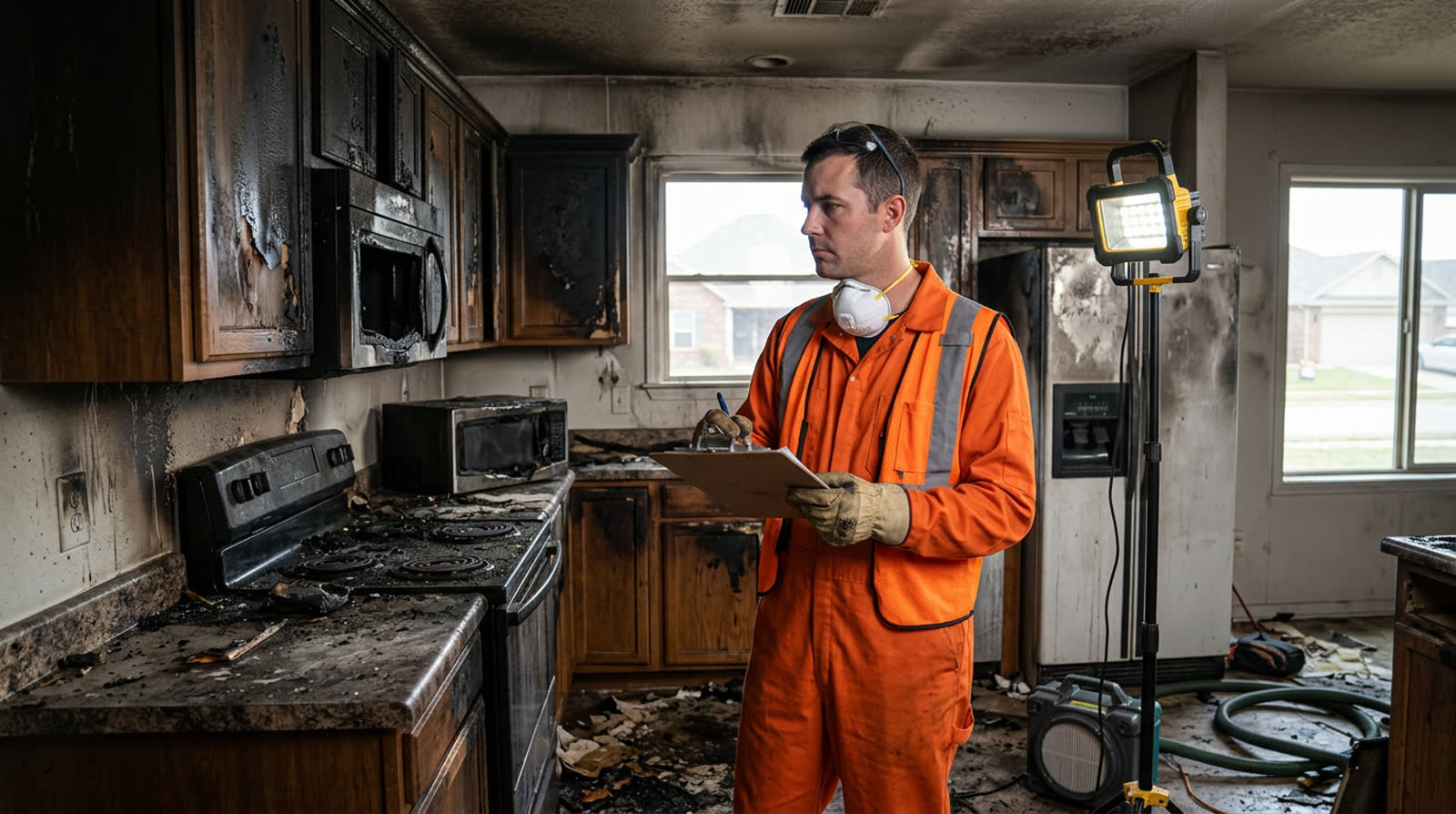
Fire damage cleanup in Edmond is a phased process, and skipping or rushing phases turns repairable damage into total losses. The correct order is (1) stabilize the structure, (2) remove suppression water, (3) contain soot, (4) protect contents, (5) clean and deodorize, (6) reconstruct. We see homeowners try to skip phases 2 and 3 — and end up with permanent smoke staining and lingering odor that no amount of paint will cover.
Why the sequence matters: soot is acidic and corrosive. Suppression water is sitting in walls and under flooring. The HVAC is contaminated. Skipping ahead to drywall replacement and paint locks all of that in permanently. The Edmond Fire Marshal's incident report (which you should request from the City of Edmond Fire Department within 7–10 business days of the loss) drives the carrier's scope, but it doesn't dictate the cleanup sequence — that's on your restoration contractor.
The damage clock after an Edmond fire
- 0–24 hours: suppression water saturating drywall and subfloor; soot on bare metal beginning to pit; protein contamination spreading from kitchen sources.
- 24–48 hours: mold spores germinating on wet porous materials; soot setting permanent stains on fabrics and porous finishes; vapor-phase smoke compounds absorbing into wood framing.
- 48–72 hours: visible mold colonies forming; HVAC redistribution of soot if the system runs even briefly; material delamination on engineered floors and particle-board cabinets.
- 72+ hours: permanent staining, structural mold, and odor that requires substrate replacement to fully resolve.
Phase 1: Same-day stabilization in Edmond
Day 1 after the fire is about preventing further damage. Broken windows get boarded up with 1/2-inch OSB sheathing screwed into framing (not nailed into trim — which is what most amateur board-ups do). Compromised roofs get tarped with 6 mil reinforced poly tarps minimum, lapped over the ridge and battened with 1×3 furring strips at 24-inch intervals. The structure is locked down to prevent vandalism, theft, and weather intrusion until the rebuild starts.
Utility lockout — OG&E and Oklahoma Natural Gas
Edmond Fire and Rescue typically calls Oklahoma Gas & Electric (OG&E) and Oklahoma Natural Gas (ONG) to the scene during active suppression. Power and gas are usually disconnected at the meter or upstream. Before any reconnect, both utilities require a licensed Oklahoma electrician's certificate (electrical) and a leak test (gas) — and the City of Edmond Building Inspections Division will issue a permit for any rewire or gas line work. Don't try to flip the main breaker back on yourself; OG&E may have pulled the meter, and the panel itself may be heat-damaged.
Why same-day matters in Oklahoma weather
An open roof during an Oklahoma spring or summer can dump 1–3 inches of rain into the structure before noon. A board-up that's a day late routinely doubles the suppression-water damage already in the building. Carriers explicitly cite the homeowner's duty to mitigate (Section I — Conditions, Duties After Loss in most Oklahoma policies); a 24-hour delay in tarping after a covered fire is the most common reason secondary water damage gets disputed.
Phase 2: Suppression-water removal
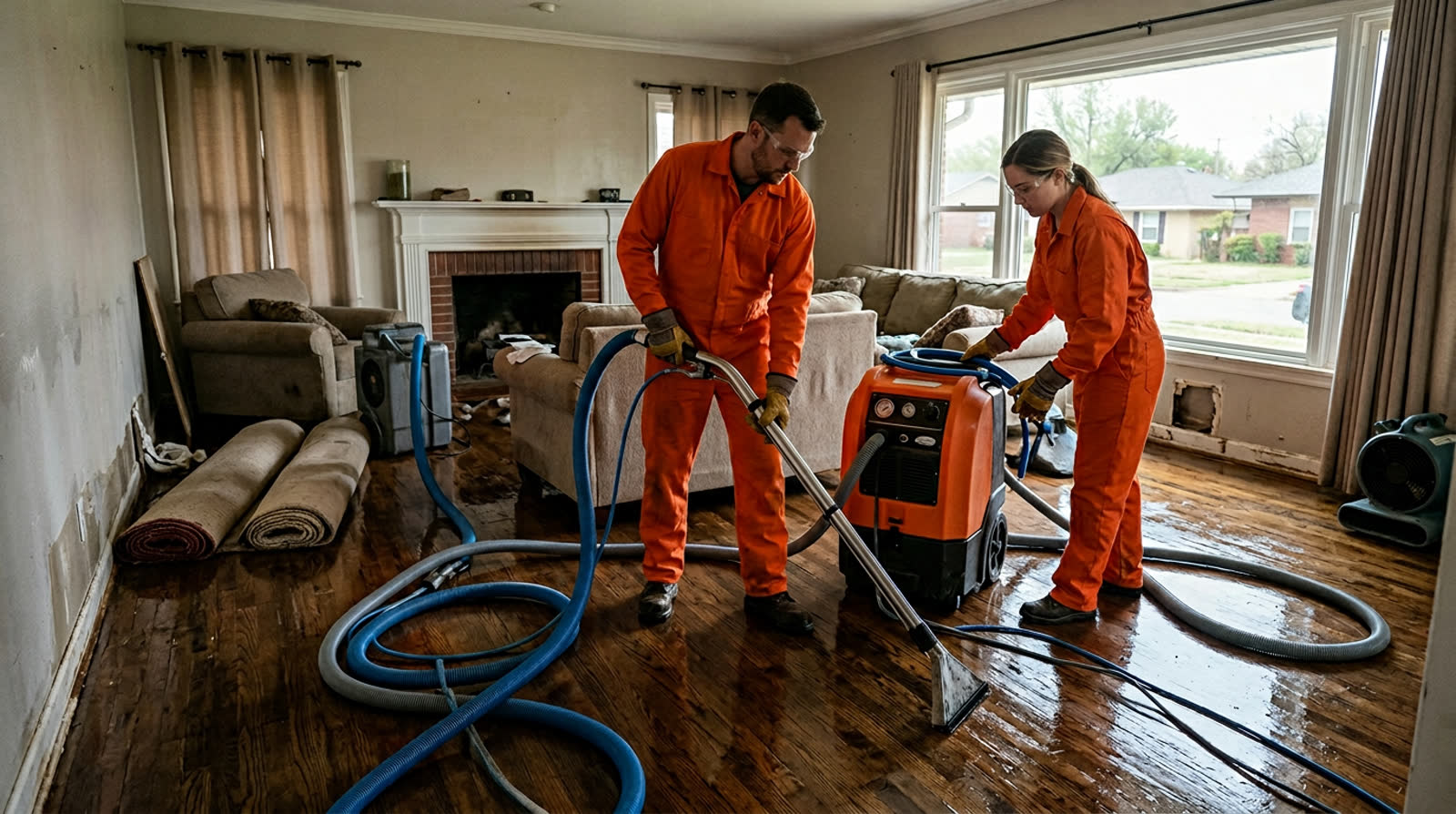
Fire suppression dumps thousands of gallons inside a structure. A typical residential fire response in Edmond uses 200–800 gallons of water per minute, and crews are on-scene running lines for 20–60 minutes. Left in place, that water causes mold inside 48 hours and continues damaging materials by the day. Water removal happens within 24 hours: extraction, demo of unsalvageable wet materials, and drying setup.
What gets extracted vs. removed
- Extracted with truck-mounted equipment: standing water on hard surfaces, water in tile substrates, water in sealed concrete slabs.
- Removed and discarded: wet carpet pad (always — it never dries fully), saturated batt insulation, drywall below the suppression water line plus 12 inches above, MDF/particle-board cabinets that absorbed water, engineered wood flooring that delaminated.
- Dried in place: structural framing, plywood subfloor (if not delaminated), solid hardwood (if caught early), tile and natural stone.
Drying targets and equipment
We follow IICRC S500 dryness standards: framing lumber to 16% moisture content or below, drywall to within 1% of the local equilibrium moisture content. Equipment for a typical Edmond two-story fire job runs 12–20 air movers (2,500+ CFM each) plus 3–5 commercial LGR dehumidifiers (130–150 pints/day each). Daily moisture readings are logged in writing — that log is what the adjuster matches against the mitigation invoice.
Related context: see our first 24 hours after water damage guide for the parallel water-only playbook, and our mitigation vs. restoration breakdown for how the two phases bill on a fire claim.
Phase 3: Soot containment and HVAC lockout
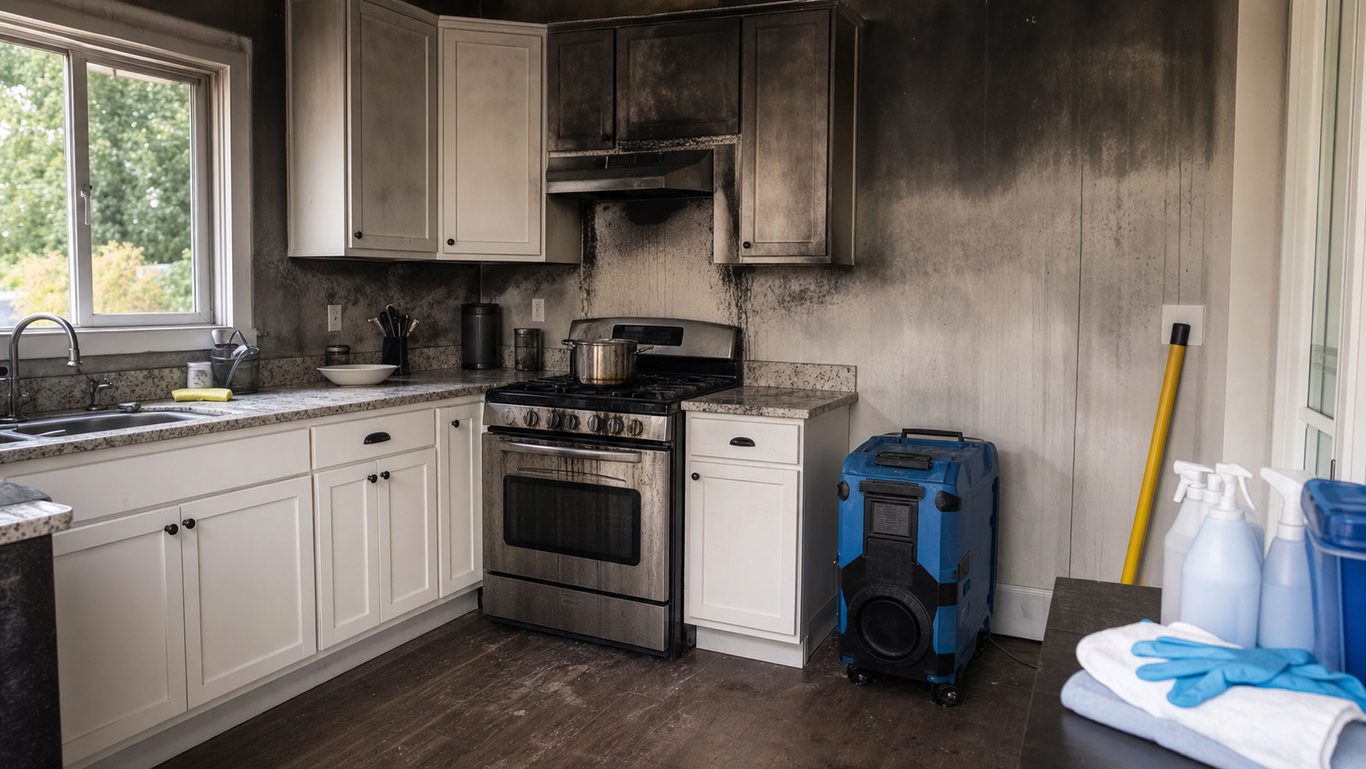
Soot is acidic. On bare metal it causes pitting in days. On porous surfaces it sets a permanent stain. On HVAC components it spreads through the whole house — even rooms the fire never touched. Containment plastic and HEPA air scrubbers go up; the HVAC stays off; salvageable contents are inventoried, packed out, and processed off-site at our cleaning facility.
The HVAC rule: off, sealed, and replaced
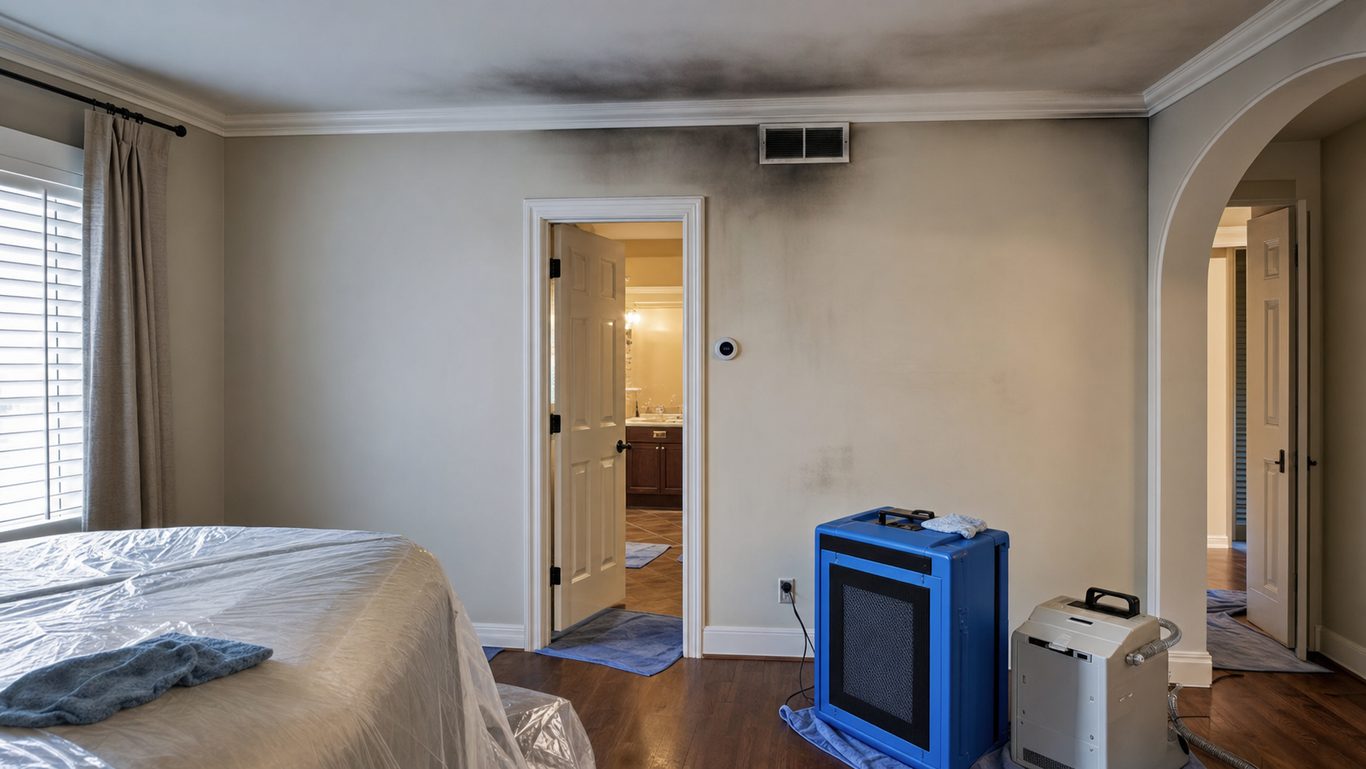
Do not turn the HVAC on after a fire. Even one cycle redistributes soot through every duct, every supply register, and into rooms that were unaffected. We seal supply and return registers with 6 mil poly and tape immediately on Day 1. The filter and blower assembly are replaced; the duct interior is brushed and HEPA-vacuumed to NADCA standards before any reuse.
Containment specs we use on Edmond fire jobs
- 6 mil polyethylene sheeting on a stud-and-zip wall separating clean and contaminated zones
- HEPA negative-air machines (500–2,000 CFM, sized to room volume) running 24/7 inside containment
- Decontamination chambers at every entry/exit point
- Tacky mats inside and outside the contamination zone to keep soot from tracking
Phase 4: Salvageable vs. unsalvageable — a homeowner's checklist
One of the hardest parts of an Edmond fire job is deciding what comes back and what gets totaled on the contents claim. Don't make those calls yourself before the adjuster sees the home. Here's how categories typically resolve.
Almost always salvageable
- Hard-cover books and important documents — freeze-dried and ozone-treated at a specialty facility
- Photos and photo albums — same process; treat as priority pack-out
- Hardwood and metal furniture — wet-cleaned and refinished if structural integrity is intact
- Most electronics — only if they were not powered on when smoke arrived; specialty cleaning of circuit boards is effective on cool, unpowered units
Sometimes salvageable
- Upholstered furniture — depends on smoke type (see Step 4 below); kitchen-grease/protein smoke usually means total loss
- Clothing and bedding — specialty laundering with deodorizing additives recovers most of it; mattresses and pillows are usually a total
- Area rugs — depends on fiber; wool recovers better than synthetic blends
Almost always a total loss
- Food — refrigerated, frozen, or pantry; document with photos and a written list, then discard
- Cosmetics, medications, and any sealed perishables — heat compromises chemistry even with sealed packaging
- MDF and particle-board furniture/cabinetry that absorbed suppression water
- HEPA filters, HVAC filters, and any porous filtration in the home
Phase 5: Cleaning and deodorization
Dry-sponge cleaning removes loose soot from non-porous surfaces. Wet cleaning with specialized fire-damage degreasers follows. Hydroxyl or ozone treatments break down odor at the molecular level. Sealing primer goes on framing and other porous surfaces before drywall to lock in residual smoke compounds. This is the phase amateurs skip — and it's the phase that determines whether the home smells fine in 90 days or smells like smoke for the next decade.
Hydroxyl vs. ozone vs. thermal fogging
- Hydroxyl generators — produce hydroxyl radicals; safe in occupied spaces; slower (3–7 day cycles); used during active cleaning when occupants may need to retrieve items.
- Ozone generators — much faster, much stronger; require unoccupied conditions because ozone is a respiratory irritant; used as a final 24–72 hour deodorization once cleaning is complete.
- Thermal fogging — heated deodorizing solvent that penetrates the same paths smoke took; used as a follow-up when ozone isn't enough on protein-fire jobs.
For a deeper write-up on smoke-odor specifics, see our smoke odor removal in Moore guide — the principles apply equally to Edmond homes.
Substrate sealing — why this is non-optional
Newly exposed wood framing, OSB sheathing, and the back of any reused drywall gets a coat of shellac-based primer (B-I-N or equivalent). Shellac is non-breathable; it locks any residual smoke compounds in the wood so they can't bleed back through new paint over the next 6 months. Skipping this is the single most common cause of "we cleaned it but it still smells" complaints we hear on second-opinion calls in Edmond.
Phase 6: Reconstruction and the Edmond timeline
Drywall, paint, flooring, trim, cabinets — back to pre-loss condition. We coordinate the rebuild so you have one contractor through the whole process instead of three or four. A typical Edmond residential fire timeline:
- Day 1: stabilization, board-up, tarp, utility lockout
- Day 1–2: suppression-water extraction begins
- Day 3–5: structural drying complete; demo of unsalvageable materials
- Week 1–3: contents pack-out and off-site processing; soot cleaning of all hard surfaces
- Week 2–4: deodorization (hydroxyl during cleaning, ozone at the end) and substrate sealing
- Week 4–10: reconstruction — drywall, paint, flooring, trim, cabinets, fixtures
- Week 10–12: final cleaning, contents return from storage, walkthrough
Edmond-specific factors that affect the timeline
Older neighborhoods around downtown Edmond and east of Boulevard (pre-1960 housing stock) often have knob-and-tube wiring, lath-and-plaster walls, and natural gas appliances that complicate post-fire reconstruction. Replacement panels and partial rewires are common, which adds 2–4 weeks. Newer builds north of 33rd Street and in the Coffee Creek and Spring Creek areas use trusses, modern plumbing, and engineered subfloor — typically a faster rebuild. Many Edmond HOAs (Oak Tree, Fairfax, Rose Creek) have specific exterior-material approval requirements for any roof, siding, or paint work, so the reconstruction permit process loops through both the City of Edmond Building Inspections Division and the HOA's architectural review.
Working with your Edmond Fire Marshal report
The Edmond Fire Marshal's incident report is the document that drives almost every part of your insurance claim. It identifies the cause and origin of the fire (electrical, kitchen, smoking materials, lightning, arson) — and that determination governs whether the claim is covered, partially covered, or denied. Request the report from the City of Edmond Fire Department's records division as soon as it's released (typically 7–10 business days after the incident).
What the report drives
- Coverage determination: sudden accidental fire is covered; arson by the policyholder is excluded; some causes (faulty workmanship by an unlicensed contractor) trigger partial denials
- Subrogation: if the cause is a defective appliance or installer error, your carrier will pursue subrogation against that party — meaning your deductible may be recoverable
- Code-upgrade scope: the fire department's notes on what failed (panel, wiring, gas connector) often dictate which code upgrades the rebuild needs to include
Insurance basics for Edmond homeowners
In Edmond, fire damage is one of the most clear-cut covered losses on a homeowner's policy. Almost all residential policies cover sudden, accidental fire — including the smoke and water damage that come with it. ALE (Additional Living Expenses) typically covers your hotel, meals, and laundry while the home is uninhabitable. Document everything, save receipts, and don't throw anything away until your adjuster has documented it. For the full claim playbook, our Oklahoma claim filing guide walks through the Xactimate scope language, ACV vs. RCV, and the supplement process — most of which transfers directly to fire claims.
Need help now? See our full Fire Mitigation service page or browse all restoration services. Don't see your city above? The full Oklahoma service area covers 27 cities.
Local context for this article: see our Edmond, OK restoration page and the Fire Mitigation in Edmond service page.
This guide also pairs with water damage restoration for suppression-water cleanup and storm-driven structure fires after lightning.
Does insurance cover fire mitigation?
Most homeowner's policies cover sudden, accidental water damage — burst pipes, supply line failures, appliance leaks. They generally do not cover gradual leaks or flood-zone flooding (which requires separate flood insurance). We bill insurance directly for covered losses and document everything for your claim.
Authoritative resources referenced
Need restoration help in Oklahoma?
24/7 dispatch, IICRC standards, direct insurance billing.