Why does the order of water extraction steps matter so much?
In Oklahoma City water losses, the difference between a three-day dry-out and a three-week rebuild is almost always the order of the first few decisions. Pulling standing water before the source is shut off is wasted effort. Running fans across wet drywall before water has been extracted just blows contaminated air around the home. Starting demolition before moisture has been mapped tears out material that could have been saved.
The standard sequence for emergency water extraction in OKC homes follows the IICRC S500 approach: stop the source, secure power, extract bulk water, assess and document scope, demolish only what cannot be dried, then set structural drying. Each step depends on the one before it. We respond 24/7 across the metro and work this same sequence on every water mitigation call.
One way to read this sequence: each step closes a door that the previous step opened. Stopping the source closes the door on more water arriving. Securing power closes the door on shock and equipment damage. Bulk extraction closes the door on water still spreading horizontally through the home. Demolition closes the door on building materials acting as a moisture reservoir. Drying closes the door on the mold-growth window. Skip any step and the next one becomes harder or impossible to do correctly. Oklahoma City homeowners who walk through this same checklist mentally during the first call, even before the crew arrives, almost always end up with a smaller project.
Step 1: How do you stop the water source in an OKC home?
Source control is the single most important first step. Until the water is stopped, every other action just keeps up with the loss. In Oklahoma City homes the source is usually one of:
- A supply-line leak (washing machine hose, ice-maker line, dishwasher feed, toilet supply) — shut off the local angle stop or quarter-turn valve at the fixture.
- A water heater rupture — shut the cold-side inlet valve at the top of the heater.
- A burst pipe — shut off the main water valve, typically at the meter on the curb or in the front yard for OKC homes built since 1970.
- A roof or storm leak — there is no internal valve. Contain the inflow with tarping or buckets and call a roofer for emergency dry-in.
- A sewage backup — shut off any plumbing fixture that drains to the affected line and call sewage cleanup immediately.
Every Oklahoma City homeowner should know where the main water shutoff is before a leak ever happens. In most OKC neighborhoods it is at the meter pit in the front yard. A standard meter key or curb stop wrench will turn it. Some homes also have an interior shutoff at the laundry room or in a utility closet.
Step 2: Why is electrical safety part of water extraction?
Standing water and live electrical outlets are an immediate shock hazard. Before any extraction starts in an Oklahoma City home, the crew confirms which circuits run through the wet area and shuts those off at the breaker panel. If water has reached an outlet, an appliance, or a fixture, the entire wet zone is treated as live until a circuit is locked out.
For most single-room losses, this means turning off the bedroom, kitchen, or bathroom circuit. For a basement or whole-floor loss, the main breaker often comes off. The crew documents which circuits were de-energized and when they were restored, partly for safety and partly for the insurance file.
For OKC homes built before 1985, finding the main water shutoff is often harder than expected. Older meters in this area sometimes need a long-handled key to reach the curb stop, and the shutoff valve at the house may be in a basement, a utility closet behind the water heater, or buried in an exterior wall niche. Homeowners should locate and test that valve before any emergency, so the first time they touch it is not during a flood at 2 a.m. The same applies to the main electrical panel: confirm which breakers control which rooms before the day a wet outlet forces the question. Both are five-minute exercises that pay back many times over during an actual loss.
Step 3: How do crews actually extract standing water?
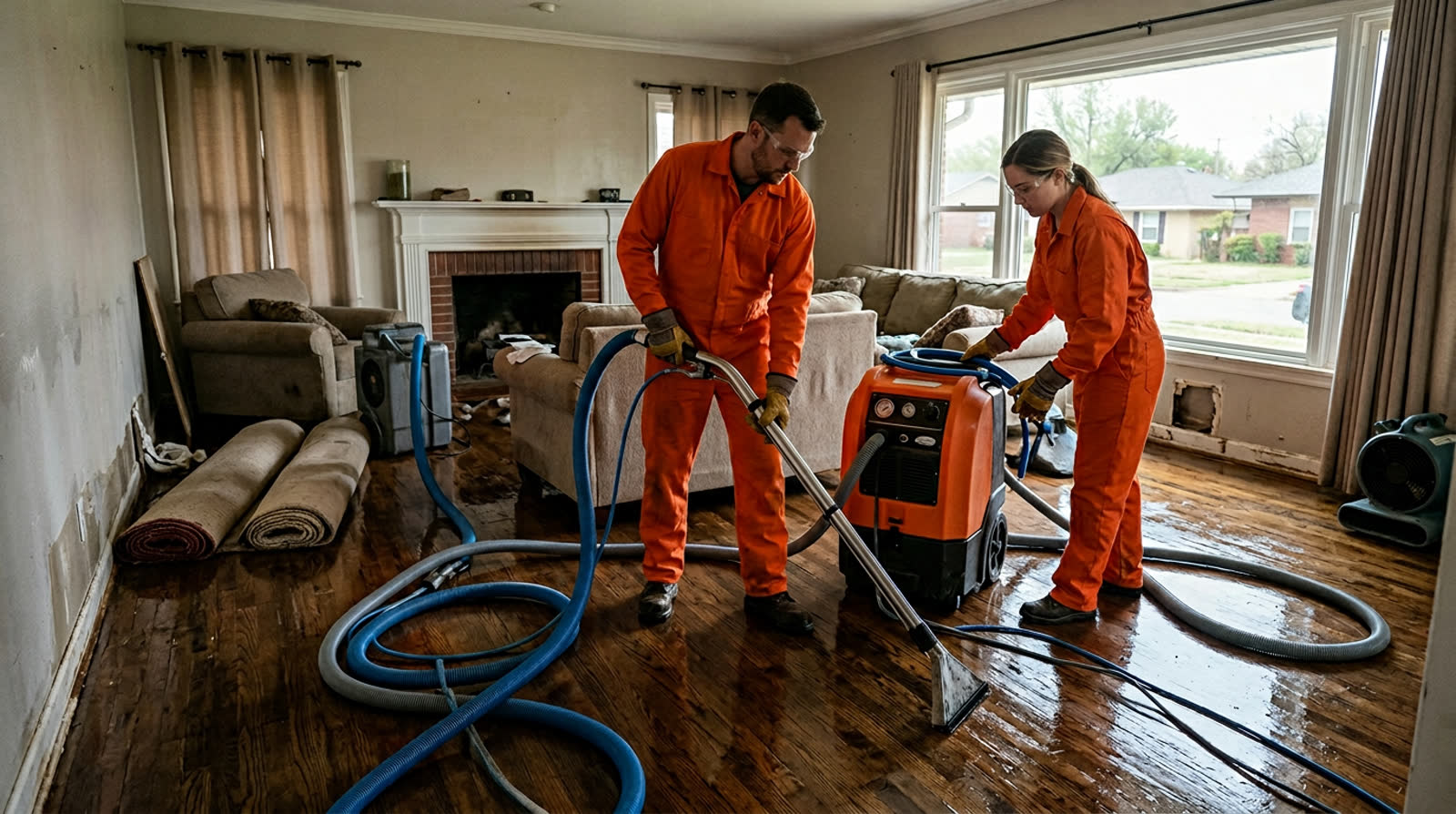
For anything more than a small fixture leak, a wet vac is not enough. The standard tool is a truck-mounted or portable extraction unit that pulls hundreds of gallons per hour and routes it directly to disposal. In an Oklahoma City home, the extraction sequence usually looks like:
- Bulk extraction from any standing water on hard floors or carpet.
- Weighted extraction ("rover") tools driven across saturated carpet to pull water out of pad and backing.
- Targeted extraction at low points where water has pooled under cabinets, behind toe-kicks, and in floor transitions.
- Inspection for water that has tracked into wall cavities — drill weep holes or remove baseboard sections to access.
The goal of extraction is not to dry the building. The goal is to get the bulk water out so drying equipment can finish the job in hours instead of weeks. Removing 90 percent of the water in the first two hours can shave a week off the total project timeline.
Step 4: What gets demolished and what gets dried?
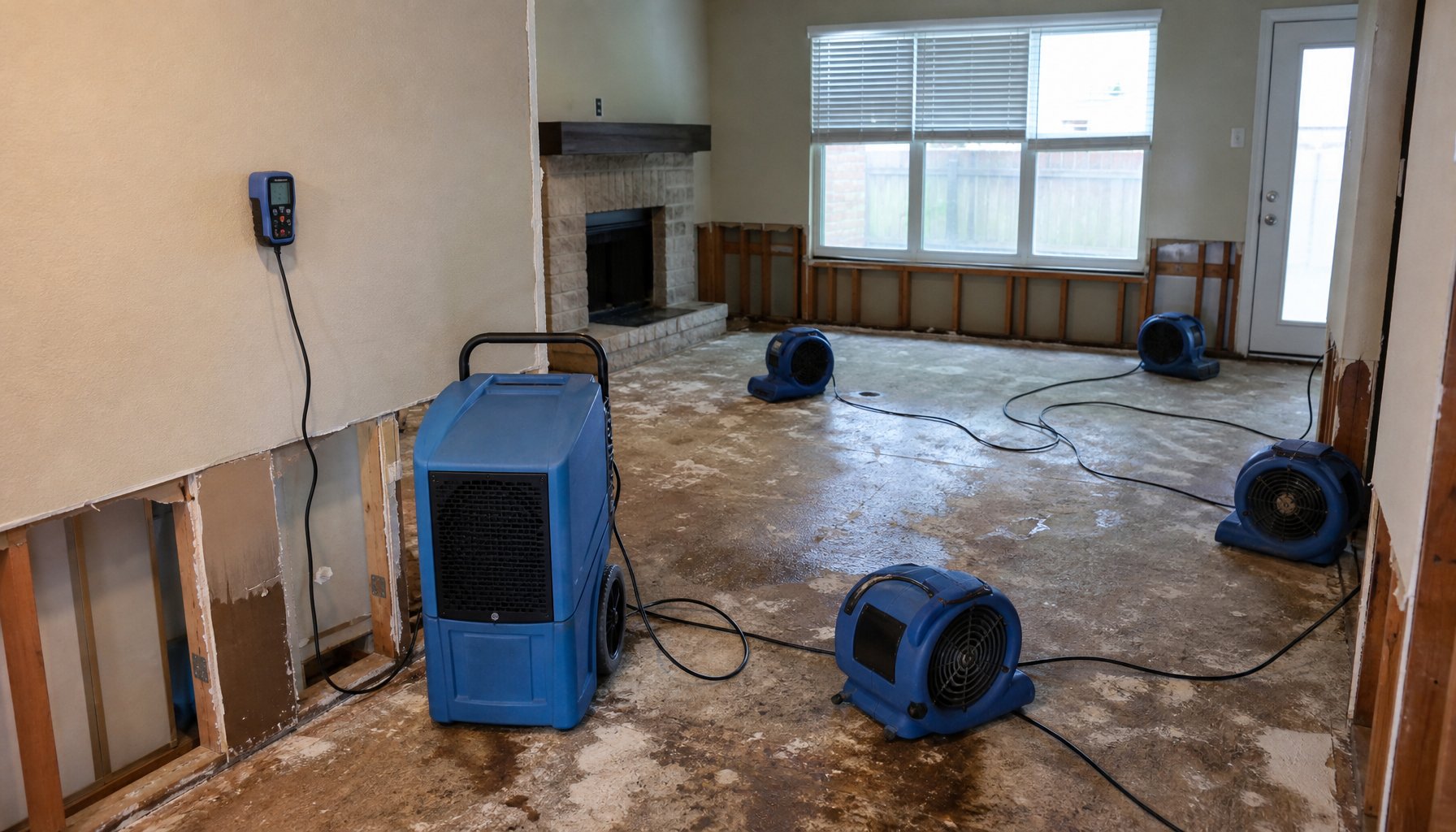
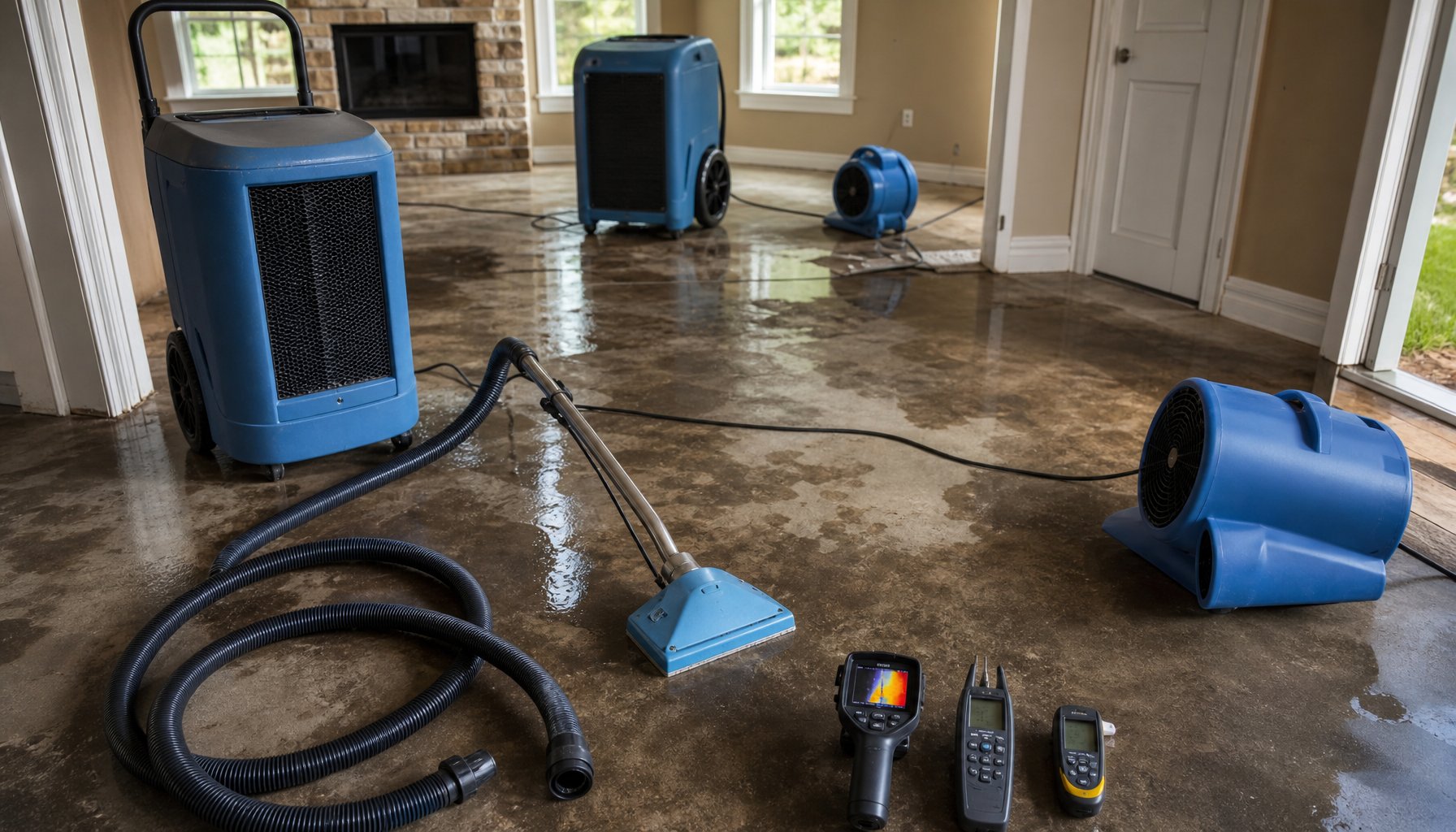
Once standing water is out, the crew maps moisture across every surface that might be wet. Moisture meters read drywall, framing, subfloor, and baseplates. Thermal imaging shows where wet material is hiding behind paint or under finished flooring. From that map, materials get sorted:
- Salvageable: Framing, structural subfloor, and most painted drywall above the waterline can dry in place if the dry-out plan is right.
- Borderline: Carpet pad almost always comes out. Carpet itself can sometimes be saved if it is clean water and the pad is replaced.
- Unsalvageable: Wet drywall below the waterline, wet insulation, MDF baseboard, particleboard cabinet boxes, and any porous material exposed to category 2 or 3 water are demolished and disposed of.
This is also when the loss is photographed and measured for the insurance file. Documented scope is what keeps the project on the covered side of the policy when the adjuster reviews the file.
Demolition scope is one of the most contested decisions on an OKC water-loss project. Carriers sometimes push for the smallest cut possible to save dollars; experienced restoration crews push for the cut that ends the moisture problem. The right answer is usually whatever the moisture map shows. If the meter reads wet six inches above the baseboard, the drywall comes off at least to the top of the wet zone, not at exactly the visible waterline. If the wall has insulation and the cavity reads wet, the insulation comes out by rule. Defending a wider cut after the fact is much harder than documenting the moisture readings that justified it in the first place.
Step 5: How does structural drying work after extraction?
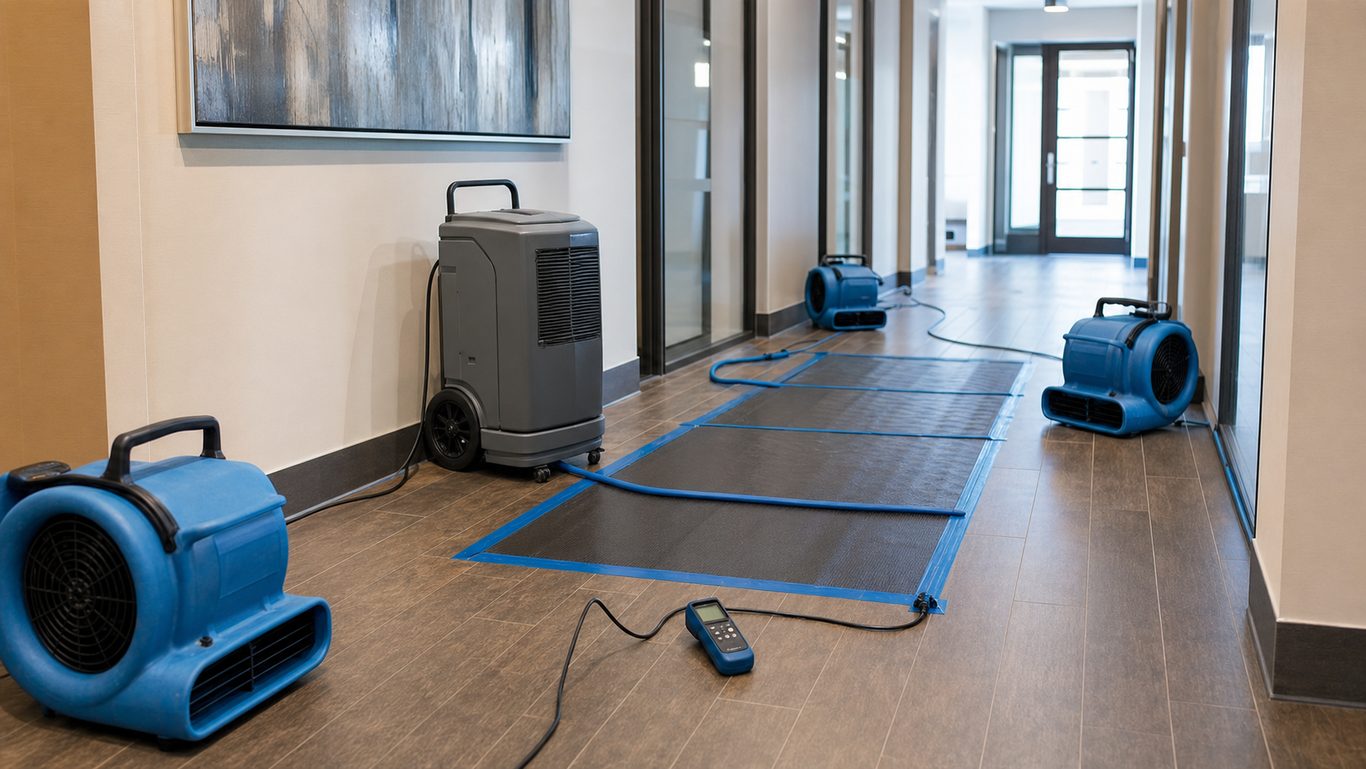
Structural drying in Oklahoma City uses calibrated dehumidifiers (usually low-grain refrigerant or LGR units) and high-velocity air movers placed on a strict pattern. The dehumidifier lowers the specific humidity of the room air; the air movers push that dry air across wet surfaces, evaporating moisture into the room air, which the dehumidifier then pulls out.
Daily monitoring is part of the job. A technician returns every 24 hours, takes moisture readings on every wet surface, logs them, adjusts equipment placement, and reports back to the homeowner and the adjuster. Drying is complete when every surface has hit dry standard for that material type, usually three to five days for a single-room loss in OKC.
When is it safe to skip professional extraction and dry it yourself?
For a tiny clean-water spill (a glass of water tipped on the carpet, a cup of overflowed sink water) a homeowner can usually handle it with towels and a fan. The line is roughly: if water has reached past one room, soaked into pad or subfloor, run for more than an hour, or come from anything other than a clean drinking-water source, professional extraction is the safer call.
The risk of skipping professional extraction is twofold. First, hidden moisture in walls and subfloor becomes the start of a mold problem two to four weeks later. Second, an insurance carrier may deny the resulting mold claim if there is no documented drying log proving the initial water was handled correctly. The cost of a documented professional dry-out is almost always less than the cost of a mold remediation scope thirty days later.
The decision to call a professional versus dry-it-yourself also affects the future buyer of the home. Oklahoma sellers are required to disclose known water damage on the property disclosure form. A documented, dried, and rebuilt water loss is a clean disclosure. An undocumented or self-handled loss often creates uncertainty for a buyer's inspector, which can lead to lower offers, repair credits, or delayed closings. Even when the homeowner does not plan to sell, the disclosure paper trail outlasts the loss. Calling a professional is partly an investment in that paper trail, not only an investment in clean drying.
Finally, the cost question. Most Oklahoma City homeowners are surprised that professional emergency extraction and dry-out is often less out-of-pocket than they assume, because the work is usually covered by the homeowners policy minus the deductible. A homeowner who has a $1,000 deductible and a $4,500 covered scope pays $1,000. A homeowner who skips the call and handles drying themselves often ends up paying out-of-pocket for any mold remediation that follows, because the carrier may decline the resulting mold claim on the grounds that the original event was not handled professionally. The math usually favors the call.
What does a typical OKC emergency extraction call look like?
For a typical Oklahoma City supply-line break — say, a washing machine hose that ruptured overnight — the call timeline usually runs:
- Hour 0: Homeowner calls. Crew dispatched.
- Hour 1-2: Crew on site. Source confirmed off. Power secured. Extraction begins.
- Hour 2-4: Bulk water out. Moisture map taken. Demolition scope agreed with homeowner.
- Hour 4-6: Wet materials removed. Antimicrobial applied where needed. Drying equipment set.
- Day 2-5: Daily monitoring; equipment moved or removed as materials dry.
- Day 5-7: Final readings. Equipment off. Rebuild starts.
Our crews respond 24/7 across Oklahoma City, Edmond, Moore, Norman, and Tulsa. Call (405) 669-4484 the moment the water is found.
What category and class is the water in your OKC home?
Two terms drive the entire extraction scope: category (how contaminated) and class (how much was wet). The IICRC S500 classifications used on Oklahoma City jobs:
- Category 1 (clean water): Comes from a sanitary source — a broken supply line, a tipped aquarium, rainwater that has not touched soil. Standard extraction applies; most materials can be dried in place.
- Category 2 (gray water): Significantly contaminated and can cause illness. Comes from washing-machine discharge, dishwasher overflow, toilet overflow with urine but no feces, aquarium water with biofilm. Porous materials are usually removed.
- Category 3 (black water): Grossly contaminated. Sewage backup, river flooding, ground water that has touched sewage. All porous materials in the wet zone are removed by rule, and the work is done under containment.
Class refers to how much porous material is wet. Class 1 is the smallest, Class 4 the deepest — saturated wet concrete, masonry, or hardwood that needs specialty drying. The crew classifies the loss on site within the first hour so the homeowner and adjuster have a defensible scope from the start.
Need help now? See our full Water Mitigation service page or browse all restoration services. Don't see your city above? The full Oklahoma service area covers 27 cities.
Local context for this article: see our Oklahoma City, OK restoration page and the Water Mitigation in Oklahoma City service page.
This guide also pairs with full water damage restoration once mitigation is complete and mold remediation if the 72-hour window was missed.
Does my homeowners insurance cover emergency water extraction in Oklahoma City?
Most Oklahoma homeowners policies cover sudden and accidental water damage, which usually includes emergency extraction, drying, demolition, and rebuild. Slow leaks that ran for weeks, flood water from outside the home, and damage attributed to neglect are typically excluded. Calling for professional extraction within the first 24 hours and getting a documented drying log started is the cleanest way to keep the loss on the covered side.
Authoritative resources referenced
Need restoration help in Oklahoma?
24/7 dispatch, IICRC standards, direct insurance billing.