Why does the equipment list matter on a Tulsa water loss?
For Tulsa homeowners watching a crew unload a truck after a water loss, the gear can look overwhelming: extraction wands, hoses, big square boxes on wheels, fans of every shape, meters with metal prongs, infrared cameras. The reason for the variety is simple — different stages of a water mitigation project need different tools, and the wrong tool at the wrong stage costs days of drying time.
A homeowner who understands the equipment list can also tell the difference between a serious restoration company and a less-equipped operator. If the crew on site does not have an LGR dehumidifier, moisture meters, and a thermal camera, the project is being run on guesswork. Our Tulsa water mitigation crews arrive with the full equipment set for every dispatch.
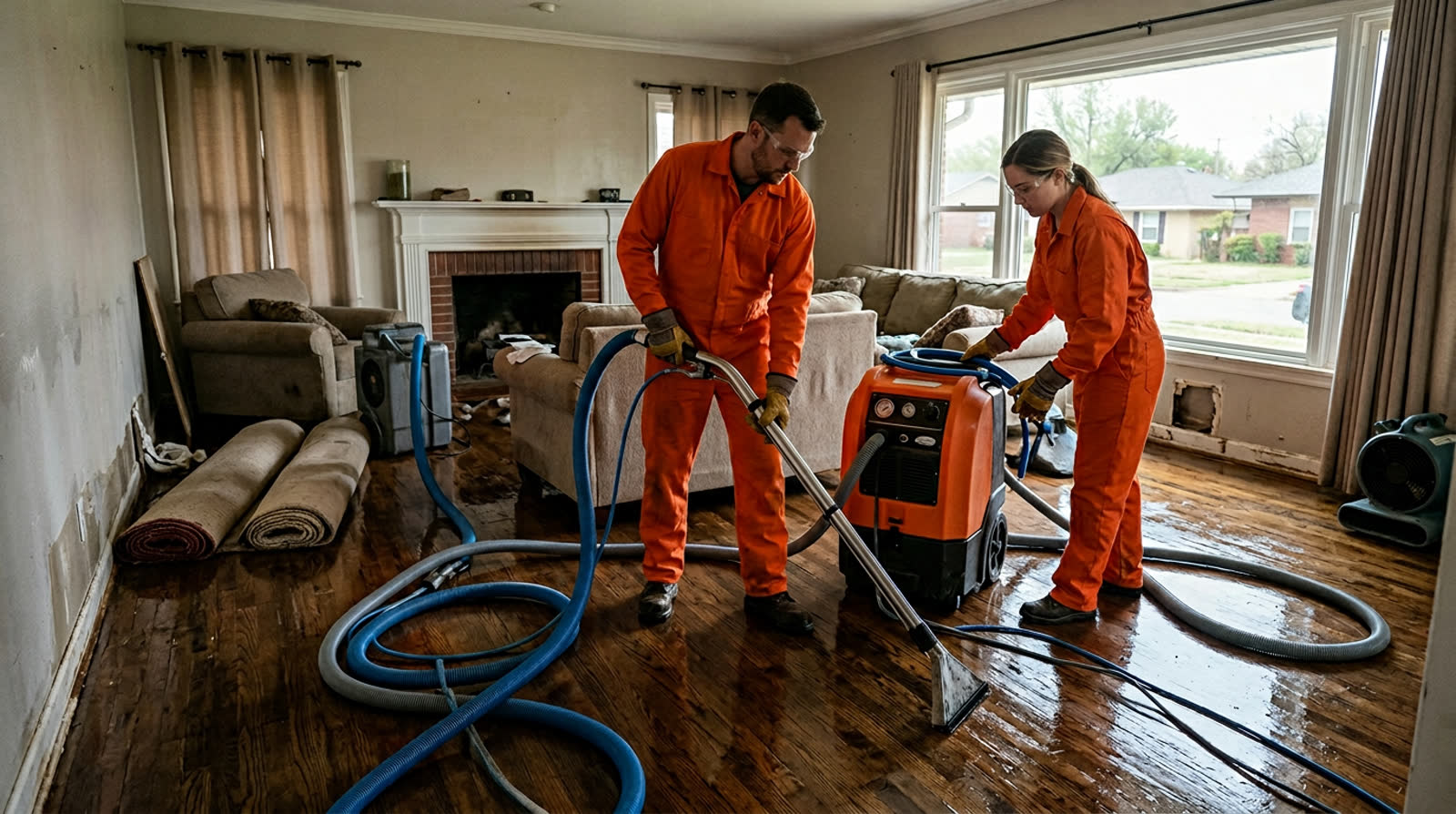
Extraction equipment: pulling the standing water out
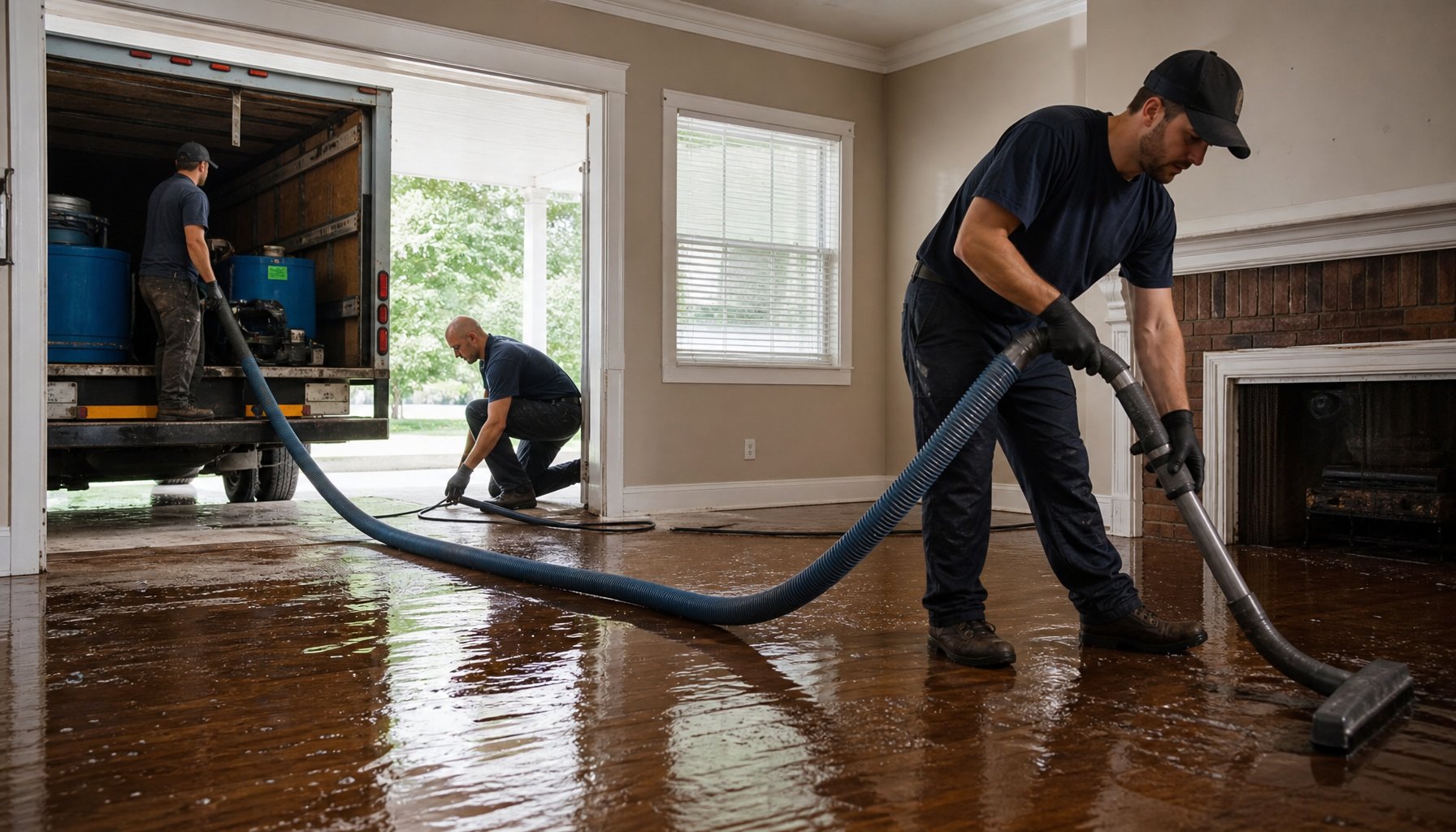
The first stage of any Tulsa water mitigation job is bulk water extraction. Equipment used for this stage:
- Truck-mounted extractors: Large vacuum and pump systems that pull hundreds of gallons per hour through a long hose, routing water directly to the truck for disposal. Used on most residential whole-room losses and almost all commercial losses.
- Portable extractors: Self-contained units carried into the home, used for second-story losses or where truck-mount access is limited.
- Weighted carpet wands ("rovers"): Heavy extraction tools driven across saturated carpet. The weight presses pad and carpet flat against the floor, pulling water out of the backing.
- Submersible pumps: Used for basement floods and any standing water more than an inch or two deep, draining to a sanitary line or sump.
Extraction is over when standing water is gone and the moisture meter reads bound water (water locked in materials) rather than free water (water still pooled in the assembly).
Each piece of equipment also has a per-day rate that goes into the insurance estimate. Carriers and restoration companies use Xactimate or similar pricing tools, which list a daily rate for each unit. Documenting which equipment was on the job and for how many days is part of how the invoice gets approved. Skipping documentation tends to mean the homeowner or the contractor absorbs the difference. On a typical Tulsa water-mitigation job, the equipment log is one of the line items the adjuster reviews most carefully, so the crew records placement and runtime daily.
Dehumidifiers: the workhorse of structural drying
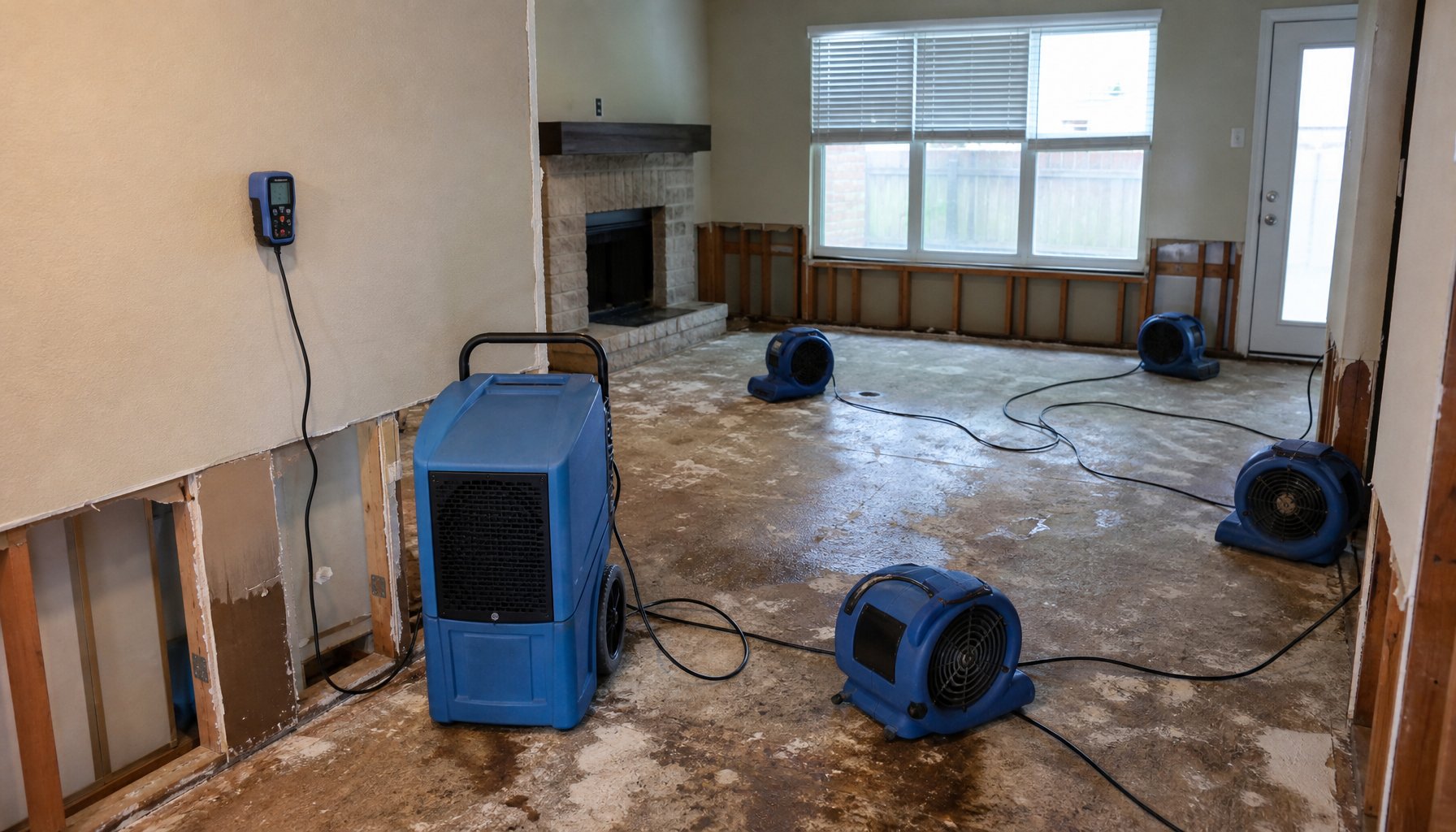
After extraction, dehumidifiers do most of the actual drying work. The standard for Tulsa restoration jobs is the low-grain refrigerant (LGR) dehumidifier. An LGR can pull moisture out of room air down to lower grain levels than a basic refrigerant unit, which is what lets it drag water back out of wet drywall, wood, and concrete.
For very large or hot-and-humid Tulsa summer jobs, a desiccant dehumidifier is sometimes used. Desiccants run on a chemical wheel rather than a refrigeration cycle and can keep working at lower temperatures and humidity levels than refrigerant units. They are louder, hotter, and need more power, so they are usually reserved for large losses or sealed structures.
Sizing dehumidification correctly is critical. Undersizing leaves moisture in the building and extends the timeline. Oversizing wastes power. The crew calculates affected volume and class of water loss and picks the unit count accordingly.
Air movers: getting moisture from materials into the air
Air movers are the second half of the drying loop. While dehumidifiers pull moisture out of the air, air movers push that drier air across wet surfaces so evaporation can happen. Two main types are used on Tulsa jobs:
- Axial air movers: Round-barrel fans with high volume and low pressure. Best for drying large flat surfaces — wet drywall, carpet, hardwood floors.
- Centrifugal (snail) air movers: Lower volume, higher pressure. Best for targeted drying — under cabinets, into wall cavities through baseboard openings, behind built-ins.
Placement matters more than count. Air movers are aimed low along walls and across wet floor surfaces, never blowing into open dry space. A good crew adjusts placement daily as wet areas dry, moving units from the now-dry surfaces to whatever surface still has moisture.
Air movers are the most physically obvious piece of equipment on any job, and they are also the most commonly miscounted by homeowners trying to compare quotes. The right number is the number it takes to dry every wet surface, not the lowest number that fits the room. A Tulsa kitchen-and-dining loss might need eight to twelve air movers if the wet footprint spans wood floor, tile, baseboard, and lower drywall on three walls. Quoting four to keep the price competitive sets up a failed dry-out a week later. The honest crew quotes what the job actually needs and documents why.
Measurement tools: meters and cameras
Restoration is not finished when the floor looks dry. It is finished when every wet material has hit a documented dry standard. That is impossible to know without measurement equipment.
- Pin moisture meters: Two prongs press into wood or drywall and read electrical resistance, which corresponds to moisture content. Used on framing, subfloor, and trim.
- Pinless moisture meters: Pressed flat against a surface, they read moisture without leaving holes. Used on finished surfaces, tile, and stone.
- Thermometers and hygrometers: Read room temperature and relative humidity to confirm the dehumidifier is working.
- Thermal imaging cameras: Show temperature differences across a wall or floor that indicate wet zones invisible to the eye. The wet material is cooler from evaporation; the camera makes the wet footprint visible.
- In-situ concrete probes: Small probes set into a slab to measure the relative humidity inside the concrete, the only reliable way to know a slab is truly dry.
Every reading is logged with the date, time, location, and equipment used. That log is the artifact the adjuster reviews when the claim closes.
Air quality equipment: HEPA scrubbers and negative-air machines
Some water losses come with air-quality risks: sewage backups, long-running leaks that grew mold before discovery, and any project where containment is needed. The equipment used for those scenarios on Tulsa jobs:
- HEPA air scrubbers: Pull air through a high-efficiency particulate filter that captures mold spores, dust, and microbial particles. Used to clean indoor air during and after demolition.
- Negative-air machines: A HEPA scrubber routed through a duct or window to exhaust filtered air outside, creating a pressure difference that keeps contaminated air from spreading into clean parts of the home.
- Containment poly and zip walls: Plastic sheeting with sealed zippers, used to isolate a work area during demolition and cleaning. Pair with a negative-air machine for full containment.
Any time a Tulsa job involves mold remediation or sewage cleanup, this equipment becomes mandatory rather than optional.
Air-quality equipment occasionally surprises homeowners. A HEPA air scrubber looks like a large box on wheels with a hose, and it runs continuously in the work area to catch particulates, mold spores, and microbial debris during demolition. The cost of running an air scrubber is small compared to the cost of cross-contaminating clean parts of the home. For Tulsa losses involving sewage backups or known mold, an air scrubber is non-optional. For routine clean-water losses it is still a useful precaution during demolition, especially if the homeowner is sensitive to dust or has respiratory conditions.
Antimicrobial application and finishing equipment
Toward the end of mitigation, the crew applies an EPA-registered antimicrobial to surfaces that were wet, particularly framing, subfloor, and slab edges that will be covered back up by new drywall and flooring. Antimicrobial is applied with low-pressure pump sprayers or ULV foggers depending on the scope.
For finishing, the crew may use surface-cleaning HEPA vacuums to remove dust and fine particulates before rebuild begins, and odor-control equipment (hydroxyl generators or ozone) when the loss left behind odors that survived drying.
Antimicrobial application is the step most homeowners do not see directly because it happens after demolition and before the rebuild crew arrives. A walking technician with a low-pressure pump sprayer treats every exposed framing surface, baseplate, slab edge, and remaining subfloor with an EPA-registered antimicrobial. The product creates an inhospitable surface for residual spores before the wall cavity is closed back up. On larger Tulsa losses or losses with any biological contamination, a ULV fogger replaces the sprayer to reach surfaces a handheld wand cannot cover. The application is fast — usually fifteen to thirty minutes in a single-room scope — but it is the layer that protects the next two decades of indoor air quality in the closed wall.
Finishing equipment also includes the unglamorous tools that close out a project: HEPA vacuums for residual dust, microfiber cloth wipes for hard surfaces, and contents-cleaning equipment for any salvageable items removed from the wet area. The crew documents which contents were cleaned, which were disposed, and which were stored off-site. That documentation becomes part of the personal-property line on the insurance claim, separate from the building scope. Tulsa homeowners with valuable contents should confirm the crew handles contents in-house rather than subcontracting, which keeps continuity and reduces the chance of items getting lost between contractors.
How Trustworthy Restoration deploys the full equipment list on Tulsa jobs
Every Tulsa dispatch goes out with the full equipment set: extraction, dehumidification, air movement, measurement, air quality, and finishing. The crew calculates the right mix on site, places equipment on a deliberate pattern, monitors daily, and documents every reading. We respond 24/7 across Tulsa, Broken Arrow, Bixby, and the OKC metro. Call (405) 669-4484 the moment a water loss is discovered.
How is equipment chosen for residential vs commercial Tulsa jobs?
The same equipment categories apply to residential and commercial Tulsa losses, but the scale and placement differ. A typical Tulsa residential single-room loss uses one truck-mount extractor, one LGR dehumidifier, four to six air movers, and a standard moisture-mapping kit. A commercial loss in a Tulsa retail or office space might scale up to multiple truck-mounts running in parallel, three to six LGR or desiccant dehumidifiers, twenty or more air movers, and HEPA scrubbers for any zone where building occupants need to keep working around the dry-out.
Commercial losses also bring scheduling constraints. Many Tulsa commercial properties cannot stop operations for a multi-day dry-out, so the crew works around staff in zones, runs extraction overnight, and sometimes deploys temporary containment walls so part of the building stays open while the wet zone dries.
What about specialty equipment for hardwood floors and concrete slabs?
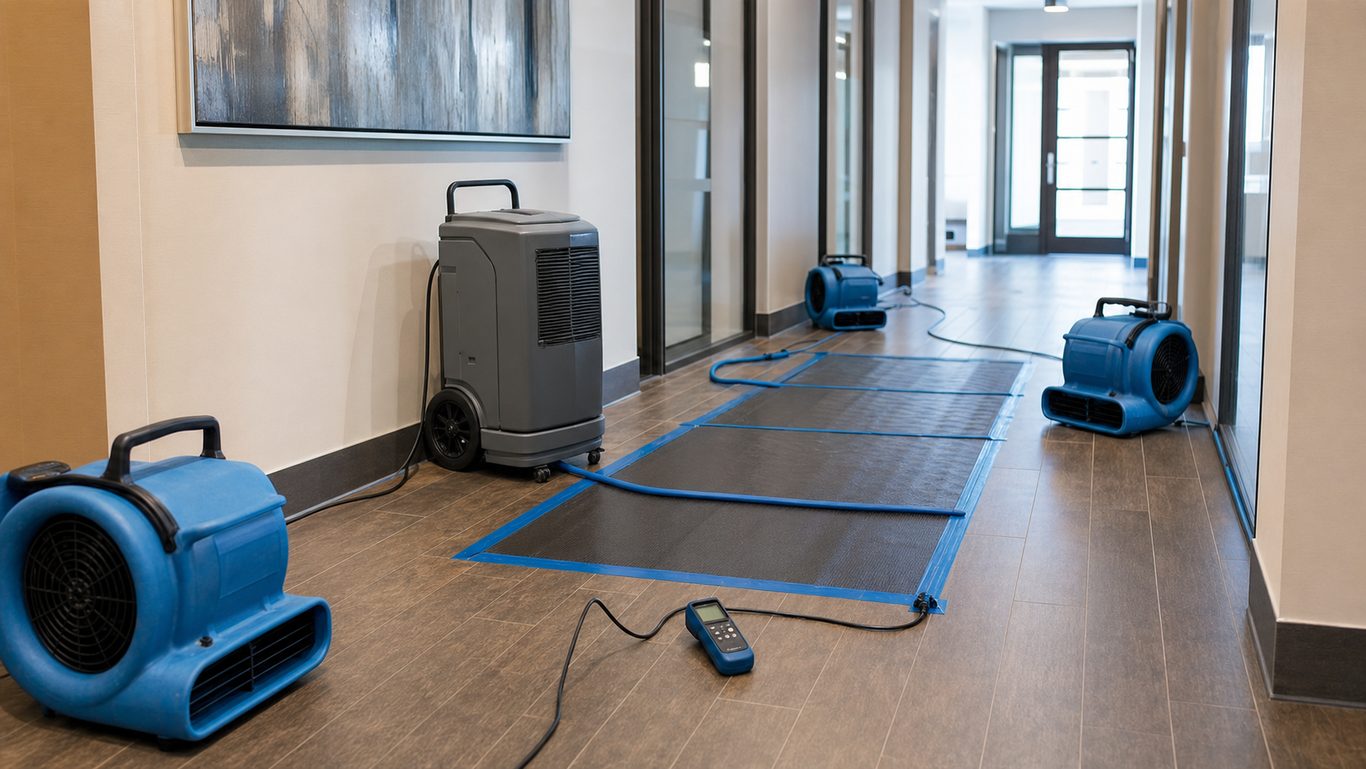
Two assemblies in Tulsa homes need specialty drying: solid hardwood floors and concrete slabs. Standard air movers blow across the surface but cannot pull water out of the wood beneath the finish or out of the dense slab. For those cases, the crew brings:
- Floor drying mats ("injectidry" systems): Sealed mats placed on the floor with a tight vacuum draw, pulling air through the hardwood from below. Used when the goal is to save the existing floor instead of replacing it.
- Slab-edge drying systems: A targeted air movement setup that pulls air through perimeter weep holes drilled near the slab edge, drying the slab from within rather than just across the surface.
- In-situ concrete RH probes: Small probes inserted into the slab to measure the relative humidity inside the concrete, the only reliable confirmation that a slab is dry enough to receive flooring again.
Specialty drying adds cost and time but often saves an entire flooring replacement that would otherwise be required.
Need help now? See our full Water Mitigation service page or browse all restoration services. Don't see your city above? The full Oklahoma service area covers 27 cities.
Local context for this article: see our Tulsa, OK restoration page and the Water Mitigation in Tulsa service page.
This guide also pairs with full water damage restoration once mitigation is complete and mold remediation if the 72-hour window was missed.
Why do you need so many air movers in one room?
Effective drying needs airflow across every wet surface, not just one. A single wet room typically has wet baseboard along three or four walls, wet drywall above the baseboard, and wet flooring across the room. An air mover dries the surface it is pointed at; a different surface needs its own air mover. Four to six air movers in a single wet room is normal, sometimes more for open-plan losses. The count comes from the affected surface area, not preference.
Authoritative resources referenced
Need restoration help in Oklahoma?
24/7 dispatch, IICRC standards, direct insurance billing.