What is structural drying, and how is it different from running fans?
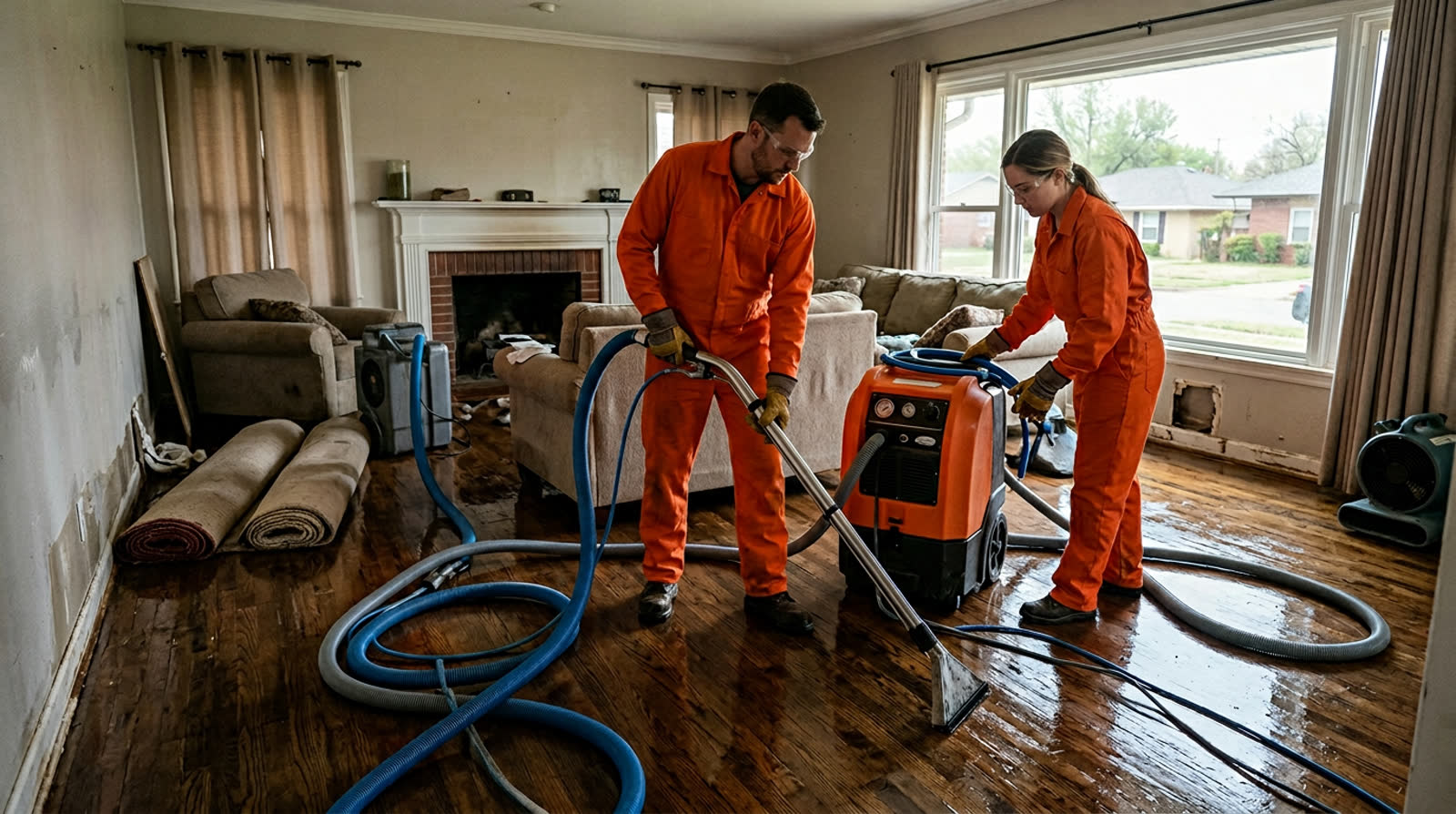
Structural drying is a measured process. Running a couple of household fans and a dehumidifier in a wet room moves air but does not actually pull moisture out of the building at the rate needed to beat mold growth. Structural drying uses commercial-grade equipment matched to the size of the wet zone, placed on a deliberate pattern, and monitored every 24 hours until every wet surface hits dry standard.
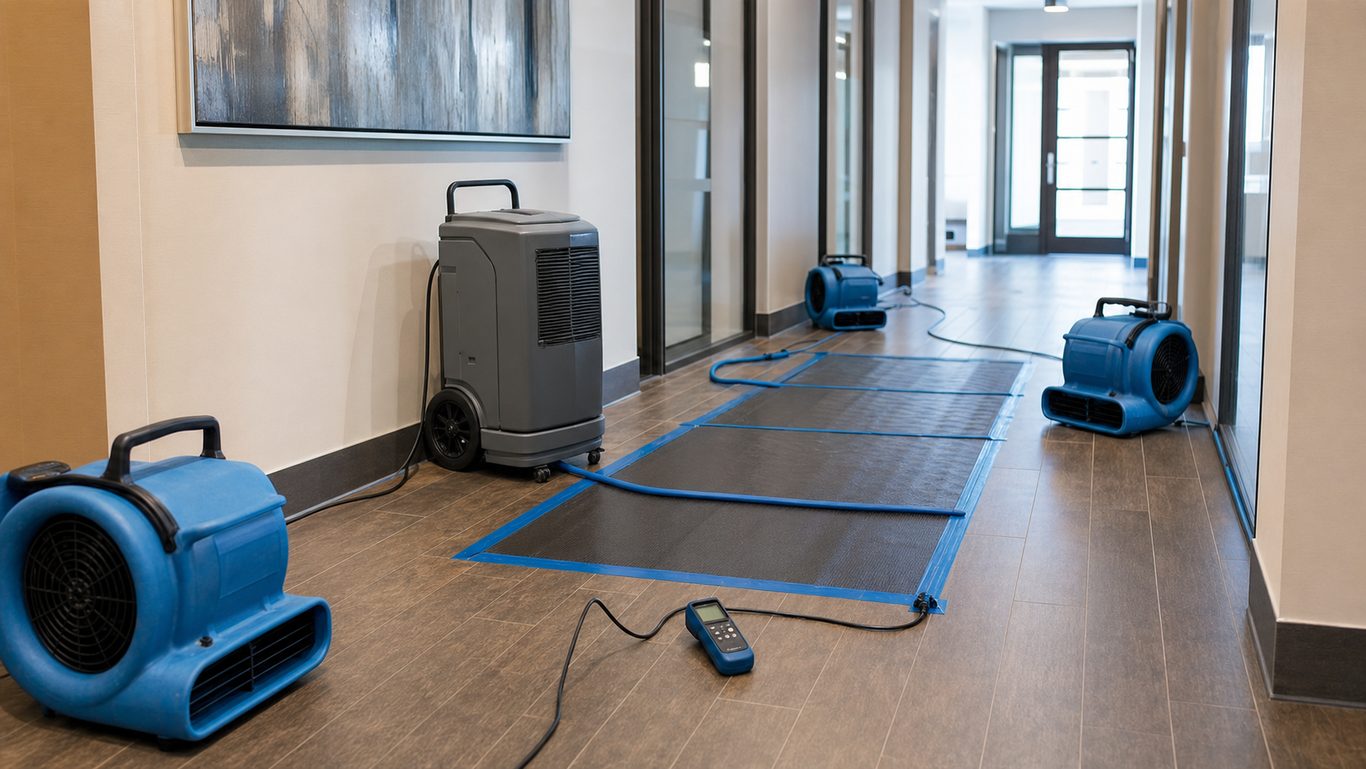
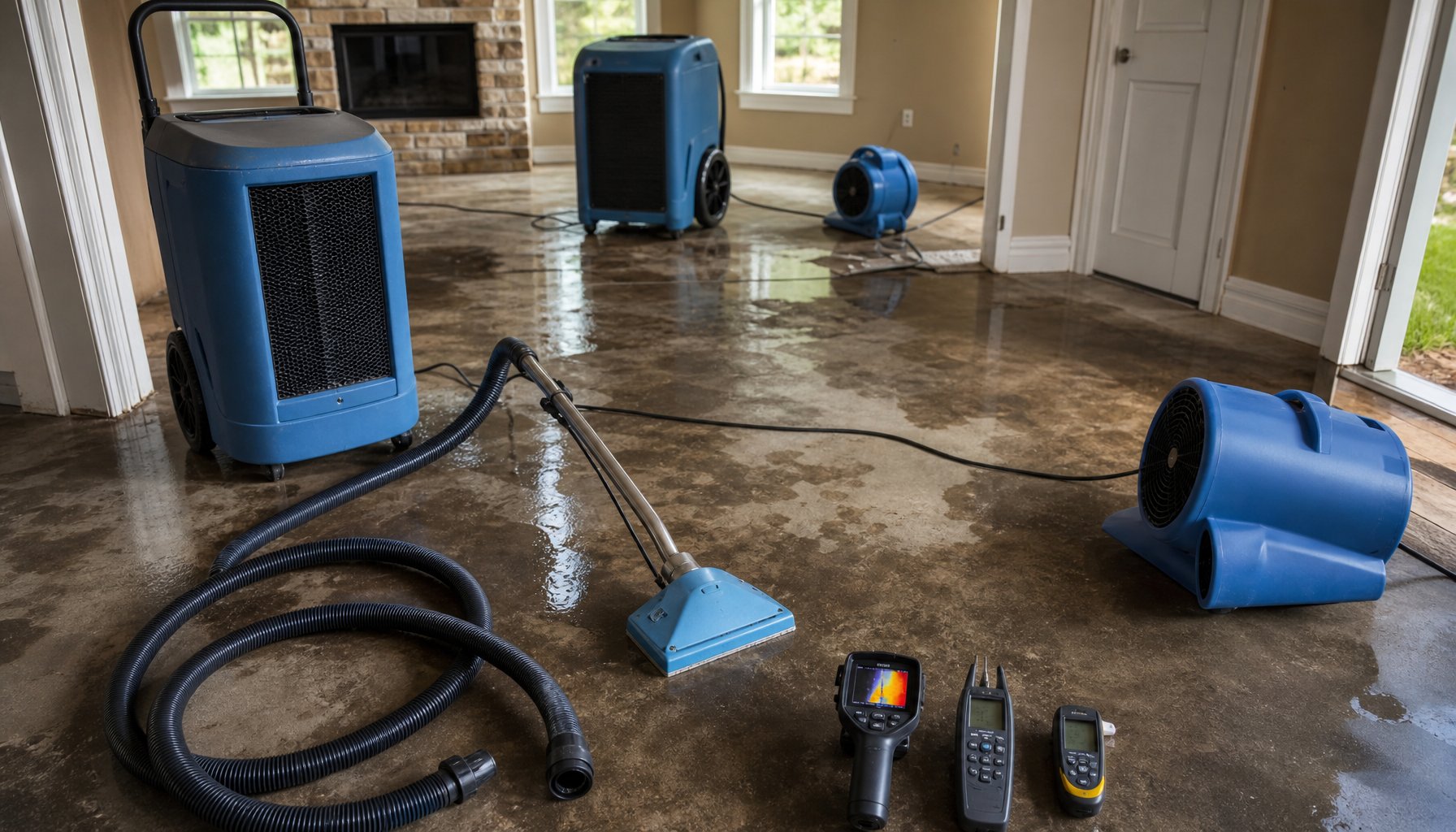
For OKC metro homes, the standard tooling is low-grain refrigerant dehumidifiers (LGRs) paired with high-velocity axial or centrifugal air movers. The dehumidifier lowers the grains of moisture per pound of dry air in the room. The air movers push that drier air across wet surfaces, accelerating evaporation. Together they create a closed loop that pulls water out of drywall, framing, subfloor, and concrete in days instead of weeks.
How does the crew decide where to put the equipment?
Equipment placement in structural drying is not arbitrary. The crew calculates the affected volume of wet space, the class of water loss (how much porous material is wet), and the category of water (how contaminated). From those three inputs the crew sizes the dehumidification capacity and the number of air movers needed.
For a typical OKC kitchen-and-dining single-room loss, the math usually lands at one LGR plus four to six air movers spaced around the perimeter to push air across baseboards and wall cavities. For a basement or whole-first-floor loss, the count scales up. Air movers always go low and pointed at wet surfaces, never blowing across an open room with no target.
Containment matters too. Closing doors to dry rooms keeps the dehumidifier from working on space that does not need drying. For long open-plan OKC homes, the crew often hangs poly sheeting to wall off the wet zone so the equipment can actually drop humidity in that area.
One mistake DIY drying often makes is treating dehumidifiers and air movers as interchangeable. They are not. A dehumidifier with no air movement in front of it only dries the immediate air column around the intake. The wet drywall ten feet away keeps releasing moisture into the room as fast as the dehumidifier removes it, and the project stalls. The opposite mistake — air movers with no dehumidifier — just moves the room's humid air around and raises the relative humidity inside finished cavities. Real structural drying requires both, sized to the job, placed deliberately, and monitored every twenty-four hours.
What does "dry standard" mean for OKC homes?
Dry standard is the moisture-content target the wet material must reach before it is considered dry. The standard is not arbitrary; it is set by industry guidance (IICRC S500) and adjusted to the specific home using a dry reference reading from an unaffected room in the same building.
Typical dry-standard targets:
- Drywall: at or below the dry reference reading from undamaged drywall elsewhere in the home.
- Wood framing and subfloor: usually 12 to 16 percent moisture content, depending on species and the home's normal baseline.
- Concrete slab: relative humidity inside the slab below 75 percent, often confirmed with in-situ probes.
- Carpet: dry to the touch, no detectable moisture on a meter in pad or backing.
The crew takes a baseline reading in a dry room before drying starts so there is a defensible "this is what dry looks like in this house" number to compare against during monitoring.
Why is daily monitoring non-negotiable?
Daily monitoring is the most important single discipline in structural drying. Without it, the project is guessing when to stop. With it, the project can prove on day five that every wet surface is dry, equipment can come down, and the rebuild can begin. The monitoring visit on an OKC structural drying project usually includes:
- Re-reading every previously wet surface with the same meter type used at intake.
- Logging the new reading next to the original reading and dry-standard target.
- Adjusting equipment placement: moving an air mover that has finished its job to one that still needs work.
- Re-checking the dehumidifier output and the relative humidity in the affected zone.
- Communicating progress to the homeowner and the carrier.
The monitoring log is the artifact that protects the homeowner if mold ever shows up later. A documented dry-out is a hard answer to the question, "Was the water handled correctly?"
One often-overlooked factor in OKC structural drying is the contribution of the home's own materials to the moisture load. A heavy carpet, even after extraction, holds a surprising amount of water in its backing and pad. Wet wood subfloor under tile or vinyl plank can keep releasing moisture for days. Concrete that took a half-inch of standing water can stay damp for weeks if the surface dries and traps water below. A good crew accounts for that residual load when sizing equipment, which is part of why a wet single-room loss often needs more dehumidification capacity than a homeowner's first guess would suggest.
How long does structural drying actually take in OKC?
For most single-room water losses in OKC homes, structural drying runs three to five days. The factors that push it longer:
- Saturated subfloor or slab — concrete and wood subfloor dry slower than drywall.
- Wet insulation left in the wall — usually a sign the demolition scope was too conservative and needs to be opened wider.
- High outdoor humidity — Oklahoma summers run high dew points, which puts more demand on the dehumidifiers.
- Slow detection — the longer the leak ran before drying started, the deeper the moisture penetrated and the longer it takes to come back out.
For larger or contaminated losses, drying can run seven to ten days. Anything beyond that usually means the demolition scope should be widened so the wet material is removed rather than dried.
What materials cannot be dried and have to come out?
Some materials cannot be dried even with the best equipment. Wet fiberglass insulation, MDF baseboard, particleboard cabinet boxes, carpet pad, and most laminate flooring are routinely demolished rather than dried. Wet drywall below the waterline that has been wet for more than 24 hours is usually cut out and replaced, because the paper face is a perfect mold substrate once wet.
The judgment call is always materials versus mold risk. Drying a borderline material costs equipment days and adds mold risk; replacing it costs material dollars but ends the moisture problem cleanly. For category 2 or category 3 water (gray or black water, including sewage backups), all porous materials in the wet zone come out by rule.
Documentation of the dry-out is the deliverable most homeowners do not realize they paid for. Beyond satisfying the adjuster, a written log with dated photos and per-surface moisture readings is the artifact a homeowner can show a future buyer, a future inspector, or a future contractor if they want to confirm the home was properly handled after the loss. We deliver that file at project close and keep a copy on the project record for at least seven years. Most homeowners never need to revisit it; the ones who do are very glad it exists.
How does structural drying fit into an insurance claim?
The documented drying log is the centerpiece of a clean water-damage claim in Oklahoma. Carriers want to see: intake moisture readings showing how wet the home was, daily monitoring showing the trend down, equipment logs showing what was deployed, photos of demolition and equipment placement, and a final reading log showing dry standard reached. With that file, claims usually close cleanly in two to four weeks.
Without that file, claims slow down and sometimes get partially denied. The carrier asks how they know the home was dried; if the contractor cannot answer with data, the carrier may not pay the full scope. Choosing a restoration company that monitors and documents is the cheapest insurance against a denied or reduced claim.
One final point on structural drying that often gets missed by homeowners shopping quotes: the cheaper quote is often the one that under-deploys equipment and under-monitors the dry-out. The expense in real structural drying is mostly labor and the daily equipment days on the job. A crew that quotes thirty percent below the rest is usually planning to leave the equipment on a single set of placements for the entire run and skip daily moisture reads. The home does not dry on schedule, the project drags into a second week, and the rebuild is delayed. When evaluating OKC drying quotes, ask how often the crew will return, how readings will be documented, and whether daily logs will be provided. Those answers separate competent crews from cheap ones.
Structural drying is also one of the few restoration services where doing the job right and doing it cheap are not always at odds, because better equipment plus daily monitoring often shortens the total run and lowers the equipment-day count. A well-run dry-out can finish in three days; a poorly run one can stretch to seven for the same loss. Faster finish means lower total cost, less disruption to the homeowner, and a smaller window for any secondary damage. The crews that monitor closely and adjust placement daily usually deliver both better and cheaper outcomes than the ones that set equipment and walk away.
Why call Trustworthy Restoration for structural drying across the OKC metro?
Trustworthy Restoration handles structural drying across Oklahoma City, Edmond, Moore, Norman, Yukon, Bixby, Tulsa, and Broken Arrow. We use calibrated LGR dehumidifiers and matched air movers, take and log daily readings, and hand off a complete dry-out file to the adjuster. If mold is found during demolition we handle the remediation on the same project. Call (405) 669-4484 for 24/7 emergency response.
How does temperature affect structural drying in OKC?
Temperature inside the drying chamber matters as much as humidity. Warmer air can hold more moisture, so a room at 80 degrees with a working dehumidifier dries faster than the same room at 65 degrees. For most OKC structural drying projects, the crew targets a chamber temperature in the high 70s to low 80s. In summer that often means working with existing HVAC and the heat that the dehumidifiers generate as a byproduct. In winter, supplemental heat is sometimes added.
Air movers also contribute heat. Several units running in a sealed room can raise the chamber temperature by 5 to 10 degrees over a few hours, which speeds evaporation. The crew monitors temperature alongside moisture readings to make sure the chamber stays in the productive range without overheating finishes or contents.
What does the homeowner need to do during structural drying?
Most of the work is on the crew, but a few things help the dry-out finish on time:
- Do not turn off the equipment. Air movers and dehumidifiers run continuously. Unplugging them overnight to reduce noise resets the clock.
- Keep doors to dry rooms closed. Containment of the drying chamber is what lets the dehumidifier actually drop humidity.
- Leave the HVAC on its normal setting. The crew may adjust the thermostat to support the drying chamber, but otherwise normal operation is fine.
- Let the crew in for daily monitoring. Missed monitoring days mean readings cannot be logged, and the project drifts out of the documented standard.
- Report changes. If a homeowner notices a new wet spot, a strange smell, a tripped breaker, or a piece of equipment that stopped, call the crew rather than wait for the next visit.
Most homeowners find the equipment more disruptive than the work. The dry-out itself is mostly hands-off after the first day.
Need help now? See our full Water Mitigation service page or browse all restoration services. Don't see your city above? The full Oklahoma service area covers 27 cities.
Local context for this article: see our Oklahoma City, OK restoration page and the Water Mitigation in Oklahoma City service page.
This guide also pairs with full water damage restoration once mitigation is complete and mold remediation if the 72-hour window was missed.
Can I rent commercial drying equipment and do this myself?
Rental dehumidifiers and air movers exist, but the equipment is only half of the job. The other half is calculating affected volume, matching equipment capacity to that volume, taking daily moisture readings on every wet surface, and adjusting placement until materials reach a defensible dry standard. Most insurance carriers will not credit a homeowner-run dry-out toward the claim because there is no documented log. The labor and documentation, not the equipment, are what make professional structural drying defensible.
Authoritative resources referenced
Need restoration help in Oklahoma?
24/7 dispatch, IICRC standards, direct insurance billing.