What does a slab leak repair actually cost in Norman?
Slab leak repair costs in Norman, Oklahoma usually break into two bills: the plumber's bill to find and fix the failed pipe, and a separate restoration bill for the water damage the leak caused inside the home. Local Norman homeowners often see plumbing-side numbers between $500 for a simple access-and-repair on a hot-water line that surfaced quickly, and $3,500 to $4,500 for a full reroute around the slab when the leak is in an old galvanized branch under a finished living space.
The restoration side runs on its own scale. After the plumber stops the leak, the slab, baseplates, subfloor, drywall, baseboard, and flooring usually need to be dried, demolished where unsalvageable, and rebuilt. A small slab leak that wets one corner of a kitchen might add $1,500 to $3,500 of restoration work. A leak that ran for days under a hallway hitting three rooms can push past $10,000 once flooring replacement and any mold remediation are included.
The reason the two bills are split is simple: plumbers are licensed to fix pipes and stop water. Restoration companies are equipped to dry the building, document the loss for insurance, and rebuild what had to be opened. Norman homeowners who skip the second step and just patch the floor over a still-damp slab usually end up paying more later for mold and warped flooring. Our team coordinates with the plumber and handles the building side from extraction through finished rebuild.
For Norman homeowners new to slab leak repair, one useful mental model is to think of the project as two parallel scopes that share a job site: a plumber working on the line under the slab, and a restoration company working on the building above it. Each scope has its own labor, its own materials, and its own invoice. Comparing only the plumbing-side estimate to a friend's slab leak project will almost always understate what the homeowner ends up paying, because the friend probably remembered the plumber's bill and not the flooring or drywall rebuild. When budgeting for a Norman slab leak, plan for both lines from the start. The cheapest path is usually the one that catches the leak fast, contains the wet footprint to a single room, and runs both scopes in parallel rather than sequentially.
It also helps to know the chronology of how the bill grows. The detection visit is the first charge. The plumbing repair or reroute is the second. Emergency extraction and equipment setup is the third, usually the same day. Daily drying monitoring continues for three to seven days. Demolition removal and disposal lands as a separate line. Rebuild — drywall, paint, baseboard, flooring — is the last and largest. A Norman homeowner who knows that order coming in is in a much stronger position when reviewing line items.
How is the slab leak detected, and does detection drive cost?
Detection method is the biggest single variable in a Norman slab leak repair budget. The cheapest detection is the one the homeowner stumbles into: a warm spot in the floor over a copper hot line, a slow rise in the water meter when nothing is running, or a hairline crack in tile that always feels damp. When the leak telegraphs itself like that, a plumber can pinpoint and access without specialized leak-locating gear.
The other end of the range is electronic leak detection with acoustic equipment, line tracing, and sometimes a borescope through a small bore in the slab. Pinpoint detection in a Norman home is often $250 to $600 on its own. That seems expensive until you compare it to the cost of opening a 12-foot wrong section of slab because the leak was guessed at, not located. Good detection saves money on demolition and floor replacement.
For the restoration side, we use moisture meters, thermal imaging, and slab-surface readings to map exactly how far the wet zone has spread. That mapping drives the dry-out plan and the demolition footprint, which keeps the restoration bill defensible if your carrier asks for proof of scope. Our water damage restoration team shares those readings with the plumber so the floor only gets opened where it needs to be opened.
Repair-in-place vs. reroute: which is cheaper in Norman homes?
Once the leak is located, the plumber chooses between repairing the failed section in place (cut the slab, expose the pipe, replace the bad section, re-pour concrete) or rerouting the line through the wall cavity and attic. In Norman, the repair-in-place option is typically the cheapest line item on the plumber's invoice, often $900 to $2,000, but it requires opening the slab, which means the restoration company has to demo flooring above the bore and rebuild it.
A reroute is usually $1,800 to $4,500 on the plumbing side. It costs more in plumbing labor but often avoids opening the slab entirely. For Norman homes with hardwood, glued vinyl plank, or set tile that would be expensive to match, the reroute is often the lower total cost once flooring replacement is added in.
If a home is on its second or third slab leak in the same line, most Norman plumbers recommend a whole-line reroute or a re-pipe rather than repeated point repairs. We see that pattern in homes built between the late 1970s and mid-1990s where copper was used under aggressive soil and water chemistry.
What does the restoration scope look like after the plumber leaves?
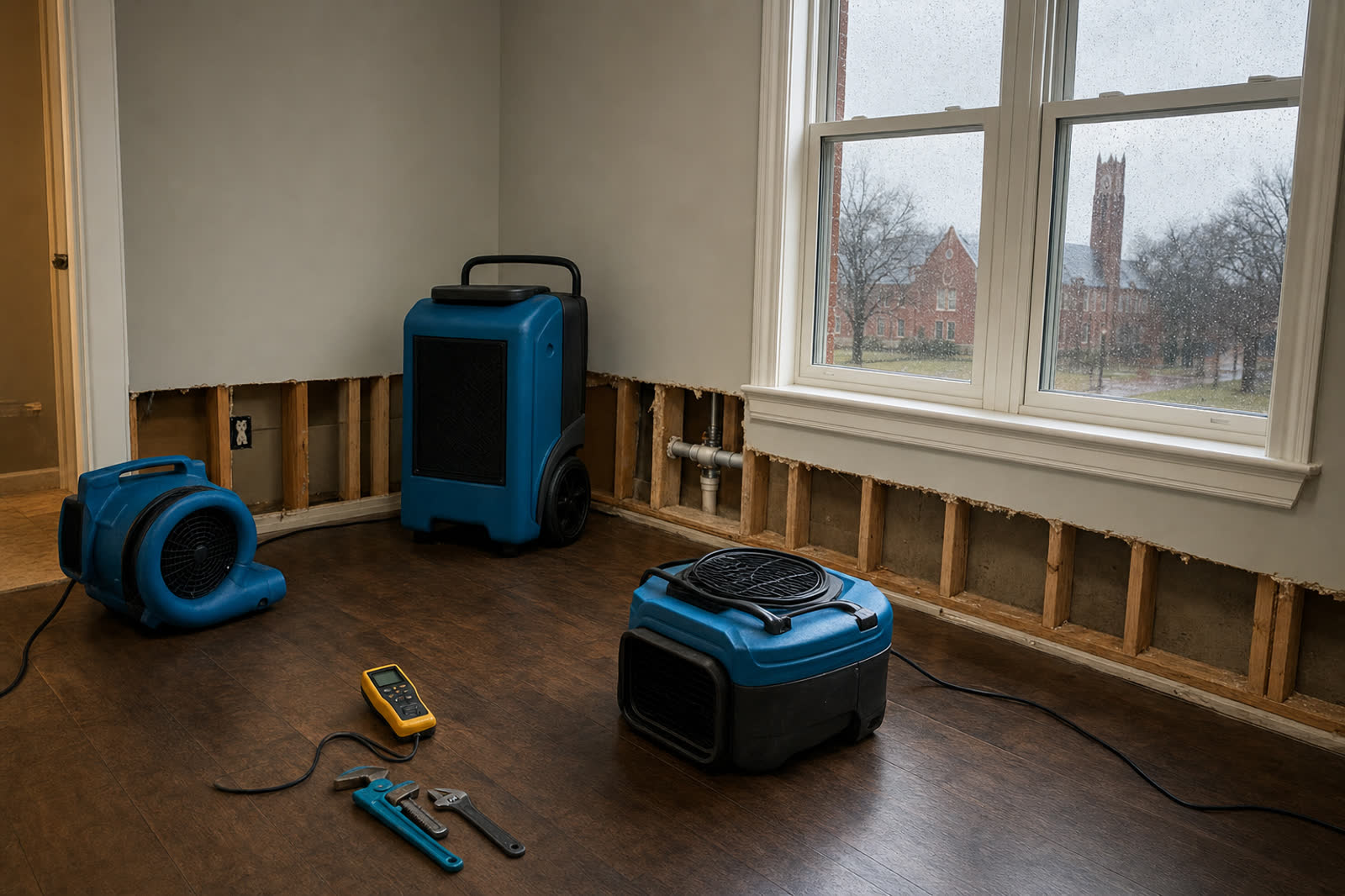
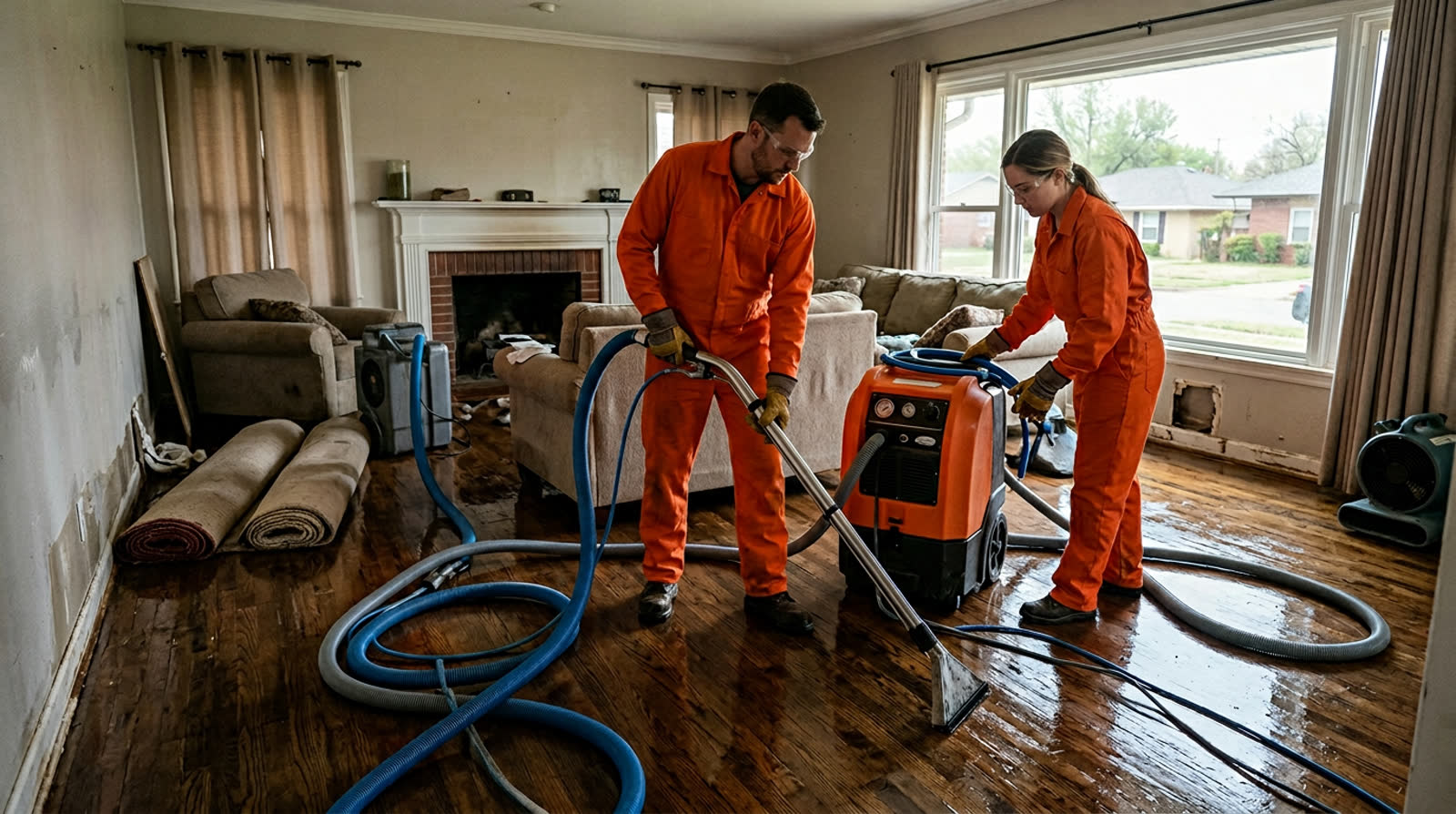
After the leak is stopped, the wet building materials are the homeowner's problem until a restoration company is on site. The slab will hold water for days. Wood baseplates wick water up the wall. Drywall, baseboard, and any flooring not rated for prolonged moisture begin to fail. Restoration scope for a Norman slab leak usually includes:
- Water extraction from any standing water and damp porous materials.
- Controlled demolition: removing wet baseboard, the bottom 12-24 inches of drywall in affected rooms, and flooring over the wet slab footprint.
- Antimicrobial treatment on exposed framing and slab edges to interrupt mold growth.
- Structural drying with low-grain refrigerant dehumidifiers and air movers, monitored daily until materials reach dry standard.
- Documented dry-out log with daily moisture readings the carrier can review.
- Rebuild: drywall, paint, baseboard, and flooring back to pre-loss condition.
For a single-room slab leak in a Norman home, the restoration phase usually runs three to six days for drying plus another one to two weeks for rebuild. For a larger leak affecting an open-plan living/kitchen/dining footprint, the timeline stretches.
How does Oklahoma homeowners insurance treat slab leak costs?
Most Oklahoma homeowners policies exclude the cost of repairing the failed pipe itself. The policy is written to cover sudden and accidental water damage that results from the leak, not the plumbing repair. In practice that usually means:
- The plumber's repair bill, including detection and any slab bore, comes out of pocket.
- Tear-out to access the pipe is sometimes covered under "access" language even when the pipe itself is not.
- The drying, demolition, mold remediation, and rebuild of water-damaged building materials usually IS covered, subject to the deductible.
- Personal property damaged by the water (rugs, furniture, contents on the wet floor) is usually covered.
Norman homeowners should not assume their carrier will deny the whole claim because the pipe was excluded. The restoration scope is a separate covered loss in most cases. Our guide to Oklahoma water damage claims walks through how to document a slab leak so the building damage stays on the covered side of the policy.
One nuance specific to Norman: many homes inside the Norman city limits are on water service that runs slightly harder on copper than the average Oklahoma City supply. Homes built between 1978 and 1996 with original copper plumbing have a notable rate of pinhole leaks in the second decade of service, and slab leaks are a common failure point. If the home has had any past slab leak, especially in a hot-water line, the carrier may treat a new leak as a known maintenance issue rather than a sudden and accidental loss. Document any prior repairs and note the date of the new failure carefully. A clear paper trail is the difference between a covered scope and a denied claim.
What raises the slab leak repair cost in Norman the most?
Several factors push a Norman slab leak bill from the low end of the range to the high end:
- Time on the floor. A leak that ran undetected for weeks pushes drying and demolition further out from the source and increases the chance of mold remediation under the floor.
- Hardwood or natural-stone flooring. Replacement cost per square foot is high, and matching existing material in older Norman homes is often impossible without replacing the entire room.
- Slab-on-grade homes with no easy reroute path. If the home does not have an accessible attic above the leak, the plumber has to either open the slab or run line through finished walls, both of which add cost.
- Hot-water-side leaks. A hot copper leak vaporizes more water into the building cavity, which means more drying time and more chance of secondary damage.
- Mold found during tear-out. Even a small mold finding triggers a separate mold remediation scope under containment.
The cheapest slab leak repairs are the ones caught early: the homeowner notices the warm spot, the meter creep, or the small ceiling stain and gets a plumber out the same day. The most expensive ones are the leaks that ran for weeks before anyone connected the wet baseboard to a slab problem.
How fast can a slab leak repair and restoration finish in Norman?
For a single-line slab leak in a Norman home with a quick detection and a cooperative carrier, the realistic timeline is:
- Day 1: Plumber detects and repairs or reroutes the line. Restoration company arrives, extracts water, sets up drying equipment, opens flooring and drywall over the wet footprint.
- Days 2-5: Daily moisture monitoring. As materials reach dry standard, equipment comes off.
- Days 5-7: Antimicrobial application, prep for rebuild, contents return to dry rooms.
- Weeks 2-3: Rebuild flooring, drywall, paint, baseboard.
For larger Norman slab leaks or homes where mold is found under the floor, add a week to ten days for containment and remediation. Our crew responds 24/7 throughout the Norman, Edmond, and Oklahoma City service area and works in parallel with whatever plumber the homeowner has already hired.
Why call Trustworthy Restoration for slab leak damage in Norman?
Most Norman homeowners discover a slab leak when they see the damage, not the leak itself. By that point the question is not just how much the plumber will charge, but how much of the home has to be opened, dried, and rebuilt to be safe and dry again. Trustworthy Restoration handles that second half: documented water damage drying, mold checks, demolition only where necessary, and a rebuild that matches what was there before. We respond 24/7 to slab leak emergencies across Norman and the OKC metro, work directly with your insurance adjuster, and keep the homeowner in the loop with daily moisture readings and a clear scope. Call (405) 669-4484 as soon as the leak is found so the building side stays on the covered side of the policy.
Need help now? See our full Water Damage Restoration service page or browse all restoration services. Don't see your city above? The full Oklahoma service area covers 27 cities.
Local context for this article: see our Norman, OK restoration page and the Water Damage Restoration in Norman service page.
This guide also pairs with emergency water mitigation and mold remediation when drying is missed.
Will my Norman homeowners policy pay for the slab leak repair itself?
Probably not. Most Oklahoma homeowners policies exclude the cost of repairing the failed pipe under the slab. They do typically cover the sudden and accidental water damage that the leak caused inside the home: the drying, demolition, mold remediation, rebuild, and any damaged personal property, all subject to your deductible. Some policies also cover the cost of accessing the pipe (tear-out of the slab or flooring), even when the pipe itself is excluded. The plumber's invoice is usually out of pocket; the restoration invoice usually is not.
Authoritative resources referenced
Need restoration help in Oklahoma?
24/7 dispatch, IICRC standards, direct insurance billing.